Thank you for visiting SNEWPapers!
Sign up free
Editorial
January 21, 1799
The Gazette
Portland, Cumberland County, Maine
What is this article about?
An editorial publishes and critiques Thomas Jefferson's 1797 letter to Philip Mazzei, decrying the rise of an Anglo-Monarchical-Aristocratic party in the US opposed by republican landowners. Includes French commentary on US ingratitude toward France and the Jay Treaty, with the editor expressing strong contempt for Jefferson and Republicans.
Clipping
OCR Quality
95%
Excellent
Full Text
Communication.
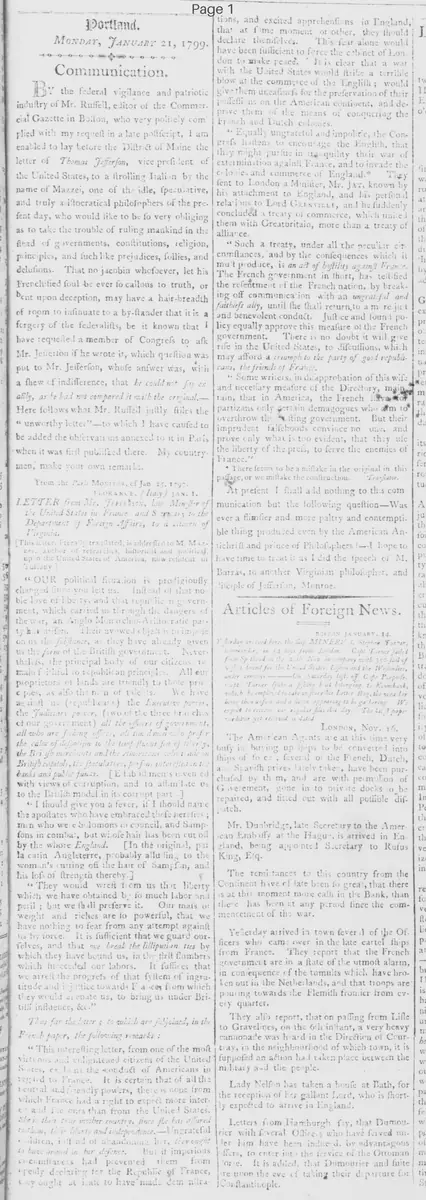
By the federal vigilance and patriotic industry of Mr. Russell, editor of the Commercial Gazette in Boston, who very politely complied with my request in a late postscript, I am enabled to lay before the District of Maine the letter of Thomas Jefferson, vice president of the United States, to a strolling Italian by the name of Mazzei, one of the idle, speculative, and truly aristocratical philosophers of the present day, who would like to be so very obliging as to take the trouble of ruling mankind in the stead of governments, constitutions, religion, principles, and such like prejudices, follies, and delusions. That no Jacobin whatsoever, let his Frenchified soul be ever so callous to truth, or bent upon deception, may have a hair-breadth of room to insinuate to a by-stander that it is a forgery of the federalists, be it known that I have requested a member of Congress to ask Mr. Jefferson if he wrote it, which question was put to Mr. Jefferson, whose answer was, with a show of indifference, that he could not say exactly, as he had not compared it with the original.
Here follows what Mr. Russell idly styles the 'unworthy letter'—to which I have caused to be added the observations annexed to it in Paris when it was first published there. My countrymen, make your own remarks.
From the Paris Monitor, of Jan. 25, 1797.
THOMAS JEFFERSON, Jan. 1.
LETTER From Mr. Jefferson, late Minister of the United States in France and Secretary to the Department of Foreign Affairs, to a citizen of Virginia.
(This letter, literally translated, is addressed to M. Mazzei, author of researches, historical and political, upon the United States of America, now resident in Tuscany.)
'Our political situation is prodigiously changed since you left us. Instead of that love of liberty, and that republican form of government, which carried us through the dangers of the war, an Anglo-Monarchio-Aristocratic party has arisen. Their avowed object is to impose on us the substance, as they have already given us the form, of the British government. Nevertheless, the principal body of our citizens remain faithful to republican principles. All our owners of lands are friendly to those principles, as also the tenants. We have against us (republicans) the Executive power, the Judiciary power, (two of the three branches of our government) all the officers of government, all who are seeking office, all the sycophants of the temple of fashion, the British merchants and the American holders of British capital, the speculators in the banks and public funds. [It is ill men who are given to corruption, and to attach us to the British model in its most corrupt part.]
I should give you a fever, if I should name the apostates who have embraced these new lies; men who were Solomons in council, and Samsons in combat, but whose hair has been cut off by the whore England. [In the original, 'la catin Angleterre', probably alluding to the woman's cutting off the hair of Samson, and his loss of strength thereby.]
They would wrest from us that liberty which we have obtained by so much labor and peril; but we shall preserve it. Our mass of weight and riches are so powerful, that we have nothing to fear from any attempt against us by force. It is sufficient that we guard ourselves, and that we break the Lilliputian ties by which they have bound us, in the first slumbers which succeeded our labors. It suffices that we arrest the progress of that system of ingratitude and injustice towards France from which they would alienate us, to bring us under British influence, &c.'
Thus far the letter; to which are subjoined, in the French paper, the following remarks:
'This interesting letter, from one of the most virtuous and enlightened citizens of the United States, explains the conduct of Americans in regard to France. It is certain that of all the neutral and friendly powers, there is none from which France had a right to expect more interest and friendship than from the United States. She is their true mother country, since she has obtained for them aid and independence. Ungrateful children, idle and addicted to ease, they ought to have armed in her defense. But imperious circumstances have prevented them from greatly declaring for the Republic of France; they ought at least to have made dominions, and excited apprehensions in England, that at some moment or other, they should declare themselves. This fear alone would have been sufficient to force the cabinet of London to make peace. It is clear that a war with the United States would strike a terrible blow at the commerce of the English; would give them uneasiness for the preservation of their possessions on the American continent, and deprive them of the means of conquering the French and Dutch colonies.
Equally ungrateful and impolitic, the Congress hastens to encourage the English, that they might pursue in tranquility their war of extermination against France, and to invade the colonies and commerce of England. They sent to London a Minister, Mr. Jay, known by his attachment to England, and his personal relations to Lord Grenville, and he suddenly concluded a treaty of commerce, which unites them with Great Britain, more than a treaty of alliance.
Such a treaty, under all the peculiar circumstances, and by the consequences which it must produce, is an act of hostility against France. The French government in short, has testified the resentment of the French nation, by breaking off communication with an ungrateful and faithless ally, until she shall return to a more just and benevolent conduct. Justice and sound policy equally approve this measure of the French government.' There is no doubt it will give rise in the United States, to discussions, which may afford a triumph to the party of good republicans, the friends of France.
Some writers, in disapprobation of this wise and necessary measure of the Directory, maintain, that in America, the French have for partisans only certain demagogues who aim to overthrow the existing government. But their imprudent falsehoods convince no one, and prove only what is too evident, that they use the liberty of the press, to serve the enemies of France.
There seems to be a mistake in the original in this passage, or we mistake the construction. Translator.
At present I shall add nothing to this communication but the following question—Was ever a slimier and more paltry and contemptible thing produced even by the American Anti-christ and prince of Philosophers!?—I hope to have time to treat it as I did the speech of M. Barras, to another Virginian philosopher, and disciple of Jefferson, Monroe.
By the federal vigilance and patriotic industry of Mr. Russell, editor of the Commercial Gazette in Boston, who very politely complied with my request in a late postscript, I am enabled to lay before the District of Maine the letter of Thomas Jefferson, vice president of the United States, to a strolling Italian by the name of Mazzei, one of the idle, speculative, and truly aristocratical philosophers of the present day, who would like to be so very obliging as to take the trouble of ruling mankind in the stead of governments, constitutions, religion, principles, and such like prejudices, follies, and delusions. That no Jacobin whatsoever, let his Frenchified soul be ever so callous to truth, or bent upon deception, may have a hair-breadth of room to insinuate to a by-stander that it is a forgery of the federalists, be it known that I have requested a member of Congress to ask Mr. Jefferson if he wrote it, which question was put to Mr. Jefferson, whose answer was, with a show of indifference, that he could not say exactly, as he had not compared it with the original.
Here follows what Mr. Russell idly styles the 'unworthy letter'—to which I have caused to be added the observations annexed to it in Paris when it was first published there. My countrymen, make your own remarks.
From the Paris Monitor, of Jan. 25, 1797.
THOMAS JEFFERSON, Jan. 1.
LETTER From Mr. Jefferson, late Minister of the United States in France and Secretary to the Department of Foreign Affairs, to a citizen of Virginia.
(This letter, literally translated, is addressed to M. Mazzei, author of researches, historical and political, upon the United States of America, now resident in Tuscany.)
'Our political situation is prodigiously changed since you left us. Instead of that love of liberty, and that republican form of government, which carried us through the dangers of the war, an Anglo-Monarchio-Aristocratic party has arisen. Their avowed object is to impose on us the substance, as they have already given us the form, of the British government. Nevertheless, the principal body of our citizens remain faithful to republican principles. All our owners of lands are friendly to those principles, as also the tenants. We have against us (republicans) the Executive power, the Judiciary power, (two of the three branches of our government) all the officers of government, all who are seeking office, all the sycophants of the temple of fashion, the British merchants and the American holders of British capital, the speculators in the banks and public funds. [It is ill men who are given to corruption, and to attach us to the British model in its most corrupt part.]
I should give you a fever, if I should name the apostates who have embraced these new lies; men who were Solomons in council, and Samsons in combat, but whose hair has been cut off by the whore England. [In the original, 'la catin Angleterre', probably alluding to the woman's cutting off the hair of Samson, and his loss of strength thereby.]
They would wrest from us that liberty which we have obtained by so much labor and peril; but we shall preserve it. Our mass of weight and riches are so powerful, that we have nothing to fear from any attempt against us by force. It is sufficient that we guard ourselves, and that we break the Lilliputian ties by which they have bound us, in the first slumbers which succeeded our labors. It suffices that we arrest the progress of that system of ingratitude and injustice towards France from which they would alienate us, to bring us under British influence, &c.'
Thus far the letter; to which are subjoined, in the French paper, the following remarks:
'This interesting letter, from one of the most virtuous and enlightened citizens of the United States, explains the conduct of Americans in regard to France. It is certain that of all the neutral and friendly powers, there is none from which France had a right to expect more interest and friendship than from the United States. She is their true mother country, since she has obtained for them aid and independence. Ungrateful children, idle and addicted to ease, they ought to have armed in her defense. But imperious circumstances have prevented them from greatly declaring for the Republic of France; they ought at least to have made dominions, and excited apprehensions in England, that at some moment or other, they should declare themselves. This fear alone would have been sufficient to force the cabinet of London to make peace. It is clear that a war with the United States would strike a terrible blow at the commerce of the English; would give them uneasiness for the preservation of their possessions on the American continent, and deprive them of the means of conquering the French and Dutch colonies.
Equally ungrateful and impolitic, the Congress hastens to encourage the English, that they might pursue in tranquility their war of extermination against France, and to invade the colonies and commerce of England. They sent to London a Minister, Mr. Jay, known by his attachment to England, and his personal relations to Lord Grenville, and he suddenly concluded a treaty of commerce, which unites them with Great Britain, more than a treaty of alliance.
Such a treaty, under all the peculiar circumstances, and by the consequences which it must produce, is an act of hostility against France. The French government in short, has testified the resentment of the French nation, by breaking off communication with an ungrateful and faithless ally, until she shall return to a more just and benevolent conduct. Justice and sound policy equally approve this measure of the French government.' There is no doubt it will give rise in the United States, to discussions, which may afford a triumph to the party of good republicans, the friends of France.
Some writers, in disapprobation of this wise and necessary measure of the Directory, maintain, that in America, the French have for partisans only certain demagogues who aim to overthrow the existing government. But their imprudent falsehoods convince no one, and prove only what is too evident, that they use the liberty of the press, to serve the enemies of France.
There seems to be a mistake in the original in this passage, or we mistake the construction. Translator.
At present I shall add nothing to this communication but the following question—Was ever a slimier and more paltry and contemptible thing produced even by the American Anti-christ and prince of Philosophers!?—I hope to have time to treat it as I did the speech of M. Barras, to another Virginian philosopher, and disciple of Jefferson, Monroe.
What sub-type of article is it?
Partisan Politics
Foreign Affairs
What keywords are associated?
Jefferson Mazzei Letter
Anglo Monarchical Party
Us France Relations
Jay Treaty Criticism
Federalist Republican Divide
Political Apostasy
British Influence
What entities or persons were involved?
Thomas Jefferson
Philip Mazzei
Mr. Russell
Federalists
Republicans
France
Great Britain
John Jay
Lord Grenville
French Directory
Editorial Details
Primary Topic
Criticism Of Thomas Jefferson's Letter To Mazzei On Us Political Factions And Foreign Influences
Stance / Tone
Strongly Anti Jeffersonian And Pro Federalist, Contemptuous And Mocking Toward Republicans And French Sympathizers
Key Figures
Thomas Jefferson
Philip Mazzei
Mr. Russell
Federalists
Republicans
France
Great Britain
John Jay
Lord Grenville
French Directory
Key Arguments
Jefferson's Letter Reveals Republican Concerns Over An Emerging Anglo Monarchical Aristocratic Party Seeking British Style Government
Republicans Face Opposition From Executive, Judiciary, Government Officers, And British Influenced Interests
Apostate Leaders Have Betrayed Revolutionary Principles Under British Influence
Us Must Resist Efforts To Alienate From France And Submit To British Sway
French Commentary Accuses Us Of Ingratitude For Aid In Independence And Criticizes Jay Treaty As Hostile To France
French Measures Against Us Are Justified Until Better Conduct
Editor Verifies Letter's Authenticity And Derides It As Slimy And Contemptible