Thank you for visiting SNEWPapers!
Sign up free
The Tucumcari News And Tucumcari Times
Tucumcari, Quay County, New Mexico
What is this article about?
Agricultural advice for planting field crops like amber cane, milo maize, corn, and fall wheat on sod; gardening tips including water conservation methods, cultivation, and specific crops such as beans, peas, melons, corn varieties, and potatoes to ensure family self-sufficiency.
Clipping
OCR Quality
Full Text
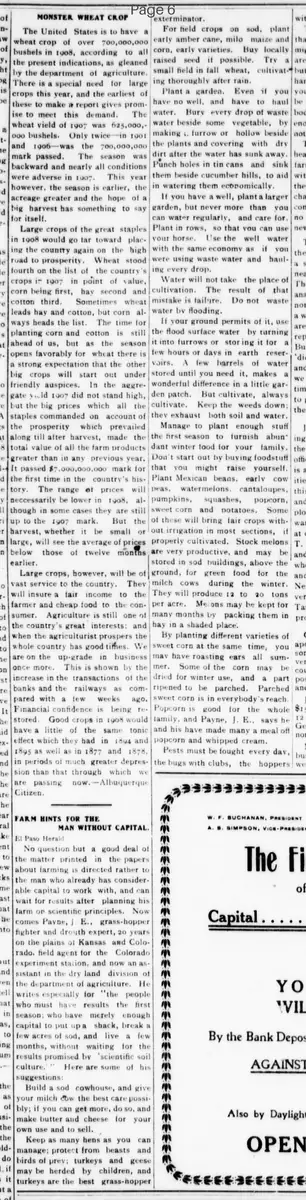
For field crops on sod, plant early amber cane, milo maize and corn, early varieties. Buy locally raised seed if possible.
Try a small field in fall wheat, cultivating thoroughly after rain.
Plant a garden.
Even if you have no well, and have to haul water.
Bury every drop of waste water beside some vegetable, by making a furrow or hollow beside the plants and covering with dry dirt after the water has sunk away.
Punch holes in tin cans and sink them beside cucumber hills, to aid in watering them economically.
If you have a well, plant a larger garden, but never more than you can water regularly, and care for.
Plant in rows, so that you can use your horse. Use the well water with the same economy as if you were using waste water and hauling every drop.
Water will not take the place of cultivation.
The result of that mistake is failure.
Do not waste water by flooding.
If your ground permits of it, use the flood surface water by turning it into furrows or storing it for a few hours or days in earth reservoirs. A few barrels of water stored until you need it, makes a wonderful difference in a little garden patch.
But cultivate, always cultivate.
Keep the weeds down: they exhaust both soil and water.
Manage to plant enough stuff the first season to furnish abundant winter food for your family.
Don't start out by buying foodstuff that you might raise yourself.
Plant Mexican beans, early cow peas, watermelons, cantaloupes, pumpkins, squashes, popcorn, sweet corn and potatoes.
Some of these will bring fair crops without irrigation in most sections, if properly cultivated. Stock melons are very productive, and may be stored in sod buildings, above the ground, for green food for the milch cows during the winter.
They will produce 12 to 20 tons per acre.
Melons may be kept for many months by packing them in hay in a shaded place.
By planting different varieties of sweet corn at the same time, you may have roasting ears all summer.
Some of the corn may be dried for winter use, and a part ripened to be parched. Parched sweet corn is in everybody's reach.
Popcorn is good for the whole family, and Payne, J. E., says he and his have made many a meal off popcorn and whipped cream.
Pests must be fought every day, the bugs with clubs, the hoppers
What sub-type of article is it?
What keywords are associated?
What entities or persons were involved?
Domestic News Details
Key Persons
Event Details
Advice on planting early varieties of amber cane, milo maize, corn, and fall wheat on sod; gardening with water conservation techniques like burying waste water, using tin cans for cucumbers, and storing water; emphasis on cultivation over watering, weed control, and planting self-sufficient crops including Mexican beans, early cow peas, watermelons, cantaloupes, pumpkins, squashes, popcorn, sweet corn, and potatoes; notes on melon productivity and storage, corn uses, and fighting pests.