Thank you for visiting SNEWPapers!
Sign up free
Literary
April 15, 1841
Watchman Of The South
Richmond, Virginia
What is this article about?
Theological essay on 'Coming to Christ,' describing it as believing in Jesus for salvation. It outlines prerequisites: awareness of estrangement from God due to sin, sense of personal misery and inability to self-save, recognition of Christ as Savior, and full reliance on his grace. Attributed to Mason.
Clipping
OCR Quality
98%
Excellent
Full Text
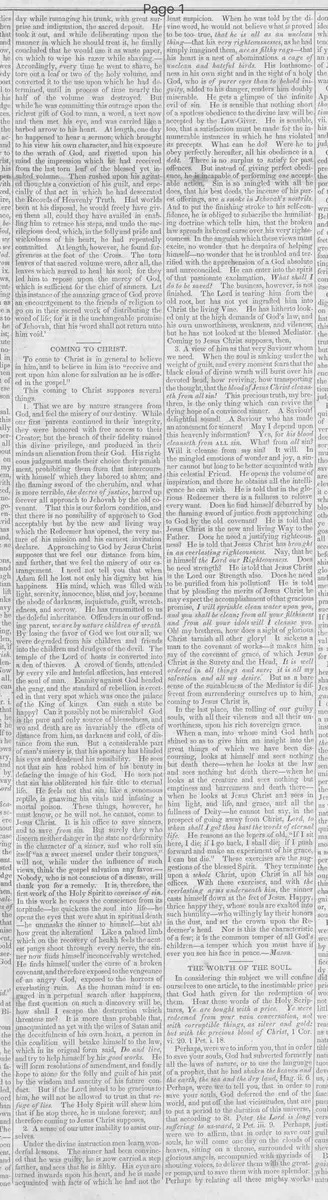
COMING TO CHRIST.
To come to Christ is in general to believe in him, and to believe in him is to "receive and rest upon him alone for salvation as he is offered in the gospel."
This coming to Christ supposes several things.
1. That we are by nature strangers from God, and feel the misery of our destiny. While our first parents continued in their integrity, they were honored with free access to their Creator: but the breach of their fidelity ruined this divine privilege, and produced in their minds an alienation from their God. His righteous judgment made their choice their punishment, prohibiting them from that intercourse with himself which they labored to shun; and the flaming sword of the cherubim, and what is more terrible, the decree of justice, barred up forever all approach to Jehovah by the old covenant. That this is our forlorn condition, and that there is no possibility of approach to God acceptably but by the new and living way which the Redeemer has opened, the very nature of his mission and his earnest invitation declare. Approaching to God by Jesus Christ supposes that we feel our distance from him, and farther, that we feel the misery of our estrangement. I need not tell you that when Adam fell he lost not only his dignity but his happiness. His mind, which was filled with light, serenity, innocence, bliss, and joy, became the abode of darkness, inquietude, guilt, wretchedness, and sorrow. He has transmitted to us the doleful inheritance. Offenders in our offending parent, we are by nature children of wrath. By losing the favor of God we lost our all; we were degraded from his children and friends into the children and drudges of the devil. The temple of the Lord of hosts is converted into a den of thieves. A crowd of fiends, attended by every vile and hateful affection, has entered the soul of man. Enmity against God headed the gang, and the standard of rebellion is erected in that very spot which was once the palace of the King of kings. Can such a state be happy? Can it possibly not be miserable? God is the pure and only source of blessedness, and wo and death are as invariably the effects of distance from him, as darkness and cold, of distance from the sun. But a considerable part of man's misery is, that his apostacy has blinded his eyes and deadened his sensibility. He sees not that sin has robbed him of his beauty in defacing the image of his God. He sees not that sin has obliterated his fair title to eternal life. He feels not that sin, like a venomous reptile, is gnawing his vitals and infusing a mortal poison. These things, however, he must know, or he will not, he cannot, come to Jesus Christ. It is his office to save sinners, and to save from sin. But surely they who discern neither danger in the state nor deformity in the character of a sinner, and who roll sin itself "as a sweet morsel under their tongues," will not, while under the influence of such views, think the gospel salvation any favor. Nobody, who is not conscious of a disease, will thank you for a remedy, It is, therefore, the first work of the Holy Spirit to convince of sin. In this work he rouses the conscience from its torpitude—he quickens the soul into life—he opens the eyes that were shut in spiritual death—he unmasks the sinner to himself—but ah! how great the alteration! Like a palsied limb which on the recovery of health feels the acutest pangs shoot through every nerve, the sinner now finds himself inconceivably wretched. He finds himself under the curse of a broken covenant, and therefore exposed to the vengeance of an angry God, exposed to the horrors of everlasting ruin. As the human mind is engaged in a perpetual search after happiness, the first question on such a discovery will be how shall I escape the destruction which threatens me? It is more than probable that, unacquainted as yet with the wiles of Satan and the deceitfulness of his own heart, a person in this condition will betake himself to the law, which in its original form said, Do and live, and try to help himself by his good works. He will form resolutions of amendment, and fondly hope to atone for the folly and guilt of his past by the wisdom and sanctity of his future conduct. But if the Lord intend to be gracious to him, he will not be allowed to trust in that refuge of lies. The Holy Spirit will shew him that if he stop there, he is undone forever; and therefore coming to Jesus Christ supposes,
2. A sense of our utter inability to assist ourselves.
Under the divine instruction men learn wonderful lessons, The sinner had been convinced that he was guilty, he is now carried a step farther, and sees that he is filthy. His eyes are turned inwards upon his heart, and he is made acquainted with facts of which he had not the least suspicion. When he was told by the divine word, he would not believe what is proved to be too true, that he is all as an unclean thing—that his very righteousnesses, as he had simply imagined them, are as filthy rags—that his heart is a nest of abominations, a cage of unclean and hateful birds. His loathsomeness in his own sight and in the sight of a holy God, who is of purer eyes than to behold iniquity, added to his danger, renders him doubly miserable. He gets a glimpse of the infinite evil of sin. He is sensible that nothing short of a spotless obedience to the divine law will be accepted by the Law-Giver. He is sensible, too, that a satisfaction must be made for the innumerable instances in which he has violated its precepts. What can he do? Were he to obey perfectly hereafter, all his obedience is a debt. There is no surplus to satisfy for past offences. But instead of giving perfect obedience, he is incapable of performing one acceptable action. Sin is so mingled with all he does, that his best deeds, the incense of his purest offerings, are a smoke in Jehovah's nostrils. And to put the finishing stroke to his self-confidence, he is obliged to subscribe the humiliating doctrine which tells him, that the broken law spreads its broad curse over his very righteousness. In the anguish which these views must excite, no wonder that he despairs of helping himself—no wonder that he is troubled and terrified with the apprehension of a God absolute and unreconciled." He can enter into the spirit of that passionate exclamation, What shall I do to be saved? The business, however, is not finished. The Lord is tearing him from the old root, but has not yet ingrafted him into Christ the living Vine. He has hitherto looked only at the high demands of God's law, and his own unworthiness, weakness, and vileness; but he has not looked at the blessed Mediator. Coming to Jesus Christ supposes, then,
3. A view of him as that very Saviour whom we need. When the soul is sinking under the weight of guilt, and every moment fears that the black cloud of divine wrath will burst over his devoted head, how reviving, how transporting the thought, that the blood of Jesus Christ cleanseth from all sin! This precious truth, my brethren, is the only thing which can revive the dying hope of a convinced sinner. A Saviour! delightful sound! A Saviour who has made an atonement for sinners! May I depend upon this heavenly information? Yes, for his blood cleanseth from ALL sin, What! from all sin? Will it cleanse from my sin? It will. In the mingled emotions of wonder and joy, a sinner cannot but long to be better acquainted with this celestial Friend. He opens the volume of inspiration, and there he obtains all the intelligence he can wish. He is told that in the glorious Redeemer there is a fullness to relieve every want. Does he find himself debarred by the flaming sword of justice from approaching to God by the old covenant? He is told that Jesus Christ is the new and living Way to the Father. Does he need a justifying righteousness? He is told that Jesus Christ has brought in an everlasting righteousness. Nay, that he is himself the Lord our Righteousness. Does he need strength? He is told that Jesus Christ is the Lord our Strength also. Does he need to be purified from his pollution? He is told that by pleading the merits of Jesus Christ he may expect the accomplishment of that gracious promise, I will sprinkle clean water upon you, and you shall be clean; from all your filthiness and from all your idols will I cleanse you. Oh! my brethren, how does a sight of glorious Christ tarnish all other glory! It sickens a man to the covenant of works—it makes him say of the covenant of grace, of which Jesus Christ is the Surety and the Head, It is well ordered in all things and sure; it is all my salvation and all my desire. But as a bare sense of the suitableness of the Mediator is different from surrendering ourselves up to him, coming to Jesus Christ is,
In the last place, the rolling of our guilty souls, with all their vileness and all their unworthiness, upon his rich sovereign grace. When a man, into whose mind God hath shined so as to give him an insight into the great things of which we have been discoursing, looks at himself and sees nothing but death there—when he looks at the law and sees nothing but death there—when he looks at the creature and sees nothing but emptiness and barrenness and death there—when he looks at Jesus Christ and sees in him light, and life, and grace, and all the fullness of Deity—he cannot but say, in the prospect of going away from Christ, Lord, to whom shall I go? thou hast the words of eternal life. He reasons as the lepers of old, "If I sit here, I die; if I go back, I shall die; if I push forward and make an experiment of his grace, I can but die." These exercises are the suggestions of the blessed Spirit. They terminate upon a whole Christ, upon Christ in all his offices. With these exercises, and with the everlasting arms underneath him, the sinner casts himself down at the feet of Jesus. Happy, thrice happy they, whose souls are exalted into such humility—who willingly lay their honors in the dust, and set the crown upon the Redeemer's head. Nor is this the characteristic of a few; it is the common temper of all God's children—a temper which you must have if ever you see his face in peace.—Mason.
To come to Christ is in general to believe in him, and to believe in him is to "receive and rest upon him alone for salvation as he is offered in the gospel."
This coming to Christ supposes several things.
1. That we are by nature strangers from God, and feel the misery of our destiny. While our first parents continued in their integrity, they were honored with free access to their Creator: but the breach of their fidelity ruined this divine privilege, and produced in their minds an alienation from their God. His righteous judgment made their choice their punishment, prohibiting them from that intercourse with himself which they labored to shun; and the flaming sword of the cherubim, and what is more terrible, the decree of justice, barred up forever all approach to Jehovah by the old covenant. That this is our forlorn condition, and that there is no possibility of approach to God acceptably but by the new and living way which the Redeemer has opened, the very nature of his mission and his earnest invitation declare. Approaching to God by Jesus Christ supposes that we feel our distance from him, and farther, that we feel the misery of our estrangement. I need not tell you that when Adam fell he lost not only his dignity but his happiness. His mind, which was filled with light, serenity, innocence, bliss, and joy, became the abode of darkness, inquietude, guilt, wretchedness, and sorrow. He has transmitted to us the doleful inheritance. Offenders in our offending parent, we are by nature children of wrath. By losing the favor of God we lost our all; we were degraded from his children and friends into the children and drudges of the devil. The temple of the Lord of hosts is converted into a den of thieves. A crowd of fiends, attended by every vile and hateful affection, has entered the soul of man. Enmity against God headed the gang, and the standard of rebellion is erected in that very spot which was once the palace of the King of kings. Can such a state be happy? Can it possibly not be miserable? God is the pure and only source of blessedness, and wo and death are as invariably the effects of distance from him, as darkness and cold, of distance from the sun. But a considerable part of man's misery is, that his apostacy has blinded his eyes and deadened his sensibility. He sees not that sin has robbed him of his beauty in defacing the image of his God. He sees not that sin has obliterated his fair title to eternal life. He feels not that sin, like a venomous reptile, is gnawing his vitals and infusing a mortal poison. These things, however, he must know, or he will not, he cannot, come to Jesus Christ. It is his office to save sinners, and to save from sin. But surely they who discern neither danger in the state nor deformity in the character of a sinner, and who roll sin itself "as a sweet morsel under their tongues," will not, while under the influence of such views, think the gospel salvation any favor. Nobody, who is not conscious of a disease, will thank you for a remedy, It is, therefore, the first work of the Holy Spirit to convince of sin. In this work he rouses the conscience from its torpitude—he quickens the soul into life—he opens the eyes that were shut in spiritual death—he unmasks the sinner to himself—but ah! how great the alteration! Like a palsied limb which on the recovery of health feels the acutest pangs shoot through every nerve, the sinner now finds himself inconceivably wretched. He finds himself under the curse of a broken covenant, and therefore exposed to the vengeance of an angry God, exposed to the horrors of everlasting ruin. As the human mind is engaged in a perpetual search after happiness, the first question on such a discovery will be how shall I escape the destruction which threatens me? It is more than probable that, unacquainted as yet with the wiles of Satan and the deceitfulness of his own heart, a person in this condition will betake himself to the law, which in its original form said, Do and live, and try to help himself by his good works. He will form resolutions of amendment, and fondly hope to atone for the folly and guilt of his past by the wisdom and sanctity of his future conduct. But if the Lord intend to be gracious to him, he will not be allowed to trust in that refuge of lies. The Holy Spirit will shew him that if he stop there, he is undone forever; and therefore coming to Jesus Christ supposes,
2. A sense of our utter inability to assist ourselves.
Under the divine instruction men learn wonderful lessons, The sinner had been convinced that he was guilty, he is now carried a step farther, and sees that he is filthy. His eyes are turned inwards upon his heart, and he is made acquainted with facts of which he had not the least suspicion. When he was told by the divine word, he would not believe what is proved to be too true, that he is all as an unclean thing—that his very righteousnesses, as he had simply imagined them, are as filthy rags—that his heart is a nest of abominations, a cage of unclean and hateful birds. His loathsomeness in his own sight and in the sight of a holy God, who is of purer eyes than to behold iniquity, added to his danger, renders him doubly miserable. He gets a glimpse of the infinite evil of sin. He is sensible that nothing short of a spotless obedience to the divine law will be accepted by the Law-Giver. He is sensible, too, that a satisfaction must be made for the innumerable instances in which he has violated its precepts. What can he do? Were he to obey perfectly hereafter, all his obedience is a debt. There is no surplus to satisfy for past offences. But instead of giving perfect obedience, he is incapable of performing one acceptable action. Sin is so mingled with all he does, that his best deeds, the incense of his purest offerings, are a smoke in Jehovah's nostrils. And to put the finishing stroke to his self-confidence, he is obliged to subscribe the humiliating doctrine which tells him, that the broken law spreads its broad curse over his very righteousness. In the anguish which these views must excite, no wonder that he despairs of helping himself—no wonder that he is troubled and terrified with the apprehension of a God absolute and unreconciled." He can enter into the spirit of that passionate exclamation, What shall I do to be saved? The business, however, is not finished. The Lord is tearing him from the old root, but has not yet ingrafted him into Christ the living Vine. He has hitherto looked only at the high demands of God's law, and his own unworthiness, weakness, and vileness; but he has not looked at the blessed Mediator. Coming to Jesus Christ supposes, then,
3. A view of him as that very Saviour whom we need. When the soul is sinking under the weight of guilt, and every moment fears that the black cloud of divine wrath will burst over his devoted head, how reviving, how transporting the thought, that the blood of Jesus Christ cleanseth from all sin! This precious truth, my brethren, is the only thing which can revive the dying hope of a convinced sinner. A Saviour! delightful sound! A Saviour who has made an atonement for sinners! May I depend upon this heavenly information? Yes, for his blood cleanseth from ALL sin, What! from all sin? Will it cleanse from my sin? It will. In the mingled emotions of wonder and joy, a sinner cannot but long to be better acquainted with this celestial Friend. He opens the volume of inspiration, and there he obtains all the intelligence he can wish. He is told that in the glorious Redeemer there is a fullness to relieve every want. Does he find himself debarred by the flaming sword of justice from approaching to God by the old covenant? He is told that Jesus Christ is the new and living Way to the Father. Does he need a justifying righteousness? He is told that Jesus Christ has brought in an everlasting righteousness. Nay, that he is himself the Lord our Righteousness. Does he need strength? He is told that Jesus Christ is the Lord our Strength also. Does he need to be purified from his pollution? He is told that by pleading the merits of Jesus Christ he may expect the accomplishment of that gracious promise, I will sprinkle clean water upon you, and you shall be clean; from all your filthiness and from all your idols will I cleanse you. Oh! my brethren, how does a sight of glorious Christ tarnish all other glory! It sickens a man to the covenant of works—it makes him say of the covenant of grace, of which Jesus Christ is the Surety and the Head, It is well ordered in all things and sure; it is all my salvation and all my desire. But as a bare sense of the suitableness of the Mediator is different from surrendering ourselves up to him, coming to Jesus Christ is,
In the last place, the rolling of our guilty souls, with all their vileness and all their unworthiness, upon his rich sovereign grace. When a man, into whose mind God hath shined so as to give him an insight into the great things of which we have been discoursing, looks at himself and sees nothing but death there—when he looks at the law and sees nothing but death there—when he looks at the creature and sees nothing but emptiness and barrenness and death there—when he looks at Jesus Christ and sees in him light, and life, and grace, and all the fullness of Deity—he cannot but say, in the prospect of going away from Christ, Lord, to whom shall I go? thou hast the words of eternal life. He reasons as the lepers of old, "If I sit here, I die; if I go back, I shall die; if I push forward and make an experiment of his grace, I can but die." These exercises are the suggestions of the blessed Spirit. They terminate upon a whole Christ, upon Christ in all his offices. With these exercises, and with the everlasting arms underneath him, the sinner casts himself down at the feet of Jesus. Happy, thrice happy they, whose souls are exalted into such humility—who willingly lay their honors in the dust, and set the crown upon the Redeemer's head. Nor is this the characteristic of a few; it is the common temper of all God's children—a temper which you must have if ever you see his face in peace.—Mason.
What sub-type of article is it?
Essay
What themes does it cover?
Religious
Moral Virtue
Death Mortality
What keywords are associated?
Coming To Christ
Salvation
Sin Conviction
Holy Spirit
Divine Grace
Jesus Savior
Spiritual Awakening
Covenant Of Grace
What entities or persons were involved?
Mason
Literary Details
Title
Coming To Christ.
Author
Mason
Key Lines
To Come To Christ Is In General To Believe In Him, And To Believe In Him Is To "Receive And Rest Upon Him Alone For Salvation As He Is Offered In The Gospel."
It Is His Office To Save Sinners, And To Save From Sin.
A Saviour! Delightful Sound! A Saviour Who Has Made An Atonement For Sinners!
Lord, To Whom Shall I Go? Thou Hast The Words Of Eternal Life.
Happy, Thrice Happy They, Whose Souls Are Exalted Into Such Humility—Who Willingly Lay Their Honors In The Dust, And Set The Crown Upon The Redeemer's Head.