Thank you for visiting SNEWPapers!
Sign up free
Richmond Enquirer
Richmond, Richmond County, Virginia
What is this article about?
Proceedings in the House of Lords on August 17 regarding the Bill of Pains and Penalties against the Queen. Petitions presented, Peers excused, debate on proceeding and high treason implications. Earl Grey's motion to consult Judges carried; Judges ruled no high treason in Queen's alleged adultery with foreigner. Counsel called in.
Clipping
OCR Quality
Full Text
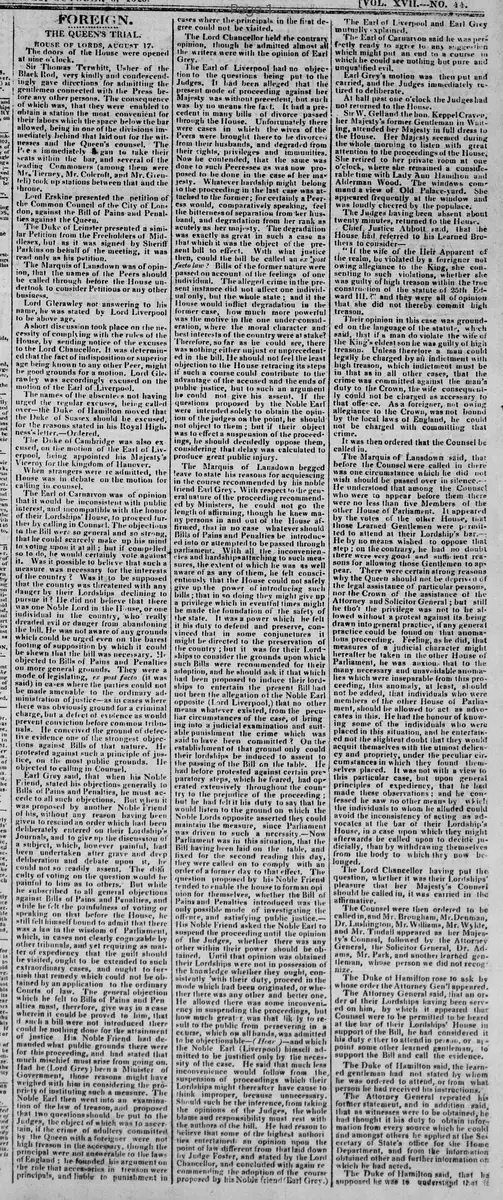
THE QUEEN'S TRIAL.
HOUSE OF LORDS, AUGUST 17.
The doors of the House were opened at nine o'clock.
Sir Thomas Tyrwhitt, Usher of the Black Rod, very kindly and condescendingly gave directions for admitting the gentlemen connected with the Press before any other persons. The consequence of which was, that they were enabled to obtain a station the most convenient for their labors which the space below the bar allowed, being in one of the divisions immediately behind that laid out for the witnesses and the Queen's counsel. The Press immediately began to take their seats within the bar, and several of the leading Commoners (among them were Mr. Tierney, Mr. Calcraft, and Mr. Goulburn) took up stations between that and the throne.
Lord Erskine presented the petition of the Common Council of the City of London, against the Bill of Pains and Penalties against the Queen.
The Duke of Leinster presented a similar Petition from the Freeholders of Middlesex, but, as it was signed by Sheriff Parkins on behalf of the meeting, it was read only as his petition.
The Marquis of Lansdown was of opinion, that the names of the Peers should be called through before the House undertook to consider Petitions or any other business.
Lord Glarawly not answering to his name, he was stated by Lord Liverpool to be above age.
A short discussion took place on the necessity of complying with the rules of the House, by sending notice of the excuses to the Lord Chancellor. It was determined that the fact of indisposition or superior age being known to any other Peer, might be good grounds for a motion. Lord Glarawly was accordingly excused on the motion of the Earl of Liverpool.
The names of the absentees not having urged the regular excuses, being called over—the Duke of Hamilton moved that the Duke of Sussex should be excused, for the reasons stated in his Royal Highness's letter.—Ordered.
The Duke of Cambridge was also excused, on the motion of the Earl of Liverpool, being appointed his Majesty's Viceroy for the kingdom of Hanover.
When strangers were re-admitted, the House was in debate on the motion for calling in counsel.
The Earl of Carnarvon was of opinion that it would be inconsistent with public interest, and incompatible with the honor of their Lordships' House, to proceed further by calling in Counsel. The objections to the Bill were so general and so strong, that he could scarcely make up his mind to voting upon it at all; but if compelled so to do, he would certainly vote against it. Was it possible to believe that such a measure, was necessary for the interests of the country? Was it to be supposed that the country was threatened with any danger by their Lordships declining to pursue it? He did not believe that there was one Noble Lord in the House, or one individual in the country, who really dreaded evil or danger from abandoning the bill. He was not aware of any grounds which could be urged even on the barest footing of supposition by which it could be shewn that the bill was necessary. He objected to Bills of Pains and Penalties on more general grounds. They were a mode of legislating, ex post facto (it was said) in cases where the parties could not be made amenable to the ordinary administration of justice—as in cases where there was obviously ground for a criminal charge, but a defect of evidence as would prevent conviction before common tribunals. He conceived the ground of defective evidence one of the strongest objections against Bills of that nature. He protested against such a principle of justice, on the most public grounds. He objected to calling in Counsel.
Earl Grey said, that when his Noble Friend, stated his objections generally to Bills of Pains and Penalties, he must acceed to all such objections. But when it was proposed by another Noble Friend of his, without any reason having been given to rescind an order which had been deliberately entered on their Lordship's Journals, and to give up the discussion of a subject, which, however painful, had been undertaken after grave and deep deliberation and debate upon it, he could not so readily assent. The difficulty of voting on the question would be painful to him as to others. But while he subscribed to all general objections against Bills of Pains and Penalties, and while he felt the painfulness of voting or speaking on that before the House, he still felt himself bound to admit that there was a law in the wisdom of Parliament, which, in cases not clearly cognizable by other tribunals, and yet requiring as matter of expediency that the guilt should be visited, ought to be extended to such extraordinary cases, and ought to furnish that remedy which could not be obtained by an application to the ordinary Courts of law. The general objection which he felt to Bills of Pains and Penalties must, therefore, give way in a case wherein it could be proved to him, that if such a bill were not introduced there could be nothing done for the attainment of justice His Noble Friend had demanded what public grounds there were for this proceeding, and had stated that much mischief must arise from going on. Had he (Lord Grey) been a Minister of Government, those reasons might have weighed with him in considering the propriety of instituting such a measure. The Noble Earl then went into an examination of the law of treason, and proposed that two questions should be put to the Judges, the object of which was to ascertain, if the crime of adultery committed by the Queen with a foreigner were not high treason in the accessary, though the principal were not answerable to the laws of England: he founded his argument on the rule that accessaries in treason were principals, and liable to punishment in cases where the principals in the first degree could not be visited.
The Lord Chancellor held the contrary opinion, though he admitted almost all the writers were with the opinion of Earl Grey.
The Earl of Liverpool had no objection to the questions being put to the Judges. It had been alleged that the present mode of proceeding against her Majesty was without precedent, but such was by no means the fact. It had a precedent in many bills of divorce passed through the House. Unfortunately there were cases in which the wives of the Peers were brought there to be divorced from their husbands, and degraded from their rights, privileges and immunities. Now he contended, that the same was done to such Peeresses as was now proposed to be done in the case of her majesty. Whatever hardship might belong to the proceeding in the last case was attached to the former; for certainly a Peeress would, comparatively speaking, feel the bitterness of separation from her husband, and degradation from her rank as acutely as her majesty. The degradation was exactly as great in such a case as that which it was the object of the present bill to effect. With what justice then, could the bill be called an ex post facto law? Bills of the former nature were passed on account of the feelings of one individual. The alleged crime in the present instance did not affect one individual only, but the whole state: and if the House would inflict degradation in the former case, how much more powerful was the motive in the one under consideration, where the moral character and best interests of the country were at stake? Therefore, so far as he could see, there was nothing either unjust or unprecedented in the bill. He should not feel the least objection to the House retracing its steps if such a course could contribute to the advantage of the accused and the ends of public justice, but to such an argument he could not give his assent. If the questions proposed by the Noble Earl were intended solely to obtain the opinion of the judges on the point, he should not object to them: but if their object was to effect a suspension of the proceedings, he should decidedly oppose them, considering that delay was calculated to produce great public injury.
The Marquis of Lansdown begged leave to state his reasons for acquiescing in the course recommended by his noble friend Earl Grey. With respect to the general nature of the proceeding recommended by Ministers, he could not go the length of affirming, though he knew many persons in and out of the House affirmed, that in no case whatever should Bills of Pains and Penalties be introduced into or attempted to be passed through parliament. With all the inconveniences and hardships attaching to such measures, the extent of which he was as well aware of as any of them, he felt conscientiously that the House could not safely give up the power of introducing such bills; that in so doing they might give up a privilege which in eventful times might be made the foundation of the safety of the state. It was a power which he felt it his duty to defend and preserve, convinced that in some conjunctures it might be directed to the preservation of the country: but it was for their Lordships to consider the grounds upon which such Bills were recommended for their adoption, and he should ask if that which had been proposed to induce their lordships to entertain the present Bill had not been the allegation of the Noble Earl opposite (Lord Liverpool.) that no other means whatever existed, from the peculiar circumstances of the case, of bringing into a judicial examination and suitable punishment the crime which was said to have been committed? On the establishment of that ground only could their lordships be induced to assent to the passing of the Bill on the table. He had before protested against certain preparatory steps, which he feared, had operated extensively throughout the country to the prejudice of the proceeding; but he had felt it his duty to say that he would listen to the ground on which the Noble Lords opposite asserted they could maintain the measure, since Parliament was driven to such a necessity.—Now Parliament was in this situation, that the Bill having been laid on the table, and fixed for the second reading this day, they were called on to comply with an order of a former day to that effect. The question proposed by his Noble Friend tended to enable the house to form an opinion for themselves, whether the Bill of Pains and Penalties introduced was the only possible mode of investigating the offence, and satisfying public justice.— His Noble Friend asked the Noble Earl to suspend the proceeding until the opinion of the Judges, whether there was any other within their power should be obtained. Until that opinion was obtained their Lordships were not in possession of the knowledge whether they ought, consistently with their duty, proceed in the mode which had been originated, or whether there was any other and better one. He allowed there was some inconvenience in suspending the proceedings, but how much greater was that likely to result to the public from persevering in a course, which on all hands, was admitted to be objectionable—(Hear)—and which the Noble Earl (Liverpool) himself admitted to be justified only by the necessity of the case. He said that much less inconvenience would follow from the suspension of proceedings which their Lordships might hereafter have cause to think improper, because unnecessary. Should such be the inference, from taking the opinions of the Judges, the whole blame and responsibility must rest with the authors of the bill. He had reason to believe that some of the highest authorities entertained an opinion upon the point of law different from that laid down by Judge Foster, and stated by the Lord Chancellor, and concluded with again recommending the adoption of the course proposed by his Noble friend (Earl Grey.)
The Earl of Liverpool and Earl Grey mutually explained.
The Earl of Carnarvon said he was perfectly ready to agree to any suggestion which might put an end to a course in which he could see nothing but pure and unqualified evil.
Earl Grey's motion was then put and carried, and the Judges immediately retired to deliberate.
At half past one o'clock the Judges had not returned to the House.
Sir W. Gell and the Hon. Keppel Craven, her Majesty's former Gentleman in Waiting, attended her Majesty in full dress to the House. Her Majesty seemed during the whole morning to listen with great attention to the proceedings of the House. She retired to her private room at one o'clock, where she remained a considerable time with Lady Ann Hamilton and Alderman Wood. The windows command a view of Old Palace-yard. She appeared frequently at the window and was loudly cheered by the populace.
The Judges having been absent about twenty minutes, returned to the House.
Chief Justice Abbott said, that the House had referred to his Learned Brothers to consider—
"If the wife of the Heir Apparent of the realm, be violated by a foreigner not owing allegiance to the King, she consenting to such violation, whether she was guilty of high treason within the true construction of the statute of 25th Edward III.?": and they were all of opinion that she did not thereby commit high treason.
Their opinion in this case was grounded on the language of the statute—which said, that if a man do violate the wife of the King's eldest son he was guilty of high treason. Unless therefore a man could legally be charged by an indictment with high treason, which indictment must be in that as in all other cases, that the crime was committed against the man's duty to the Crown, the wife consequently could not be charged as accessory to that offence. As a foreigner, not owing allegiance to the Crown, was not bound by the local laws of England, he could not be charged with committing that crime.
It was then ordered that the Counsel be called in.
The Marquis of Lansdown said, that before the Counsel were called in there was one circumstance which he did not wish should be passed over in silence.— He understood that among the Counsel who were to appear before them—there were no less than five Members of the other House of Parliament. It appeared by the votes of the other House, that those Learned Gentlemen were permitted to attend at their Lordship's bar.— He by no means wished to oppose that step; on the contrary, he had no doubt there were very good and sufficient reasons for allowing those Gentlemen to appear. There were certain strong reasons why the Queen should not be deprived of the legal assistance of particular persons, nor the Crown of the assistance of the Attorney and Solicitor General: but still he tho't the privilege was not to be allowed without a protest against its being drawn into general practice, if any general practice could be found on that anomalous proceeding. Feeling, as he did, that measures of a judicial character might hereafter be taken in the other House of Parliament, he was anxious, that to the many necessary and unavoidable anomalies which were inseparable from this proceeding, this anomaly, at least, should not be added, that individuals who were members of the other House of Parliament, should be allowed to act as advocates in this. He had the honour of knowing some of the individuals who were placed in this situation, and he entertained not the slightest doubt that they would acquit themselves with the utmost delicacy and propriety, under the peculiar circumstances in which they found themselves placed. It was not with a view to this particular case, but upon general principles of expediency, that he had made these observations: and he confessed he saw no other means by which the individuals to whom he alluded could avoid the inconsistency of acting as advocates at the bar of their Lordships' House, in a case upon which they might afterwards be called upon to decide judicially, than by withdrawing themselves from the body to which they now belonged.
The Lord Chancellor having put the question, whether it was their Lordships' pleasure that her Majesty's Counsel should be called in, it was carried in the affirmative.
The Counsel were then ordered to be called in, and Mr. Brougham, Mr. Denman, Dr. Lushington, Mr. Williams, Mr. Wylke, and Mr. Tindall appeared as her Majesty's Counsel, followed by the Attorney General. The Solicitor General, Dr. Adams, Mr. Park, and another learned gentleman, whose person we did not recognize.
The Duke of Hamilton rose to ask by whose order the Attorney Gen'l appeared.
The Attorney General said, that an order of their Lordships having been served on him, by which it appeared that Counsel were to be permitted to be heard at the bar of their Lordships' House in support of the Bill, he had considered it his duty either to attend in person, or appoint some other learned gentleman, to support the Bill and call the evidence.
The Duke of Hamilton said, the learned gentleman had not stated by whom he was ordered to attend, or from what person he had received his instructions.
The Attorney General repeated his former statement, and in addition said, that as witnesses were to be examined, he had thought it his duty to obtain information from every source which he could and amongst others he applied at the Secretary of State's office for the Home Department, and from the information obtained other and further information on which he had acted.
The Duke of Hamilton said, that he supposed he was to understand that
What sub-type of article is it?
What keywords are associated?
What entities or persons were involved?
Where did it happen?
Foreign News Details
Primary Location
House Of Lords
Event Date
August 17
Key Persons
Outcome
earl grey's motion to put questions to the judges was carried; judges opined that the wife of the heir apparent consenting to violation by a foreigner does not commit high treason; counsel called in.
Event Details
Proceedings in the House of Lords on the Bill of Pains and Penalties against the Queen. Petitions presented against the Bill. Discussion on calling names of Peers and excuses for absentees. Debate on proceeding with the Bill, objections to Bills of Pains and Penalties, and whether adultery by the Queen constitutes high treason. Questions put to Judges, who delivered opinion. Queen attended with attendants. Counsel for the Queen and Attorney General appeared.