Thank you for visiting SNEWPapers!
Sign up free
The National Intelligencer And Washington Advertiser
Washington, District Of Columbia
What is this article about?
A letter to the editors of the National Intelligencer expresses relief at the escape of Americans imprisoned in Carthagena for joining Miranda's expedition but argues against U.S. government intervention, as it would damage national reputation, imply complicity, and set a dangerous precedent. Signed HERMES.
Merged-components note: This is a single letter to the editor regarding the men confined in Carthagena, split across pages 2 and 3 in sequential reading order.
Clippings
1 of 2
OCR Quality
Full Text
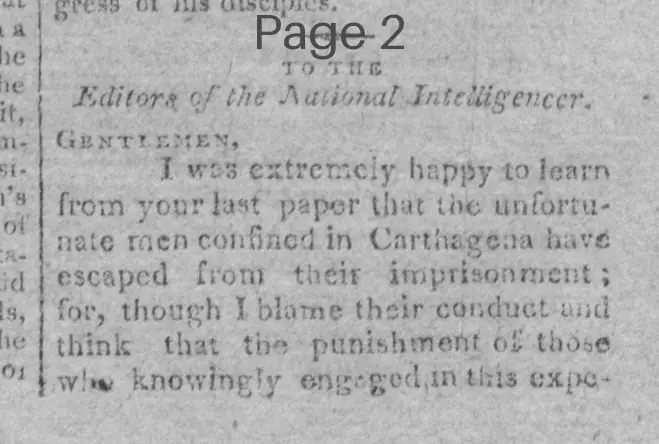
Editors of the National Intelligencer.
GENTLEMEN,
I was extremely happy to learn
from your last paper that the unfortunate
men confined in Carthagena have
escaped from their imprisonment;
for, though I blame their conduct and
think that the punishment of those who
knowingly engaged in this expedition
when distress was rife, I have never ceased to sympathize with their sufferings, and would have contributed to their relief as an individual, could my mite have been of service. Since these persons are released, permit me to call your attention to the decision on this subject at the last session of Congress, and the principles on which it was grounded. Those men, taken by the public authority of a Spanish province in a hostile expedition against the country, were tried and condemned for the act. Whilst suffering under the punishment inflicted by the laws of that country, an application was made by them to the government of the United States for interference for their relief. A committee of the House of Representatives having reported in their favor, the report was negatived by the casting vote of the Speaker, and thus was avoided a decision, which, in my opinion, would not only have formed a dangerous precedent, but would have depreciated the character of the nation in the eyes of the world. We can only judge of the character of a nation from that part of its conduct with which we are acquainted, and therefore no doubt often judge erroneously. Other nations have but the same means of judging of us and of course sometimes do us injustice. For instance—I have been credibly informed that on the western coast of South America, where all our trade, being contrary to the laws of the government of the provinces on the coast, is carried on by means of armed vessels, the impression conveyed by our mercantile enterprises in those seas is, that the people of the United States are radically unprincipled and avaricious, regardless of the means to obtain any end they have in view. Seeing our citizens engaged, with foreigners, in such enterprises as that of Miranda, would not the people and government of Caraccas and the other provinces be induced to think this a characteristic trait in our national character? If the simple detection of these men would produce that impression, how much would it not have been strengthened, and what prejudices would not have been excited against this country, had Congress interposed for the relief of these men! Again—those persons were engaged in ports of the United States for the service in which they were employed, whether with a knowledge of their destination or otherwise is not now the question. From this circumstance a suspicion very naturally seized on the minds of the Spanish government that the American government had knowledge of the transaction, and prejudice was consequently infused into their minds against us. Would not an application for the release of these men have been considered as facto evidence of a connection between this government and the persons concerned? And would not this government, by claiming or asking them as citizens, have been considered as sanctioning their acts? After our citizens, "above the dull pursuits of civil life," despising their household gods and native land, had marched under the banners of a Miranda or a Burr to invade a foreign country, had been taken and condemned as pirates, would it have been believed that the government would have lent them its aid, unless it had authorised or connived at the expedition? The very act of interference could have had no other effect than that of substituting the government as the offender instead of the individuals, and thus at once have put an end to any advantages we might ever derive from amity or commerce with those provinces. But fortunately we have escaped the evil consequences which would have been attendant on such a course of conduct. That part of Congress which prevailed in negativing the proposition for interference in behalf of these persons, had an invidious task to perform, one which called for all their fortitude. They had to withstand the sympathy which we all feel for fellow creatures in distress; they had to withstand strong and reiterated appeals to their passions and feelings; but more than all they had to bear, unmoved, imputations of obduracy of heart and insensibility to those feelings which are the peculiar attributes of humanity. They followed the dictates of judgment in preference to the impulse of their feelings, and in so doing have set up a beacon to warn future adventurers that the United States as a nation will not acknowledge as citizens those who voluntarily expatriate themselves on unlawful expeditions. This great principle may be considered as decided; for never, perhaps, will such a case again occur, the circumstances of which were so favorable to the sufferers. The decision stands on record as a precedent. I rejoice as much as any one that these men are released; but I rejoice also that they were not released through the instrumentality of the government. Such a course would neither have been consistent with sound policy or the dictates of wisdom, in the opinion of HERMES.
What sub-type of article is it?
What themes does it cover?
What keywords are associated?
What entities or persons were involved?
Letter to Editor Details
Author
Hermes
Recipient
Editors Of The National Intelligencer
Main Argument
the u.s. government should not have intervened to free americans imprisoned in carthagena for participating in miranda's hostile expedition, as it would create a dangerous precedent, damage national character, and imply official complicity, potentially harming relations with spanish provinces.
Notable Details