Thank you for visiting SNEWPapers!
Sign up free
The Freeman's Journal, Or, New Hampshire Gazette
Portsmouth, Rockingham County, New Hampshire
What is this article about?
Correspondence between Generals Washington and Howe in 1777 debating the exchange of prisoners from the Revolutionary War, focusing on allegations of mistreatment, conditions for exchange, and the status of key officers like General Lee and Lt. Col. Campbell.
Merged-components note: This is a continuation of the detailed correspondence between General Washington and General Howe regarding the exchange of prisoners, spanning across pages.
Clippings
1 of 2
OCR Quality
Full Text
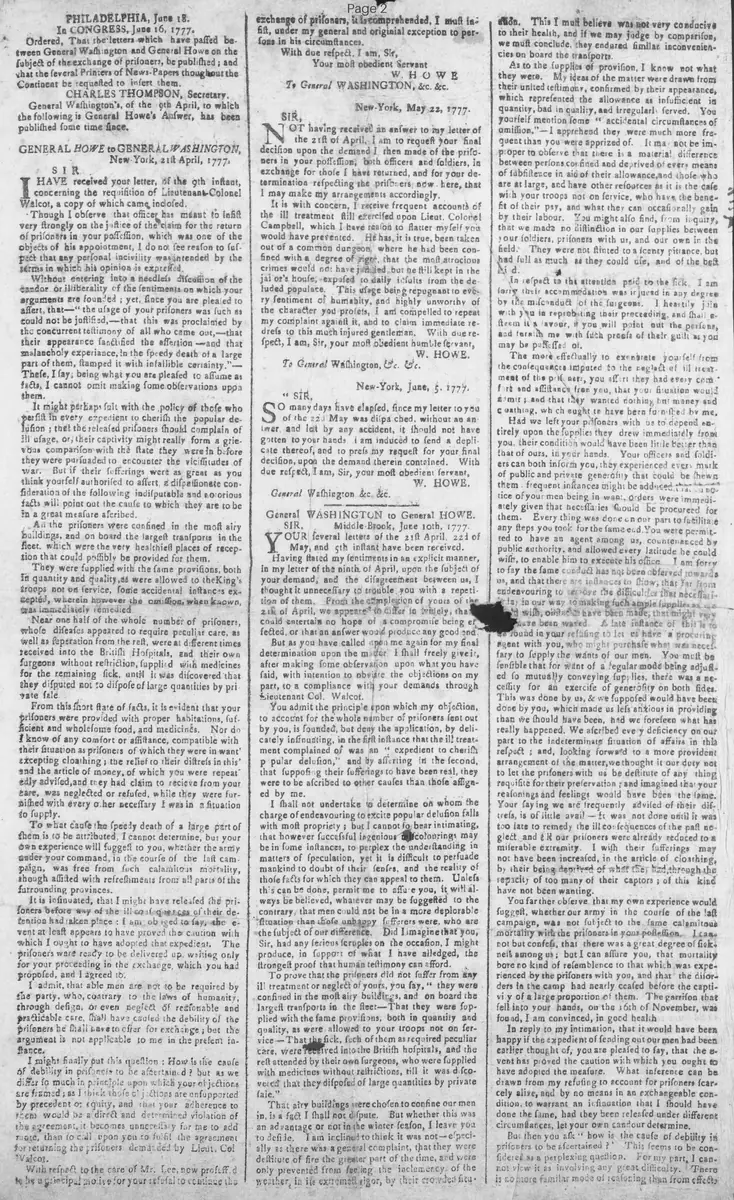
IN CONGRESS, June 16, 1777.
Ordered, That the letters which have passed between General Washington and General Howe on the subject of the exchange of prisoners, be published; and that the several Printers of News-Papers throughout the Continent be requested to insert them.
CHARLES THOMPSON, Secretary.
General Washington's, of the 9th April, to which the following is General Howe's Answer, has been published some time Since.
GENERAL HOWE TO GENERAL WASHINGTON
New-York, 21st April, 1777
SIR,
I HAVE received your letter, of the 9th instant, concerning the requisition of Lieutenant-Colonel Walcot, a copy of which came enclosed.
Though I observe that officer has meant to insist very strongly on the justice of the claim for the return of prisoners in your possession, which was one of the objects of his appointment, I do not see reason to suspect that any personal incivility was intended by the terms in which his opinion is expressed.
Without entering into a heedless discussion of the Candor or illiberality of the sentiments on which your arguments are founded; yet, since you are pleased to assert, that—'the usage of your prisoners was such as could not be justified,—that this was proclaimed by the concurrent testimony of all who came out,—that their appearance sanctified the assertion—and that melancholy experience, in the speedy death of a large part of them, stamped it with infallible certainty.'—These, I say, being what you are pleased to assume as facts, I cannot omit making some observations upon them.
It might perhaps suit with the policy of those who persist in every expedient to cherish the popular delusion: that the released prisoners should complain of ill usage, or, their captivity might really form a grievous comparison with the state they were in before they were persuaded to encounter the vicissitudes of war. But if their sufferings were as great as you think yourself authorised to assert, a dispassionate consideration of the following indisputable and notorious facts will point out the cause to which they are to be in a great measure ascribed.
All the prisoners were confined in the most airy buildings, and on board the largest transports in the fleet, which were the very healthiest places of reception that could possibly be provided for them.
They were supplied with the same provisions, both in quantity and quality, as were allowed to the King's troops not on service, some accidental instances excepted, wherein however the omission, when known, was immediately remedied.
Near one half of the whole number of prisoners, whose diseases appeared to require peculiar care, as well as separation from the rest, were at different times received into the British Hospitals, and their own surgeons without restriction, supplied with medicines for the remaining sick, until it was discovered that they disputed not to dispose of large quantities by private sale.
From this short state of facts, it is evident that your prisoners were provided with proper habitations, sufficient and wholesome food, and medicines. Nor do I know of any comfort or assistance, compatible with their situation as prisoners of which they were in want, excepting clothing; the relief to their distress in this, and the article of money, of which you were repeatedly advised, and they had claim to receive from your care, was neglected or refused, while they were furnished with every other necessary I was in a situation to supply.
To what cause the speedy death of a large part of them is to be attributed, I cannot determine, but your own experience will suggest to you, whether the army under your command, in the course of the last campaign, was free from such calamitous mortality, though assisted with refreshments from all parts of the surrounding provinces.
It is insinuated, that I might have released the prisoners before any of the ill consequences of their detention had taken place: I am obliged to say, the event at least appears to have proved the caution with which I ought to have adopted that expedient. The prisoners were ready to be delivered up, waiting only for your proceeding in the exchange, which you had proposed, and I agreed to:
I admit, that able men are not to be required by the party, who, contrary to the laws of humanity, through design, or even neglect of reasonable and practicable care, shall have caused the debility of the prisoners he shall have to offer for exchange; but the argument is not applicable to me in the present instance.
I might finally put this question: How is the cause of debility in prisoners to be ascertained? but as we differ so much in principle upon which your objections are framed; as I think those objections are unsupported by precedent or equity, and that your adherence to them would be a direct and determined violation of the agreement, it becomes unnecessary for me to add more, than to call upon you to fulfill the agreement for returning the prisoners demanded by Lieut. Col. Walcot.
With respect to the care of Mr. Lee, now professed we by a principal motive for your refusal to continue the exchange of prisoners. it is comprehended. I must insist, under my general and original exception to persons in his circumstances.
With due respect, I am, Sir,
Your most obedient Servant
W. HOWE
To General WASHINGTON, &c. &c.
New-York, May 22, 1777.
SIR,
NOT having received an answer to my letter of the 21st of April, I am to request your final decision upon the demand I then made of the prisoners in your possession, both officers and soldiers, in exchange for those I have returned, and for your determination respecting the prisoners now here, that I may make my arrangements accordingly.
It is with concern, I receive frequent accounts of the ill treatment still exercised upon Lieut. Colonel Campbell, which I have reason to flatter myself you would have prevented. He has, it is true, been taken out of a common dungeon, where he had been confined with a degree of rigor, that the most atrocious crimes would not have justified; but he still kept in the jailor's house,—exposed to daily insults from the deluded populace. This usage being repugnant to every sentiment of humanity, and highly unworthy of the character you profess, I am compelled to repeat my complaint against it, and to claim immediate redress to this much injured gentleman. With due respect, I am, Sir, your most obedient humble servant,
W. HOWE.
To General Washington, &c. &c.
New-York, June, 5. 1777.
SIR,
AS many days have elapsed since my letter to you of the 22d of May, and left by any accident, it should not have gotten to your hands I am induced to send a duplicate thereof, and to press my request for your final decision, upon the demand therein contained. With due respect, I am, Sir, your most obedient servant,
W. HOWE.
General Washington &c. &c.
General WASHINGTON to General HOWE.
SIR,
Middle-Brook, June 30th, 1777
YOUR Several letters of the 21st April, 22d of May, and 5th instant have been received.
Having stated my sentiments in an explicit manner, in my letter of the ninth of April, upon the subject of your demand: and the disagreement between us. I thought it unnecessary to trouble you with a repetition of them. From the complexion of yours of the 21st of April, we appear to differ so widely, that I could entertain no hope of a compromise being effected, or that an answer would produce any good end.
But as you have called upon me again for my final determination upon the matter, I shall freely give it, after making some observation upon what you have said, with intention to obviate the objections on my part, to a compliance with your demands through Lieutenant Col. Walcot.
You admit the principle upon which my objection, to account for the whole number of prisoners sent out by you, is founded, but deny the application, by delicately insinuating, in the first instance that the ill treatment complained of was an "expedient to cherish popular delusion," and by asserting in the second, that supposing their sufferings to have been real, they were to be ascribed to other causes than those assigned by me.
I Shall not undertake to determine on whom the charge of endeavouring to excite popular delusion falls with most propriety; but I cannot so far bear insinuating, that however successful ingenious misrepresentations may be in some instances, to perplex the understanding in matters of speculation, yet it is difficult to persuade mankind to doubt of their senses, and the reality of those facts for which they can appeal to them. Unless this can be done, permit me to assure you, it will always be believed, whatever may be suggested to the contrary, that men could not be in a more deplorable situation than those unhappy sufferers were, who are the subject of our difference. Did I imagine that you, Sir, had any serious scruples on the occasion, I might produce, in support of what I have alleged, the strongest proof that human testimony can afford.
To prove that the prisoners did not suffer from any ill treatment or neglect of yours, you say, "they were confined in the most airy buildings, and on board the largest transports in the fleet—That they were supplied with the same provisions, both in quantity and quality, as were allowed to your troops not on service— That the sick, such of them as required peculiar care, were received into the British hospitals, and the rest attended by their own surgeons, who were supplied with medicines without restrictions, till it was discovered that they disposed of large quantities by private sale."
That airy buildings were chosen to confine our men in, is a fact I shall not dispute. But whether this was an advantage or not in the winter season, I leave you to decide. I am inclined to think it was not—especially as there was a general complaint, that they were destitute of fire the greater part of the time, and were only prevented from feeling the inclemency of the weather, in its extremest rigor, by their crowded situation.
This I must believe was not very conducive to their health, and if we may judge by comparison, we must conclude, they endured similar inconveniences on board the transports.
As to the supplies of provision, I know not what they were. My ideas of the matter were drawn from their united testimony, confirmed by their appearance, which represented the allowance as insufficient in quantity, bad in quality, and irregularly served. You yourself mention some "accidental circumstances of omission."—I apprehend they were much more frequent than you were apprised of. It may not be improper to observe that there is a material difference between persons confined and deprived of every means of subsistence in aid of their allowance, and those who are at large, and have other resources as it is the case with your troops not on service, who have the benefit of their pay, and what they can occasionally gain by their labour. You might also find, from inquiry, that we made no distinction in our supplies between your soldiers, prisoners with us, and our own in the field. They were not stinted to a scanty pittance, but had full as much as they could use, and of the best kind.
In respect to the attention paid to the sick, I am sorry their accommodation was injured in any degree by the misconduct of the surgeons. I heartily join with you in reprobating their proceeding, and shall esteem it a favour, if you will point out the persons, and furnish me with such proofs of their guilt as you may be possessed of.
The more effectually to exculpate yourself from the consequences imputed to the alleged ill treatment of the prisoners, you assert they had every comfort and assistance from you, that your situation would admit; and that they wanted nothing but money and clothing, which ought to have been furnished by me.
Had we left your prisoners with us to depend entirely upon the supplies they drew immediately from you, their condition would have been little better than that of ours, in your hands. Your officers and soldiers can both inform you, they experienced every mark of public and private generosity that could be shown them frequent instances might be adduced that notice of your men being in want, Orders were immediately given that necessaries should be procured for them. Every thing was done on our part to facilitate any steps you took for the same end. You were permitted to have an agent among us, countenanced by public authority, and allowed every latitude he could wish, to enable him to execute his office. I am sorry to say the same conduct has not been observed towards us, and that there are instances to show, that far from endeavouring to remove the difficulties that necessarily lay in our way to making such ample supplies as I wish, obstacles have been made, that might very well have been waived. A late instance of this is to be found in your refusing to let us have a procuring agent with you, who might purchase what was necessary to supply the wants of our men. You must be sensible that for want of a regular mode being adjusted of mutually conveying supplies, there was a necessity for an exercise of generosity on both sides.
This was done by us, & we supposed would have been done by you, which made us less anxious in providing than we should have been, had we foreseen what has really happened. We ascribed every deficiency on our part to the indeterminate situation of affairs in this respect: and, looking forward to a more provident arrangement of the matter, we thought it our duty not to let the prisoners with us be destitute of any thing requisite for their preservation; and imagined that your reasonings and feelings would have been the same.
Your saying we are frequently advised of their distress, is of little avail - it was not done until it was too late to remedy the ill consequences of the past neglect. and as our prisoners were already reduced to a miserable extremity. I wish their sufferings may not have been increased, in the article of clothing, by their being deprived of what they had, through the rapacity of too many of their captors; of this kind have not been wanting.
You further observe, that my own experience would suggest, whether our army in the course of the last campaign, was not subject to the same calamitous mortality with the prisoners in your possession, I cannot but confess, that there was a great degree of sickness among us; but I can assure you, that mortality bore no kind of resemblance to that which was experienced by the prisoners with you, and that the disorders in the camp had nearly ceased before the captivity of a large proportion of them. The garrison that fell into your hands, on the 6th of November, was found, I am convinced, in good health
In reply to my intimation, that it would have been happy if the expedient of sending out our men had been earlier thought of; you are pleased to say, that the event has proved the caution with which you ought to have adopted the measure. What inference can be drawn from my refusing to account for prisoners scarcely alive, and by no means in an exchangeable condition, to warrant an insinuation that I should have done the same, had they been released under different circumstances, let your own candour determine.
But then you ask "how is the cause of debility in prisoners to be ascertained?" This seems to be considered as a perplexing question. For my part, I cannot view it as involving any great difficulty. There is no more familiar mode of reasoning than from effects
To causes, even in matters of the most interesting importance. In the subject before us, the appearance of the prisoners, and what eventually happened, proved, that they had been hardly dealt with; but their joint severities, aided by the information of others, not interested in the dispute more than as they regarded the rights of humanity, established the fact too firmly for incredulity itself to doubt it.
I should hardly believe you to be serious in your application of the exception, to which you allude, to the case of Major General Lee, if you had not persisted in a discrimination respecting him. I did not entertain the most distant idea, that he could have been supposed to come under the description contained in it: and to force such a construction upon that gentleman's circumstances, however it may be an evidence of ingenuity, is but an indifferent specimen of candor. I will add here to what I have already advanced on this head, and can by no means think of departing from it.
I am now to give you my final decision on the subject of your demands. In doing this I can little more than repeat what I have already said. I am extremely desirous of a general exchange on liberal and impartial principles, and it is with great concern I find that a matter so mutually interesting, is impeded by unnecessary obstacles. But I cannot consent to its taking place on terms so disadvantageous as those you propose, and which appear to me so contrary to justice and the spirit of the agreement.
I think it proper to declare, that I wish the difference between us to be adjusted on a generous and equitable plan, and mean not to avail myself of the releasement of the prisoners, to extort any thing from you not compatible with the strictest justice. Let a reasonable proportion of prisoners, to be accounted for, be settled, and General Lee declared exchangeable, when we shall have an officer of yours of equal rank in our possession: I ask no more. These being done, I shall be happy to proceed to a general exchange. But, in the mean time, I am willing that a partial one should take place on the prisoners now in your hands, as far as those in ours will extend, except with respect to Lieut. Col. Campbell and the Hessian field officers, who will be detained till you recognize General Lee a prisoner of war, and place him on the footing I claim.
This latter proposition I am induced to make, from the distinction which your letter of the 22d of May, seems to hold forth, and I think it necessary to add, that your conduct towards prisoners will govern mine.
The situation of Lieut. Col. Campbell, as represented to you, is such as I neither wished nor occasioned; scan the subject, and hope there would have been no farther cause of uneasiness. That gentleman, I am persuaded, will do me the justice to say, he has received no ill treatment at my instance. Unnecessary severity and every species of insult I despise, and, I trust, none will ever have reason to censure me in this respect. I have written again on your remonstrance, and have no doubt such a line of conduct will be adopted, as will be consistent with the dictates of humanity, and agreeable to both his and your wishes. I am, Sir, with due respect, your most obedient servant,
G. WASHINGTON.
His Excellency General Sir William Howe.
What sub-type of article is it?
What themes does it cover?
What keywords are associated?
What entities or persons were involved?
Where did it happen?
Story Details
Key Persons
Location
New York, Middle Brook, Philadelphia
Event Date
1777
Story Details
Exchange of letters between Generals Washington and Howe debating prisoner treatment, conditions for exchange, and specific cases like General Lee and Lt. Col. Campbell, with Washington refusing unequal terms.