Thank you for visiting SNEWPapers!
Sign up free
Delaware Gazette And Peninsula Advertiser
Wilmington, New Castle County, Delaware
What is this article about?
J. A. Mossel argues for improving slave conditions in British West Indies through wages, gradual emancipation, and hiring free African laborers like Kroomen, to prevent rebellions, promote stability, and aid Africa's civilization, drawing on historical examples and moral imperatives.
Merged-components note: This is a continuation of the essay on the amelioration of slavery from page 2 to page 3; relabeled to literary as it is a serialized essay.
Clippings
1 of 2
OCR Quality
Full Text
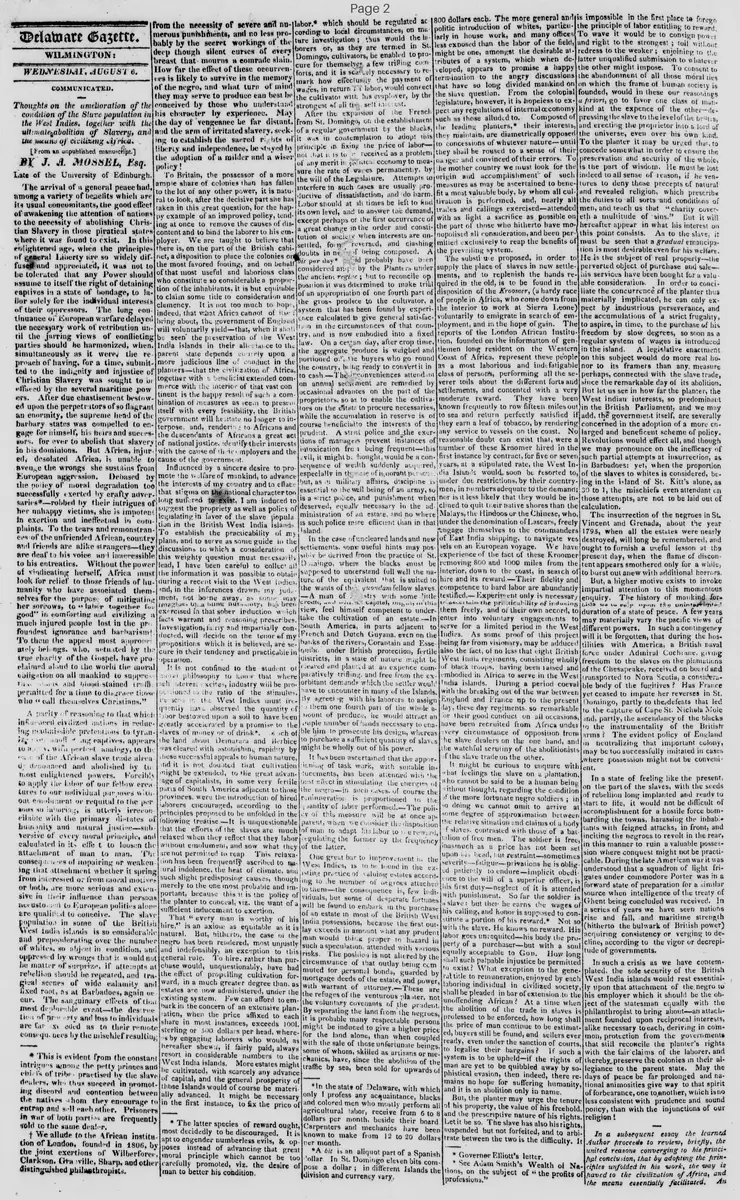
Thoughts on the amelioration of the condition of the Slave population in the West Indies, together with the ultimate abolition of Slavery, and the means of civilizing Africa.
[From an unpublished manuscript.]
BY J. A. MOSSEL, Esq.
Late of the University of Edinburgh.
The arrival of a general peace had, among a variety of benefits which are its usual concomitants, the good effect of awakening the attention of nations to the necessity of abolishing Christian Slavery in those piratical states where it was found to exist. In this enlightened age, when the principles of general Liberty are so widely diffused and appreciated, it was not to be tolerated that any Power should assume to itself the right of detaining captives in a state of bondage, to labour solely for the individual interests of their oppressors. The long continuance of European warfare delayed the necessary work of retribution until the jarring views of conflicting parties should be harmonized, when, simultaneously as it were, the reproach of having, for a time, submitted to the indignity and injustice of Christian Slavery was sought to be effaced by the several maritime powers. After due chastisement bestowed upon the perpetrators of so flagrant an enormity, the supreme head of the Barbary states was compelled to engage for himself, his heirs and successors, for ever to abolish that slavery in his dominions. But Africa, injured, desolated Africa, is unable to avenge the wrongs she sustains from European aggression. Debased by the policy of moral degradation too successfully exerted by crafty adversaries—robbed by their intrigues of her unhappy victims, she is impotent in exertion and ineffectual in complaints. To the tears and remonstrances of the unfriended African, country and friends are alike strangers—they are deaf to his voice and inaccessible to his entreaties. Without the power of vindicating herself, Africa must look for relief to those friends of humanity who have associated themselves for the purpose of mitigating her sorrows, to 'labour together for good' in comforting and civilizing a much injured people lost in the profoundest ignorance and barbarism. To them the appeal most appropriately belongs, who, actuated by the true charity of the Gospel, have proclaimed aloud to the world the moral obligation on all mankind to suppress this vile and blood-stained traffic permitted for a time to disgrace those who 'call themselves Christians.'
A parity of reasoning to that which impelled civilized nations in reducing inadmissible pretensions to tyranny, and freeing captives, appears so obvious with perfect analogy, to the case of the African slave trade already denounced and abolished by the most enlightened powers. Forcibly to apply the labor of our fellow creatures to our individual purposes without emolument or requital to the persons so labouring, is utterly irreconcilable with the ordinary dictates of humanity and natural justice—subversive of every moral principle, and calculated in its effect to loosen the attachment of man to man. The consequences of impairing or weakening that attachment whether it spring from interested or from moral motives or both, are more serious and extensive in their influence than persons accustomed to European politics alone are qualified to conceive. The slave population in some of the British West India islands is so considerable and preponderating over the number of whites, so abject in condition, and oppressed by wrongs that it would not be matter of surprise, if attempts at rebellion should be repeated, and tragical scenes of wide calamity and fixed root, as at Barbadoes, again occur. The sanguinary effects of that most deplorable event—the destruction of property and loss to individuals are far exceeded as to their remote consequences by the mischief resulting
* This is evident from the constant intrigues among the petty princes and chiefs of tribes—practised by the slave dealers, who thus succeeding promote discord and contention between the natives whom they encourage to entrap and sell each other. Prisoners in war of both parties are frequently sold to the same dealer.
We allude to the African institution of London, founded in 1806, by the joint exertions of Wilberforce, Clarkson, Granville, Sharp, and other distinguished philanthropists.
from the necessity of severe and numerous punishments, and no less probably by the secret workings of the deep though silent curses of every breast that mourns a comrade slain. How far the effect of these occurrences is likely to survive in the memory of the negro, and what turn of mind they may serve to produce can best be conceived by those who understand his character by experience. May the day of vengeance be far distant, and the arm of irritated slavery, seeking to establish the sacred rights of liberty and independence, be stayed by the adoption of a milder and a wiser policy!
To Britain, the possessor of a more ample share of colonies than has fallen to the lot of any other power, it is natural to look, after the decisive part she has taken in this great question, for the happy example of an improved policy, tending at once to remove the causes of discontent and to bind the laborer to his employer. We are taught to believe that there is, on the part of the British cabinet, a disposition to place the colonies on the most favored footing, and on behalf of that most useful and laborious class who constitute so considerable a proportion of the inhabitants, it is but equitable to claim some title to consideration and clemency. It is not too much to hope, indeed, that what Africa cannot of herself bring about, the government of England will voluntarily yield—that, when it shall be seen the preservation of the West India islands in their allegiance to the parent state depends entirely upon a more judicious line of conduct in the planters—that the civilization of Africa, together with a beneficial extended commerce with the interior of that vast continent is the happy result of such a combination of measures as seem to present itself with every feasibility, the British government will hesitate no longer to interpose, and, rendering to Africans and the descendants of Africans a great act of national justice, identify their interests with the cause of their employers and the cause of the government.
Influenced by a sincere desire to promote the welfare of mankind, to advance the interests of my country and to efface that stigma on the national character too long suffered to exist, I am induced to suggest the propriety as well as policy of legislating in favour of the slave population in the British West India islands. To establish the practicability of my plans, and to serve as some guide in the discussions to which a consideration of this weighty question must necessarily lead, I have been careful to collect all the information it was possible to obtain during a recent visit to the West Indies, and, in the inferences drawn, my judgment, not borne away, as some may imagine, by a blind humanity, has been exercised in that sober induction which facts warrant and reasoning prescribes. Investigation, fairly and impartially conducted, will decide on the tenor of my propositions which it is believed, are secure in their tendency and practicable in operation.
It is not confined to the student of moral philosophy to know that where self interest excites, industry will be proportioned to the ratio of the stimulus. Persons in the West Indies must frequently have observed the quantity of labour bestowed upon a soil to have been greatly accelerated by a promise to the slaves of money or of drink*. Much of the land about Demerara and Berbice was cleared with astonishing rapidity by these successful appeals to human nature, and it is not doubted that cultivation might be extended, to the great advantage of capitalists, in some very fertile parts of South America adjacent to those provinces, were the introduction of hired laborers encouraged, according to the principles proposed to be unfolded in the following treatise.—It is unquestionable that the efforts of the slaves are much relaxed when they reflect that they labor without emolument, and sow what they are not permitted to reap. This relaxation has been frequently ascribed to natural indolence, the heat of climate, and such slight predisposing causes, though merely to the one most probable and important, because this it is the policy of the planter to conceal, viz. the want of a sufficient inducement to exertion.
That 'every man is worthy of his hire,' is an axiom as equitable as it is natural. But, hitherto, the case of the negro has been rendered, most unjustly and indefensibly, an exception to this general rule. To hire, rather than purchase would, unquestionably, have had the effect of propelling cultivation forward, in a much greater degree than, as estates are now administered, under the existing system. Few can afford to embark in the concern of an extensive plantation, when the price affixed to each slave in most instances, exceeds 100l. sterling or 500 dollars per head, whereas by engaging laborers who would, as hereafter shown, if fairly paid, always resort in considerable numbers to the West India islands. More estates might be cultivated, with scarcely any advance of capital, and the general prosperity of those Islands would of course be materially advanced. It might be necessary in the first instance, to fix the price of labor.* which should be regulated according to local circumstances on mature investigation; thus would the laborers or, as they are termed in St. Domingo, cultivators, be enabled to procure for themselves a few trifling comforts, and it is scarcely necessary to remark how effectually the payment of wages, in return for labor, would connect the cultivator with his employer, by the strongest of all ties, self interest.
After the expulsion of the French from St. Domingo, on the establishment of a regular government by the blacks, it was in contemplation to adopt this principle in fixing the price of labor—not that it is to be received as a problem of any merit in political economy to measure the rate of wages permanently, by the will of the Legislature. Attempts to interfere in such cases are usually productive of dissatisfaction, and do harm. Labor should at all times be left to find its own level, and to answer the demand, except perhaps on the first occurrence of a great change in the order and constitution of society when interests are unsettled, fortunes reversed, and clashing doubts in men's minds of being composed. A dollar per day* would probably have been considered ample by the Planters under the ancient regime; but to reconcile opposition it was determined to make trial of an appropriation of one fourth part of the gross produce to the cultivator, a system that has been found by experience calculated to give general satisfaction in the circumstances of that country, and is now embodied into a fixed law. On a certain day, after crop time, the aggregate produce is weighed and portioned off, the buyers who go round the country, being ready to convert it into cash.—Their inconveniences attendant on annual settlement are remedied by occasional advances on the part of the proprietors, so as to enable the cultivators on the estate to procure necessaries, while the accumulation in reserve is of course beneficial to the interests of the prudent. A strict police and the exertions of managers prevent instances of intoxication from being frequent—this evil, it might be thought, would be a consequence of wealth suddenly attained especially in the case of ignorant persons but, as in military affairs, discipline is essential to the well being of an army, so is a strict police, and punishment where deserved, equally necessary in the administration of an estate, and no where is such police more efficient than in that island.
In the case of uncleared lands and new settlements, some useful hints may possibly be derived from the practice of St. Domingo, where the blacks must be supposed to understand full well the nature of the equivalent that is suited to the wants of their quondam fellow slaves. —A man of small capital, with some little credit, and with a view, feels himself competent to undertake the cultivation of an estate.—In South America, in parts adjacent to French and Dutch Guyana, even on the banks of the rivers, Corantain and Essequibo, under British protection, fertile districts, in a state of nature might be cleared and planted at an expense comparatively trifling, and free from the exorbitant demands which the settler would have to encounter in many of the Islands. By agreeing with his laborers to assign them one fourth part of the whole amount of produce, he would attract an ample number of hands necessary to enable him to prosecute his design, whereas to purchase a sufficient quantity of slaves might be wholly out of his power.
It has been ascertained that the apportioning of task work, with suitable inducements, has been attended with the best effect in stimulating the energies of the negro—in such cases, of course the remuneration is proportioned to the quantity of labor performed.—The policy of this measure will be at once apparent, when we consider the disposition of man to adapt his labor to the reward, regulating the former by the frequency of the latter.
One great bar to improvement in the West Indies, is to be found in the existing practice of valuing estates according to the number of negroes attached to them—the consequence is, few individuals, but some of desperate fortunes will be found to embark in the purchase of an estate in most of the British West India possessions, because the first outlay exceeds in amount what any prudent man would think proper to hazard in such a speculation, attended with various risks. The position is not altered by the circumstance of that outlay being commuted for personal bonds, guarded by mortgage deeds of the estate, and power, with warrant of attorney.—These are the refuges of the venturous planter, not the voluntary covenants of the prudent. By separating the land from the negroes, it is probable many respectable persons might be induced to give a higher price for the land alone, than when coupled with the sale of those unfortunate beings, some of whom, skilled as artisans or mechanics, have, since the abolition of the traffic by sea, been sold for upwards of
*In the state of Delaware, with which only I profess any acquaintance, blacks and colored men who mostly perform all agricultural labor, receive from 6 to 8 dollars per month, beside their board. Carpenters and mechanics have been known to make from 12 to 20 dollars per month.
*A bit is an aliquot part of a Spanish dollar. In St. Domingo eleven bits compose a dollar; in different Islands the division and currency vary.
800 dollars each. The more general and politic introduction of whites, particularly in house work, and many offices less exposed than the labor of the field, might be one, amongst the desirable attributes of a system, which when developed, appears to promise a happy termination to the angry discussions that have so long divided mankind on the slave question. From the colonial legislature, however, it is hopeless to expect any regulations of internal economy such as those alluded to. Composed of the leading planters,* their interests, they maintain, are diametrically opposed to concessions of whatever nature—until they shall be roused to a sense of their danger and convinced of their errors. To the mother country we must look for the origin and accomplishment of such measures as may be ascertained to benefit a most valuable body, by whom all cultivation is performed, and nearly all trades and callings exercised—attended with as light a sacrifice as possible on the part of those who hitherto have monopolised all consideration, and been permitted exclusively to reap the benefits of the prevailing system.
The substitute proposed, in order to supply the place of slaves in new settlements, and to replenish the hands required in the old, is to be found in the disposition of the Kroomen, (a hardy race of people in Africa, who come down from the interior to work at Sierra Leone) voluntarily to emigrate in search of employment, and in the hope of gain. The reports of the London African Institution, founded on the information of gentlemen long resident on the Western Coast of Africa, represent these people as a most laborious and indefatigable class of persons, performing all the severer toils about the different forts and settlements, and contented with a very moderate reward. They have been known frequently to row fifteen miles out to sea and return perfectly satisfied if they earn a leaf of tobacco, by rendering any service to vessels on the coast. No reasonable doubt can exist that, were a number of these Kroomen hired in the first instance by contract, for five or seven years, at a stipulated rate, the West India Islands would soon be resorted to, under due restrictions, by their countrymen, in numbers adequate to the demand; nor is it less likely that they would be inclined to quit their native shores than the Malays, the Hindoos or the Chinese, who, under the denomination of Lascars, freely engage themselves to the commanders of East India shipping, to navigate vessels on an European voyage. We have experience of the fact of these Kroomen removing 800 and 1000 miles from the interior, down to the coast, in search of hire and its reward.—Their fidelity and competence to hard labor are abundantly testified.—Experiment only is necessary to ascertain the practicability of inducing them freely, and of their own accord, to enter into voluntary engagements to serve for a limited period in the West Indies. As some proof of this project being far from visionary, may be adduced also the fact, of no less than eight British West India regiments, consisting wholly of black troops, having been raised and embodied in Africa to serve in the West India islands. During a period coeval with the breaking out of the war between England and France up to the present day, these eight regiments, so remarkable for their good conduct on all occasions, have been recruited from Africa under every circumstance of opposition from the slave dealers on the one hand, and the watchful scrutiny of the abolitionists of the slave trade on the other.
It might be curious to enquire with what feelings the slave on a plantation, who cannot be said to be a human being without thought, regarding the condition of the more fortunate negro soldiers; in so doing we cannot omit to arrive at some degree of approximation between the relative situation and claims of a body of slaves, contrasted with those of a battalion of free men. The soldier is free, inasmuch as a price has not been set upon his head, but restraint—sometimes severity—fatigue—privations he is obliged patiently to endure—implicit obedience to the will of a superior officer, is his first duty—neglect of it is attended with punishment. So far the soldier is a slave: but there he earns the wages of his calling, and honor is supposed to constitute a portion of his reward.* Not so with the slave. He knows no reward. His labor goes unrequited—his body the property of a purchaser—but with a soul equally acceptable to God. How long shall such palpable injustice be permitted to exist? What exception to the general title to remuneration, enjoyed by each laboring individual in civilized society, shall be pleaded in bar of extension to the unoffending African? At a time when the abolition of the trade in slaves is professed to be enforced, how long shall the price of man continue to be estimated, buyers still be found, and sellers ever ready, even under the sanction of courts, to legalise their bargains? If such a system is to be upheld—if the rights of man are yet to be quibbled away by sophistical evasion, then indeed, there remains no hope for suffering humanity, and it is an abolition only in name.
But, the planter may urge the tenure of his property, the value of his freehold, and the prescriptive nature of his rights. Let it be so. The slave has also his rights, suspended but not forfeited, and to arbitrate between the two is the difficulty. It
* Governor Elliott's letter.
See Adam Smith's Wealth of Nations, on the subject of 'the profits of professions.'
is impossible in the first place to forego the principle of labor entitling to reward. To waive it would be to consign power and right to the strongest; toil without redress to the weaker; enjoining to the latter unqualified submission to whatever the other might impose. To consent to the abandonment of all those moral ties on which the frame of human society is founded, would in these our reasonings a priori, go to favor one class of mankind at the expense of the other—depressing the slave to the level of the brutes, and erecting the proprietor into a lord of the universe, even over his own kind.
To the planter it may be urged that, to concede somewhat in order to ensure the preservation and security of the whole, is the part of wisdom. He must be lost indeed to all sense of reason, if he ventures to deny those precepts of natural and revealed religion, which prescribe the duties to all sorts and conditions of men, and teach us that 'charity covereth a multitude of sins.' But it will hereafter appear in what his interest on this point consists. As to the slave, it must be seen that a gradual emancipation is most desirable even for his welfare. He is the subject of real property—the perverted object of purchase and sale—his services have been bought for a valuable consideration. In order to conciliate the concurrence of the planter thus materially implicated, he can only expect by industrious perseverance, and the accumulations of a strict frugality, to aspire, in time, to the purchase of his freedom by slow degrees, so soon as a regular system of wages is introduced in the island. A legislative enactment on this subject would do more real honor to its framers than any measure perhaps, connected with the slave trade, since the remarkable day of its abolition. But let us see in how far the planter, the West Indian interests, so predominant in the British Parliament, and we may add, the government itself, are severally concerned in the adoption of a more enlarged and beneficent scheme of policy.
Revolutions would effect all, and though we may pronounce on the inefficacy of such partial attempts at insurrection, as in Barbadoes: yet, when the proportion of the slaves to whites is considered, being in the island of St. Kitt's alone, as 30 to 1, the mischiefs even attendant on those attempts, are not to be laid out of calculation.
The insurrection of the negroes in St. Vincent and Grenada, about the year 1795, when all the estates were nearly destroyed, will long be remembered, and ought to furnish a useful lesson at the present day, when the flame of discontent appears smothered only for a while, to burst out anew with additional horrors.
But, a higher motive exists to invoke impartial attention to this momentous enquiry. The history of mankind forbids us to rely upon the uninterrupted duration of a state of peace. A few years may materially vary the pacific views of different powers. In such a contingency will it be forgotten, that during the hostilities with America, a British naval force under Admiral Cochrane, giving freedom to the slaves on the plantations of the Chesapeake, received on board and transported to Nova Scotia, a considerable body of the fugitives? Has France yet ceased to impute her reverses in St. Domingo, partly to the defeats that led to the capture of Cape St. Nicholas Mole and, partly, the ascendancy of the blacks to the instrumentality of the British arms? The evident policy of England in neutralizing that important colony, may be too successfully imitated in cases where possession might not be convenient.
In a state of feeling like the present on the part of the slaves, with the seeds of rebellion long implanted and ready to start to life, it would not be difficult of accomplishment for a hostile force bombarding the towns, harassing the inhabitants with feigned attacks, in front, and inciting the negroes to revolt in the rear, in this manner to ruin a valuable possession where conquest might not be practicable. During the late American war it was understood that a squadron of light frigates under commodore Porter was in a forward state of preparation for a similar purpose when intelligence of the treaty of Ghent being concluded was received. In a series of years we have seen nations rise and fall, and maritime strength (hitherto the bulwark of British power) acquiring consistency or verging to decline, according to the vigor or decrepitude of governments.
In such a crisis as we have contemplated, the sole security of the British West India islands would rest essentially upon that attachment of the negro to his employer which it should be the object of the statesman equally with the philanthropist to bring about—an attachment founded upon reciprocal interests, alike necessary to each, deriving in common, protection from the governments that still reconcile the planter's rights with the fair claims of the laborer, and thereby, preserve the colonies in their allegiance to the parent state. May the days of peace be far prolonged and national animosities give way to that spirit of forbearance, one to another, which is no less consistent with prudence and sound policy, than with the injunctions of our religion!
In a subsequent essay the learned Author proceeds to review, briefly, the united reasons converging to his principal conclusion, that by adopting the principles unfolded in his work, the way is opened to the civilization of Africa, and the means essentially facilitated.
elaborate detail of his views on this interesting subject, occupies the remainder which we shall publish, if our limits will admit, on a future occasion.
What sub-type of article is it?
What themes does it cover?
What keywords are associated?
What entities or persons were involved?
Literary Details
Title
Thoughts On The Amelioration Of The Condition Of The Slave Population In The West Indies, Together With The Ultimate Abolition Of Slavery, And The Means Of Civilizing Africa.
Author
By J. A. Mossel, Esq. Late Of The University Of Edinburgh.
Subject
On Improving Slave Conditions, Abolishing Slavery, And Civilizing Africa
Key Lines