Thank you for visiting SNEWPapers!
Sign up free
New England Artisan, And Laboring Man's Repository
Providence, Providence County, Rhode Island
What is this article about?
Report from London Crisis on the end of tithes in Ireland, with peasants in Dublin, Wicklow, and Kilkenny resolving against landlords paying tithes, leading to labor boycotts affecting figures like Lord Cloncurry and Mr. Bourne; criticizes church establishment amid unrest.
Clipping
OCR Quality
Full Text
Alarming Symptoms
IN CHURCH AND STATE.
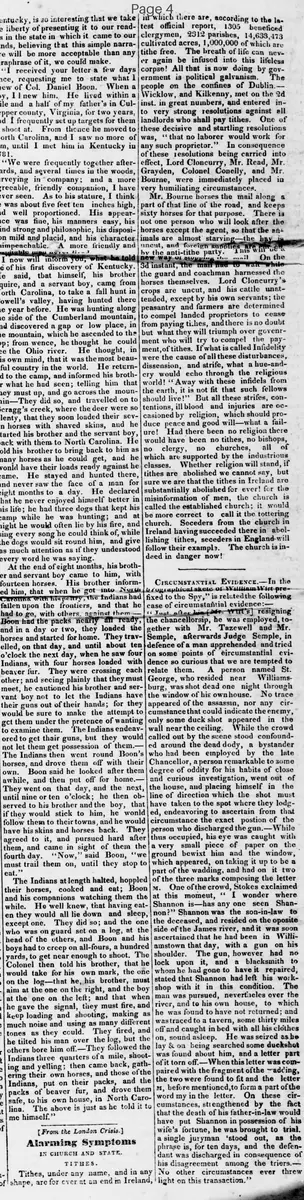
Tithes, under any name, and in any shape, are for ever at an end in Ireland, in which there are, according to the latest official report, 1305 beneficed clergymen, 2312 parishes, 14,633,473 cultivated acres, 1,000,000 of which are tithe free. The breath of life can never again be infused into this lifeless corpse! All that is now doing by government is political galvanism. The people on the confines of Dublin.—Wicklow, and Kilkenny, met on the 2d inst. in great numbers, and entered into very strong resolutions against all landlords who shall pay tithes. One of these decisive and startling resolutions was, "that no laborer would work for any such proprietor." In consequence of these resolutions being carried into effect. Lord Cloncurry, Mr. Read, Mr. Grayden, Colonel Conolly, and Mr. Bourne, were immediately placed in very humiliating circumstances.
Mr. Bourne horses the mail along a part of that line of the road, and keeps sixty horses for that purpose. There is not one person who will look after the horses except the agent, so that the animals are almost starving—the hay is cut, and foreign supplies stopped by the anti-tithe party. On the 3d instant, the mail had to wait while the guard and coachman harnessed the horses themselves. Lord Cloncurry's crops are uncut, and his cattle unattended, except by his own servants; the peasantry and farmers are determined to compel landed proprietors to cease from paying tithes, and there is no doubt but what they will triumph over government who will try to compel the payment, of tithes. If what is called Infidelity were the cause of all these disturbances, dissension, and strife, what a hue-and-cry would echo through the religious world! "Away with these infidels from the earth, it is not fit that such fellows should live!" But all these strifes, contentions, ill blood and injuries are occasioned by religion, which should produce peace and good will—what a failure! Had there been no religion there would have been no tithes, no bishops, no clergy, no churches, all of which are supported by the industrious classes.
Whether religion will stand, if tithes are abolished we cannot say, but sure we are that the tithes in Ireland are substantially abolished for ever! for the misinformation of men, the church is called the established church; it would be more correct to call it the tottering church. Seceders from the church in Ireland having succeeded there in abolishing tithes, seceders in England—will follow their example. The church is indeed in danger now!
What sub-type of article is it?
What keywords are associated?
What entities or persons were involved?
Where did it happen?
Foreign News Details
Primary Location
Ireland
Event Date
2d Inst. And 3d Instant
Key Persons
Outcome
tithes abolished forever in ireland; peasants triumph over government efforts to enforce payment; landlords face labor boycotts and humiliating circumstances.
Event Details
Tithes are declared ended in Ireland, with 1305 beneficed clergymen and 2312 parishes affected across 14,633,473 cultivated acres, 1,000,000 tithe-free. People near Dublin, Wicklow, and Kilkenny met on the 2d inst. to resolve against landlords paying tithes, including no laborers working for such proprietors. This impacts Lord Cloncurry, Mr. Read, Mr. Grayden, Colonel Conolly, and Mr. Bourne, whose operations suffer from lack of labor, leading to uncut crops, unattended cattle, and neglected mail horses. Peasants and farmers aim to compel proprietors to stop paying tithes, succeeding against government. The unrest is attributed to religion rather than infidelity, endangering the church.