Thank you for visiting SNEWPapers!
Sign up free
Gazette Of The United States And Daily Evening Advertiser
Philadelphia, Philadelphia County, Pennsylvania
What is this article about?
A letter to Mr. Phinney critiques a correspondent's justification of self-created Democratic Societies based on natural differences in human capacities, arguing it undermines representative democracy where sovereignty lies with the people via elections. References Burke-Paine debate and affirms constitutional democratic elements.
Clipping
OCR Quality
Full Text
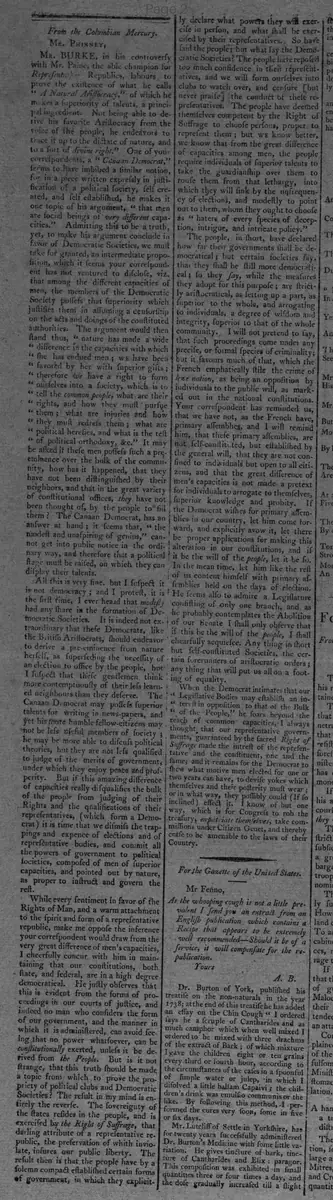
MR. PHINNEY,
MR. BURKE, in his controversy with Mr. Paine, the able champion for Representative Republics, labours to prove the existence of what he calls "A Natural Aristocracy," of which he makes a superiority of talents, a principal ingredient. Not being able to derive his favorite Aristocracy from the voice of the people, he endeavors to trace it up to the dictate of nature, and to a sort of divine right. One of your correspondents, a "Canaan Democrat," seems to have imbibed a similar notion, for in a piece written expressly in justification of a political society, self created, and self established, he makes it one topic of his argument, "that men are social beings of very different capacities." Admitting this to be a truth, yet, to make his argument conclude in favor of Democratic Societies, we must take for granted, an intermediate proposition, which it seems your correspondent has not ventured to disclose, viz. that among the different capacities of men, the members of the Democratic Society possess that superiority which justifies them in assuming a censorship on the acts and doings of the constituted authorities. The argument would then stand thus, "nature has made a wide difference in the capacities with which she has endued men; we have been favored by her with superior gifts; therefore we have a right to form ourselves into a society, which is to tell the common people, what are their rights, and how they must pursue them; what are injuries and how they must redress them; what are political heresies, and what is the test of political orthodoxy, &c." It may be asked if these men possess such a pre-eminence over the bulk of the community, how has it happened, that they have not been distinguished by their neighbors, and that in the great variety of constitutional offices, they have not been thought of, by the people to fill them? The Canaan Democrat, has an answer at hand; it seems that, "the modest and unassuming of genius," cannot get into public notice in the ordinary way, and therefore that a political stage must be raised, on which they can display their talents.
All this is very fine, but I suspect it is not democracy; and I protest, it is the first time, I ever heard that money had any share in the formation of Democratic Societies. It is indeed not extraordinary that these Democrats, like their British Aristocrats, should endeavor to derive a pre-eminence from nature herself, as superseding the necessity of an election to office by the people, but I suspect that these gentlemen think more contemptuously of their less learned neighbours than they deserve. The Canaan Democrat may possess superior talents for writing in news-papers, and yet his more humble fellow-citizens may not be less useful members of society; he may be more able to discuss political theories, but they are not less qualified to judge of the merits of government, under which they enjoy peace and prosperity. But if this amazing difference of capacities really disqualifies the bulk of the people from judging of their Rights and the qualifications of their representatives, (which form a Democrat) it is time that we dismiss the trappings and expense of elections and of representative bodies, and commit all the powers of government to political societies, composed of men of superior capacities, and pointed out by nature, as proper to instruct and govern the rest.
While every sentiment in favor of the Rights of Man, and a warm attachment to the spirit and form of a representative republic, make me oppose the inference your correspondent would draw from the very great difference of men's capacities, I cheerfully concur with him in maintaining that our constitutions, both state, and federal, are in a high degree democratical. He justly observes that this is evident from the forms of proceedings in our courts of justice, and indeed no man who considers the form of our government, and the manner in which it is administered, can avoid seeing that no power whatsoever, can be constitutionally exerted, unless it be derived from the People. But is it not strange, that this truth should be made a topic from which to prove the propriety of political clubs and Democratic Societies? The result in my mind is entirely the reverse. The sovereignty of the states resides in the people, and is exercised by the Right of Suffrage, that darling attribute of a representative republic, the preservation of which inviolate, insures our public liberty. The result then is that the people have by a solemn compact established certain forms of government, in which they explicitly declare what powers they will exer.
What sub-type of article is it?
What themes does it cover?
What keywords are associated?
What entities or persons were involved?
Letter to Editor Details
Recipient
Mr. Phinney
Main Argument
the letter argues against deriving a 'natural aristocracy' or superiority of capacities as justification for self-created democratic societies to censor authorities, emphasizing that in representative republics, sovereignty resides in the people exercised through elections, not in elite groups.
Notable Details