Thank you for visiting SNEWPapers!
Sign up free
Norfolk Gazette And Publick Ledger
Norfolk, Virginia
What is this article about?
A report from the Journal de Paris describes the revolutionary unrest in French provinces after Napoleon's return from Elba, detailing conspiracies against the Bourbons, calumnies, arrests, and threats of massacres halted by allied troops' advance. Written on July 6, 1815.
Clipping
OCR Quality
Full Text
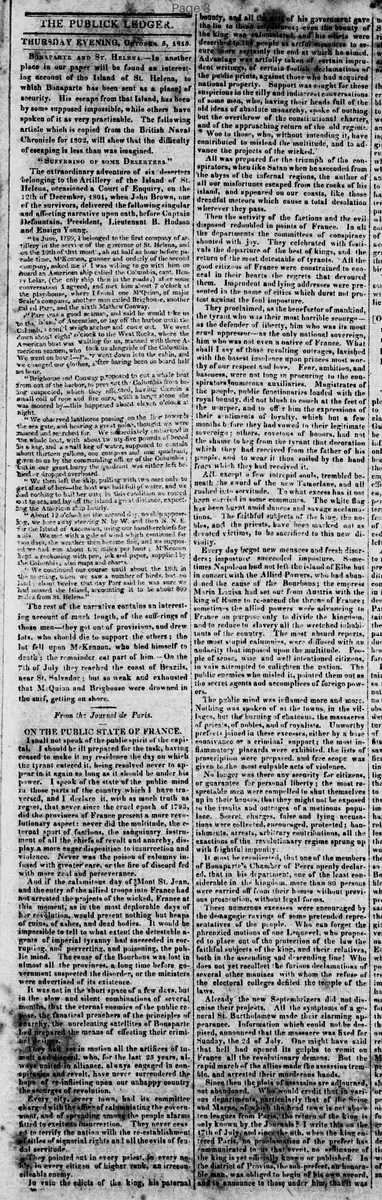
ON THE PUBLIC STATE OF FRANCE.
I shall not speak of the public spirit of the capital. I should be ill prepared for the task, having ceased to make it my residence the day on which the tyrant entered it, being resolved never to appear in it again so long as it should be under his power. I speak of the state of the public mind in those parts of the country which I have traversed, and I declare it, with as much truth as regret, that never since the crucial epoch of 1793, did the provinces of France present a more revolutionary aspect: never did the multitude, the eternal sport of factions, the sanguinary instrument of all the chiefs of revolt and anarchy, display a more eager disposition to insurrection and violence. Never was the poison of calumny infused with greater care, or the fire of discord fed with more zeal and perseverance.
And if the calamitous day of Mont St. Jean, and the entry of the allied troops into France had not arrested the projects of the wicked, France at this moment, as in the most deplorable days of her revolution, would present nothing but heaps of ruins of ashes, and dead bodies. It would be impossible to tell to what extent the detestable agents of imperial tyranny had succeeded in corrupting, and perverting, and poisoning, the public mind. The cause of the Bourbons was lost in almost all the provinces, a long time before government suspected the disorder, or the ministers were advertised of its existence.
It was not in the short space of a few days, but in the slow and silent combinations of several months, that the eternal enemies of the public repose, the fanatical preachers of the principles of anarchy, the unrelenting satellites of Bonaparte had prepared the means of effecting their criminal designs. They had put in motion all the artifices of tumult and discord: who, for the last 25 years, always united in alliance, always engaged in conspiracies and revolt, have never surrendered the hope of re-inflicting upon our unhappy country the scourges of revolution.
Every city, every town, had its committee charged with the office of calumniating the government, and of spreading among the people alarms fitted to excite to insurrection. They never ceased to terrify the nation with the re-establishment of seignorial rights and all the evils of feudal servitude.
They pointed out in every priest, in every noble, in every citizen of higher rank, an irreconcilable enemy.
In vain: the edicts of the king, his bounty, and all the acts of his government gave the lie to these impostures; even the bounty of the king was calumniated, and his edicts were described to the people as artful measures to secure more certainly the end at which he aimed.
Advantage was artfully taken of certain imprudent writings, of certain foolish declamations of the public prints, against those who had acquired national property. Support was sought for those suspicions in the silly and indiscreet conversations of some men, who, having their heads full of the old ideas of absolute monarchy, spoke of nothing but the overthrow of the constitutional charter, and of the approaching return of the old regime.
Woe to those, who, without intending it, have contributed to mislead the multitude, and to advance the projects of the wicked.
All was prepared for the triumph of the conspirators, when like Satan when he ascended from the abyss of the infernal regions, the author of all our misfortunes escaped from the rocks of his island, and appeared on our coasts, like those dreadful meteors which cause a total desolation wherever they pass.
Then the activity of the factions and the evil disposed redoubled in points of France. In all the departments the committees of conspiracy shouted with joy. They celebrated with festivals the departure of the best of kings, and the return of the most detestable of tyrants. All the good citizens of France were constrained to conceal in their hearts the regrets that devoured them. Imprudent and lying addresses were presented in the name of cities which durst not protest against the foul imposture.
They proclaimed, as the benefactor of mankind, the tyrant who was their most horrible scourge—as the defender of liberty, him who was its most cruel oppressor—as the only national sovereign, him who was not even a native of France. What shall I say of those revolting outrages, lavished with the basest insolence upon princes most worthy of our respect and love. Fear, ambition, and baseness, were not long in procuring to the conspirators numerous auxiliaries. Magistrates of the people, public functionaries loaded with the royal bounty, did not blush to crouch at the feet of the usurper, and to offer him the expressions of their sentiments of loyalty, which but a few months before they had vowed to their legitimate sovereign: others, covetous of honors, had not the shame to beg from the tyrant that decoration which they had received from the father of his people, and to wear it thus soiled by the hand from which they had received it.
All, except a few intrepid souls, trembled beneath the sword of the new Tamerlane, and all rushed into servitude. To what excess has it not been carried in some communes. The white flag has been burnt amid dances and savage acclamations. The faithful subjects of the king, the nobles, and the priests, have been marked out as devoted victims, to be sacrificed to this new divinity.
Every day I hear of new menaces and fresh disorders: imposture succeeded imposture. Sometimes Napoleon had not left the island of Elba but in concert with the Allied Powers, who had abandoned the cause of the Bourbons; the empress Marie Louisa had set out from Austria with the king of Rome to re-ascend the throne of France; sometimes the allied powers were advancing to France on purpose only to divide the kingdom, and to reduce to slavery all the wretched inhabitants of the country. The most absurd reports, the most stupid calumnies, were diffused with an audacity that imposed upon the multitude. People of sense, wise and well intentioned citizens, in vain attempted to enlighten the nation. The public enemies who misled it, pointed them out as the secret agents and accomplices of foreign powers.
The public mind was inflamed more and more. Nothing was spoken of at the towns, in the villages, but the burning of chateaus, the massacres of priests, of nobles, and of royalists. Unworthy prefects joined in these excesses, either by base connivance or a criminal support; the most inflammatory placards were exhibited, the lists of proscription were prepared, and free scope was given to the most culpable acts of violence.
No longer was there any security for citizens, or guarantee for personal liberty; the most respectable men were compelled to shut themselves up in their houses, that they might not be exposed to the insults and outrages of a mutinous populace. Secret charges, false and lying accusations were collected, encouraged, protected; banishments, arrests, arbitrary contributions, all the exactions of the revolutionary regime sprung up with frightful impunity.
It must be recollected, that one of the members of Bonaparte's Chamber of Peers openly declared, that in his department, one of the least considerable in the kingdom, more than 80 persons were carried off from their homes without previous prosecution, without legal forms.
These numerous excesses were encouraged by the demagogic ravings of some pretended representatives of the people.—Who can forget the frenzied motions of one Lequevel, who proposed to place out of the protection of the law the faithful subjects of the king, and their relatives, both in the ascending and descending line! Who does not yet recollect the furious declamations of several other maniacs with whom the refuse of the electoral colleges defiled the temple of the laws.
Already the new Septembrizers did not disguise their projects. All the symptoms of a general St. Bartholomew made their alarming appearance. Information which could not be despised, announced that the massacre was fixed for Sunday, the 2d of July. One might have said that hell had opened its gulphs to vomit on France all the revolutionary demons. But the rapid march of the allies made the assassins tremble, and arrested their murderous hands.
Since then the plots of assassins are adjourned, not abandoned. Who would credit that in various departments, particularly that of the Seine and Marne of which the head town is not above ten leagues from Paris the return of the king is only known by the Journals? I write this on the 6th of July and since the 5th, when the king entered Paris, no proclamation of the prefect has communicated to us that event, no ordinance of the king is yet officially known or published. In the district of Provins, the sub-prefect, an honorable man, was obliged to begin of his own accord, and to announce to those under him, that it was
What sub-type of article is it?
What keywords are associated?
What entities or persons were involved?
Where did it happen?
Foreign News Details
Primary Location
France
Event Date
On The 6th Of July
Key Persons
Outcome
more than 80 persons were carried off from their homes without previous prosecution; plots of assassins adjourned by the rapid march of the allies
Event Details
The author describes the revolutionary disposition in French provinces, conspiracies by Bonaparte's supporters to incite insurrection against the Bourbons through calumny and committees, celebrations of Napoleon's return, arrests, threats of massacres planned for July 2, halted by allied advance; written July 6 after king's entry on the 5th.