Thank you for visiting SNEWPapers!
Sign up free
National Gazette
Philadelphia, Philadelphia County, Pennsylvania
What is this article about?
Mr. Williamson's speech conclusion promotes foreign commerce to boost agriculture via export demand, proposes tonnage duties to encourage native seamen apprenticeships, and advocates localized hospital funds for sick seamen from wage deductions and duties. References North Carolina's similar law.
Clipping
OCR Quality
Full Text
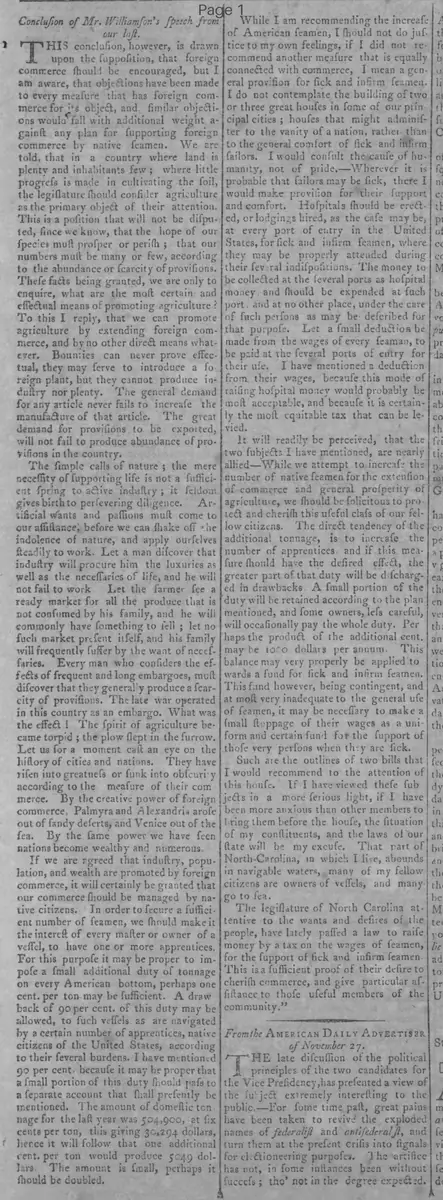
commerce should be encouraged, but I am aware, that objections have been made to every measure that has foreign commerce for its object, and similar objections would fall with additional weight against any plan for supporting foreign commerce by native seamen. We are told, that in a country where land is plenty and inhabitants few; where little progress is made in cultivating the soil, the legislature should consider agriculture as the primary object of their attention. This is a position that will not be disputed, since we know, that the hope of our species must prosper or perish; that our numbers must be many or few, according to the abundance or scarcity of provisions. These facts being granted, we are only to enquire, what are the most certain and effectual means of promoting agriculture? To this I reply, that we can promote agriculture by extending foreign commerce, and by no other direct means whatever. Bounties can never prove effectual, they may serve to introduce a foreign plant, but they cannot produce industry nor plenty. The general demand for any article never fails to increase the manufacture of that article. The great demand for provisions to be exported, will not fail to produce abundance of provisions in the country.
The simple calls of nature; the mere necessity of supporting life is not a sufficient spring to active industry; it seldom gives birth to persevering diligence. Artificial wants and passions must come to our assistance, before we can shake off the indolence of nature, and apply ourselves steadily to work. Let a man discover that industry will procure him the luxuries as well as the necessaries of life, and he will not fail to work. Let the farmer see a ready market for all the produce that is not consumed by his family, and he will commonly have something to sell; let no such market present itself, and his family will frequently suffer by the want of necessaries. Every man who considers the effects of frequent and long embargoes, must discover that they generally produce a scarcity of provisions. The late war operated in this country as an embargo. What was the effect! The spirit of agriculture became torpid; the plow slept in the furrow. Let us for a moment cast an eye on the history of cities and nations. They have risen into greatness or sunk into obscurity according to the measure of their commerce. By the creative power of foreign commerce, Palmyra and Alexandria arose out of sandy deserts, and Venice out of the sea. By the same power we have seen nations become wealthy and numerous. If we are agreed that industry, population, and wealth are promoted by foreign commerce, it will certainly be granted that our commerce should be managed by native citizens. In order to secure a sufficient number of seamen, we should make it the interest of every master or owner of a vessel, to have one or more apprentices. For this purpose it may be proper to impose a small additional duty of tonnage on every American bottom, perhaps one cent per ton may be sufficient. A drawback of 90 per cent. of this duty may be allowed, to such vessels as are navigated by a certain number of apprentices, native citizens of the United States, according to their several burdens. I have mentioned 90 per cent. because it may be proper that a small portion of this duty should pass to a separate account that shall presently be mentioned. The amount of domestic tonnage for the last year was 504,900, at six cents per ton, this giving 30,294 dollars, hence it will follow that one additional cent per ton would produce 5,049 dollars. The amount is small, perhaps it should be doubled.
While I am recommending the increase of American seamen, I should not do justice to my own feelings, if I did not recommend another measure that is equally connected with commerce, I mean a general provision for sick and infirm seamen. I do not contemplate the building of two or three great houses in some of our principal cities; houses that might administer to the vanity of a nation, rather than to the general comfort of sick and infirm sailors. I would consult the cause of humanity, not of pride. Wherever it is probable that sailors may be sick, there I would make provision for their support and comfort. Hospitals should be erected, or lodgings hired, as the case may be, at every port of entry in the United States, for sick and infirm seamen, where they may be properly attended during their several indispositions. The money to be collected at the several ports as hospital money, and should be expended at such port, and at no other place, under the care of such persons as may be described for that purpose. Let a small deduction be made from the wages of every seaman, to be paid at the several ports of entry for their use. I have mentioned a deduction from their wages, because this mode of raising hospital money would probably be most acceptable, and because it is certainly the most equitable tax that can be levied.
It will readily be perceived, that the two subjects I have mentioned, are nearly allied—While we attempt to increase the number of native seamen for the extension of commerce and general prosperity of agriculture, we should be solicitous to protect and cherish this useful class of our fellow citizens. The direct tendency of the additional tonnage, is to increase the number of apprentices, and if this measure should have the desired effect, the greater part of that duty will be discharged in drawbacks. A small portion of the duty will be retained according to the plan mentioned, and some owners, less careful, will occasionally pay the whole duty. Perhaps the product of the additional cent, may be 1,000 dollars per annum. This balance may very properly be applied towards a fund for sick and infirm seamen. This fund however, being contingent, and at most very inadequate to the general use of seamen, it may be necessary to make a small stoppage of their wages as a uniform and certain fund for the support of those very persons when they are sick. Such are the outlines of two bills that I would recommend to the attention of this house. If I have viewed these subjects in a more serious light, if I have been more anxious than other members to bring them before the house, the situation of my constituents, and the laws of our state will be my excuse. That part of North-Carolina, in which I live, abounds in navigable waters, many of my fellow citizens are owners of vessels, and many go to sea. The legislature of North Carolina attentive to the wants and desires of the people, have lately passed a law to raise money by a tax on the wages of seamen, for the support of sick and infirm seamen. This is a sufficient proof of their desire to cherish commerce, and give particular assistance to those useful members of the community.
What sub-type of article is it?
What themes does it cover?
What keywords are associated?
What entities or persons were involved?
Where did it happen?
Story Details
Key Persons
Location
United States, North Carolina
Story Details
Mr. Williamson concludes his speech advocating extension of foreign commerce to promote agriculture by creating demand for provisions, increasing native seamen through additional tonnage duties with drawbacks for apprentices, and establishing hospital provisions for sick and infirm seamen funded by wage deductions and duty remnants.