Thank you for visiting SNEWPapers!
Sign up free
Evening Times Republican
Marshalltown, Marshall County, Iowa
What is this article about?
Trans-Canadian Railway Company initiates reconnaissance survey led by G. W. Perry for a 2,830-mile route from Quebec to Port Simpson, Canada, bypassing Winnipeg and saving 248 miles over the existing Canadian Pacific line. Construction began in 1901; route through timber-rich, farmable territories.
Clipping
OCR Quality
Full Text
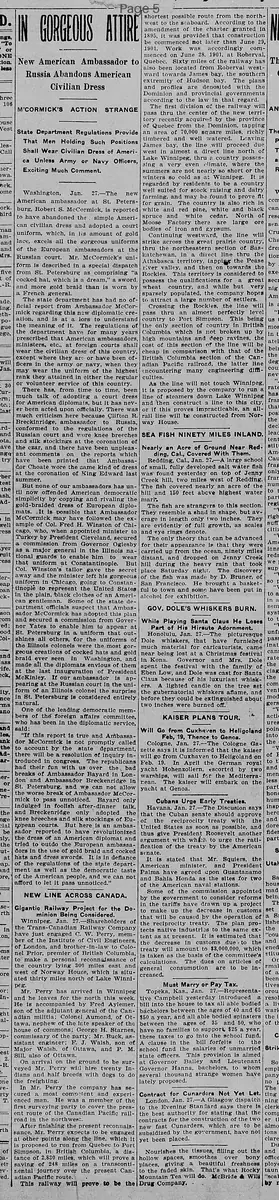
Gigantic Railway Project for the Dominion Being Considered.
Winnipeg, Jan. 27.—Shareholders of the Trans-Canadian Railway Company have just engaged G. W. Perry, member of the Institute of Civil Engineers, of London, and brother-in-law to Colonel Prior, premier of British Columbia, to make a personal reconnaissance of the country lying 300 miles east and west of Norway House, which is situated thirty miles north of Lake Winnipeg.
Mr. Perry has arrived in Winnipeg and he leaves for the north this week. He is accompanied by Fred Aylmer, son of the adjutant general of the Canadian militia; Colonel Aumond, of Ottawa, nephew of the late speaker of the house of commons; George H. Starnes, commissary of the party; Mr. Buck, assistant engineer; F. J. Walsh, son of Major Walsh, of Ottawa, and P. M. Sill, also of Ottawa.
On arrival on the ground to be surveyed Mr. Perry will hire twenty Indians and half breeds with dogs to do the freighting. In Mr. Perry, the company has secured a most competent and experienced man. He was a member of the first surveying party to cover the present route of the Canadian Pacific railroad in the northwest
After finishing the present reconnaissance, Mr. Perry expects to be engaged at other points along the line, which it is proposed to run from Quebec to Port Simpson, in British Columbia, a distance of 2,830 miles, which will prove a saving of 248 miles on a transcontinental journey over the present Canadian Pacific route.
This railway will prove to be the shortest possible route from the northwest to the seaboard. According to the amendment of the charter granted in 1895, it was provided that construction be commenced not later than June 29, 1901. Work was accordingly commenced on June 28, 1901, at Roberval, Quebec. Sixty miles of the railway has also been located from Roberval westward towards James bay, the southern extremity of Hudson bay. The plans and profiles are deposited with the Dominion and provincial governments according to the law in that regard.
The first division of the railway will pass thru the center of the new territory recently acquired by the province of Quebec from the Dominion, tapping an area of 70,000 square miles, richly timbered and well watered. Leaving James bay, the line will proceed due west in almost a direct line north of Lake Winnipeg, thru a country possessing a very even climate, where the summers are not nearly so short or the winters so cold as at Winnipeg. It is regarded by residents to be a country well suited for stock raising and dairy farming, and may be found to prove fit for grain.
The country is also rich in white and red pine, white and black spruce and white cedar. North of Moose Factory there are large ore bodies of iron and gypsum. Continuing westward, the line will strike across the great prairie country, thru the northeastern section of Saskatchewan, in a direct line thru the Athabasca territory, tapping the Peace river valley, and then on towards the Rockies.
This territory is considered to possess the qualifications for a great wheat country, and while but very sparsely populated, the company hopes to attract a large number of settlers. Crossing the Rockies, the line will pass thru an almost perfectly level country to Port Simpson. This being the only section of country in British Columbia which is not broken up by high mountains and deep ravines, the cost of this section of the line will be cheap in comparison with that of the British Columbia section of the Canadian Pacific railroad, the latter line encountering many engineering difficulties.
As the line will not touch Winnipeg, it is proposed by the company to run a line of steamers down Lake Winnipeg and then construct a line to this city, or if this proves impracticable, an all-rail line will be constructed from Norway House.
What sub-type of article is it?
What keywords are associated?
What entities or persons were involved?
Where did it happen?
Foreign News Details
Primary Location
Canada
Event Date
Jan. 27
Key Persons
Outcome
proposed 2,830-mile railway from quebec to port simpson, saving 248 miles over canadian pacific route; construction commenced june 28, 1901 at roberval, quebec; 60 miles located westward towards james bay.
Event Details
Shareholders of the Trans-Canadian Railway Company engaged G. W. Perry to reconnaissance 300 miles east and west of Norway House, north of Lake Winnipeg. Perry, arrived in Winnipeg, leaves this week with party including Fred Aylmer, Colonel Aumond, George H. Starnes, Mr. Buck, F. J. Walsh, and P. M. Sill. Will hire Indians and half-breeds for freighting. Perry experienced from Canadian Pacific survey. Line to run from Quebec to Port Simpson, through new Quebec territory, James Bay, north of Lake Winnipeg, Saskatchewan, Athabasca, Peace River Valley, Rockies to Port Simpson. Area rich in timber, minerals, suitable for farming and stock raising. Company to attract settlers. Plan for connection to Winnipeg via steamer or rail.