Thank you for visiting SNEWPapers!
Sign up free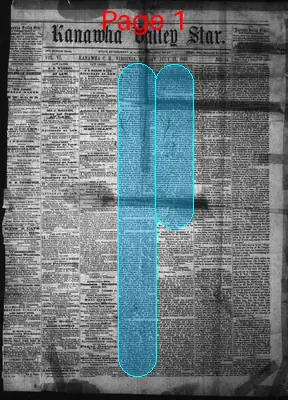
Kanawha Valley Star
Charleston, Kanawha County, West Virginia
What is this article about?
John C. Breckinridge accepts the Democratic nomination for President on July 9, 1860, following the Baltimore convention's unanimous selection on June 23. He endorses the platform emphasizing state equality, territorial rights, and constitutional protections for property, including slaves, while invoking divine providence for the Union.
Merged-components note: Merged split OCR components containing the full text of John C. Breckinridge's acceptance letter, which was parsed into two adjacent blocks due to column layout.
Clipping
OCR Quality
Full Text
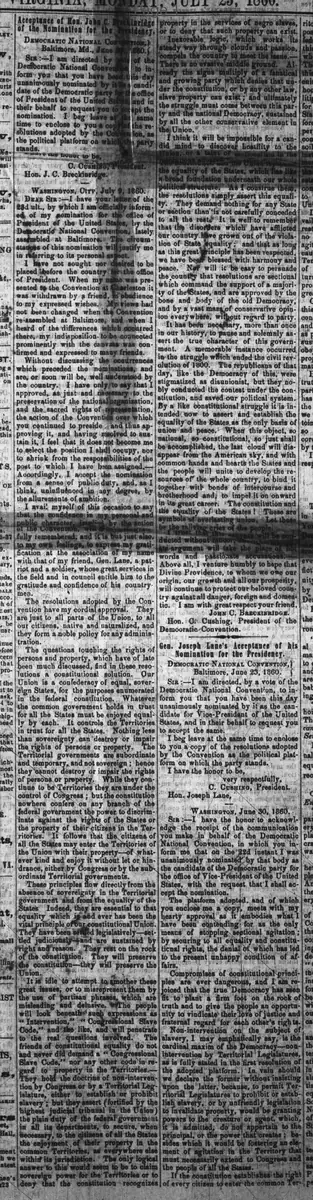
of the Nomination for the Presidency.
Democratic National Convention
Baltimore, Md., June 23, 1860.
Sir: I am directed by the Democratic National Convention to inform you that you have been this day unanimously nominated by it as the candidate of the Democratic party for the office of President of the United States, and in their behalf to request you to accept the nomination. I beg leave at the same time to enclose to you a copy of the resolutions adopted by the Convention, as the political platform on which the party stands.
I have the honor to be
Your obedient servant,
C. CUSHING, President.
Hon. J. C. Breckinridge.
Washington City, July 9, 1860.
Sir: I have your letter of the 23d ult., by which I am officially informed of my nomination for the office of President of the United States, by the Democratic National Convention, lately assembled at Baltimore. The circumstances of this nomination will justify me in referring to its personal aspect.
I have not sought nor desired to be placed before the country for the office of President. When my name was presented to the Convention at Charleston it was withdrawn by a friend, in obedience to my expressed wishes. My views had not been changed when the Convention re-assembled at Baltimore, and when I heard of the differences which occurred there, my indisposition to be connected prominently with the canvass was confirmed and expressed to many friends.
Without discussing the occurrences which preceded the nominations, and which are, or soon will be, well understood by the country, I have only to say that I approved, as just and necessary to the preservation of the national organization, and the sacred rights of representation, the action of the Convention over which you continued to preside, and thus approving it, and having resolved to sustain it, I feel that it does not become me to select the position I shall occupy, nor to shrink from the responsibilities of the post to which I have been assigned.
Accordingly, I accept the nomination from a sense of public duty, and, as I think, uninfluenced in any degree by the allurements of ambition.
I avail myself of this occasion to say that the confidence in my personal and public character, implied by the action of the Convention, is fully remembered, and it is but just also to my own feelings to express my gratification at the association of my name with that of my friend, Gen. Lane, a patriot and a soldier, whose great services in the field and in council entitle him to the gratitude and confidence of his countrymen.
The resolutions adopted by the Convention have my cordial approval. They are just to all parts of the Union, to all our citizens, native and naturalized, and they form a noble policy for any administration.
The questions touching the rights of persons and property, which have of late been much discussed, find in these resolutions a constitutional solution. Our Union is a confederacy of equal, sovereign States, for the purposes enumerated in the federal constitution. Whatever the common government holds in trust for all the States must be enjoyed equally by each. It controls the Territories in trust for all the States. Nothing less than sovereignty can destroy or impair the rights of persons or property. The Territorial governments are subordinate and temporary and not sovereign; hence they cannot destroy or impair the rights of persons or property. While they continue to be Territories they are under the control of Congress; but the constitution nowhere confers on any branch of the federal government the power to discriminate against the rights of the States or the property of their citizens in the Territories. It follows that the citizens of all the States may enter the Territories of the Union with their property--of whatever kind--and enjoy it without let or hindrance, either by Congress or by the subordinate Territorial governments.
These principles flow directly from the absence of sovereignty in the Territorial government and from the equality of the States. Indeed, they are essential to that equality which is and ever has been the vital principle of our constitutional Union. They have been settled legislatively--settled judiciously and are sustained by right and reason. They rest on the rock of the constitution. They will preserve the constitution--they will preserve the Union.
It is idle to attempt to smother these great issues, or to misrepresent them by the use of partisan phrases, which are misleading and delusive. The people will look beneath such expressions as "Intervention," "Congressional Slave Code," and the like, and will penetrate to the real questions involved. The friends of constitutional equality do not and never did demand a "Congressional Slave Code," nor any other code in regard to property in the Territories. They hold the doctrine of non-intervention by Congress or by a Territorial Legislature, either to establish or prohibit slavery; but they assert, fortified by the highest judicial tribunal in the Union, the plain duty of the federal government in all its departments, to secure, when necessary, to the citizens of all the States the enjoyment of their property in the common Territories, as everywhere else within its jurisdiction. The only logical answer to this would seem to be to claim sovereign power for the Territories or to deny that the constitution recognizes property in the services of negro slaves, or to deny that such property can exist. Inexorable logic, which works its steady way through clouds and passion, compels the country to meet the issue. There is no evasive middle ground. Already the signs multiply of a fanatical and growing party which denies that under the constitution or by any other law slave property can exist; and ultimately the struggle must come between this party and the national Democracy, sustained by all the other conservative elements in the Union.
I think it will be impossible for a candid mind to discover hostility to the Union, or a taint of sectionalism in the equality of the States, which lies like a broad foundation underneath our whole political structure. As I construe them, the resolutions simply assert this equality. They demand nothing for any State or section than is not carefully conceded to all the rest. It is well to remember that the disorders which have afflicted our country have grown out of the violation of State equality; and that as long as this great principle has been respected, we have been blessed with harmony and peace. Nor will it be easy to persuade the country that resolutions are sectional which command the support of a majority of the States, and are approved by the bone and body of the old Democracy, and by a vast mass of conservative opinion everywhere, without regard to party.
It has been necessary, more than once in our history, to pause and solemnly assert the true character of this government. A memorable instance occurred in the struggle which ended the civil revolution of 1800. The republicans of that day, like the Democracy of this, were stigmatized as disunionists, but they nobly conducted the contest under the constitution, and saved our political system. By a like constitutional struggle it is intended now to assert and establish the equality of the States as the only basis of union and peace. When this object, so national, so constitutional, so just shall be accomplished, the last cloud will disappear from the American sky, and with common hands and hearts the States and the people will unite to develop the resources of the whole country to bind it together with bonds of intercourse and brotherhood and, to impel it onward in its great career. The constitution and the equality of the States! These are symbols of everlasting union. Let these be the rallying cries of the people.
I trust that this canvas will be conducted without rancor, and that argument will take the place of not words and passionate accusations. Above all, I venture humbly to hope that Divine Providence, to whom we owe our origin, our growth and all our prosperity, will continue to protect our beloved country against all danger, foreign and domestic.
I am with great respect your friend and obedient servant,
JOHN C. BRECKINRIDGE.
Hon. C. Cushing, President of the Democratic Convention.
What sub-type of article is it?
What themes does it cover?
What keywords are associated?
What entities or persons were involved?
Where did it happen?
Story Details
Key Persons
Location
Baltimore, Md.; Washington City
Event Date
June 23, 1860; July 9, 1860
Story Details
C. Cushing informs Breckinridge of his unanimous nomination by the Democratic National Convention in Baltimore. Breckinridge accepts from a sense of duty, despite initial reluctance, endorses the platform on state equality and territorial property rights including slavery, and expresses hope for constitutional resolution and divine protection of the Union.