Thank you for visiting SNEWPapers!
Sign up free
Story
October 14, 1943
The Lexington Advertiser
Lexington, Holmes County, Mississippi
What is this article about?
Practical guide to substituting honey for sugar in baking: adjust liquids, bake low to avoid burning, minimize heating to retain flavor, and store sealed for longevity. Honey keeps baked goods moist due to hygroscopic nature.
Clipping
OCR Quality
95%
Excellent
Full Text
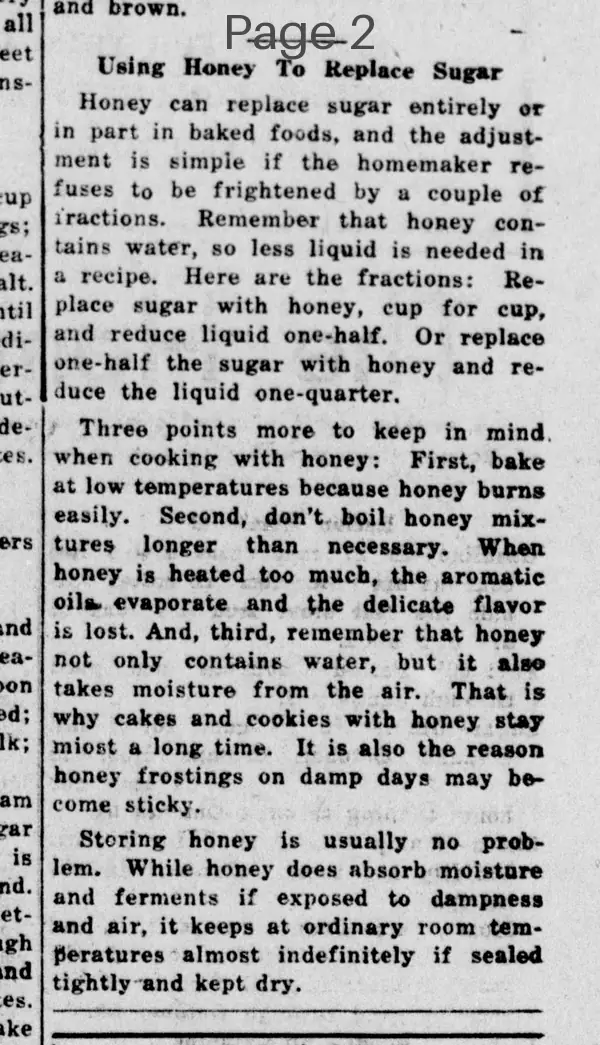
Using Honey To Replace Sugar
Honey can replace sugar entirely or in part in baked foods, and the adjustment is simple if the homemaker refuses to be frightened by a couple of fractions. Remember that honey contains water, so less liquid is needed in a recipe. Here are the fractions:
Replace sugar with honey, cup for cup, and reduce liquid one-half. Or replace one-half the sugar with honey and reduce the liquid one-quarter.
Three points more to keep in mind when cooking with honey: First, bake at low temperatures because honey burns easily. Second, don't boil honey mixtures longer than necessary. When honey is heated too much, the aromatic oils evaporate and the delicate flavor is lost. And, third, remember that honey not only contains water but it also takes moisture from the air. That is why cakes and cookies with honey stay moist a long time. It is also the reason honey frostings on damp days may become sticky.
Storing honey is usually no problem. While honey does absorb moisture and ferments if exposed to dampness and air, it keeps at ordinary room temperatures almost indefinitely if sealed tightly-and kept dry.
Honey can replace sugar entirely or in part in baked foods, and the adjustment is simple if the homemaker refuses to be frightened by a couple of fractions. Remember that honey contains water, so less liquid is needed in a recipe. Here are the fractions:
Replace sugar with honey, cup for cup, and reduce liquid one-half. Or replace one-half the sugar with honey and reduce the liquid one-quarter.
Three points more to keep in mind when cooking with honey: First, bake at low temperatures because honey burns easily. Second, don't boil honey mixtures longer than necessary. When honey is heated too much, the aromatic oils evaporate and the delicate flavor is lost. And, third, remember that honey not only contains water but it also takes moisture from the air. That is why cakes and cookies with honey stay moist a long time. It is also the reason honey frostings on damp days may become sticky.
Storing honey is usually no problem. While honey does absorb moisture and ferments if exposed to dampness and air, it keeps at ordinary room temperatures almost indefinitely if sealed tightly-and kept dry.
What sub-type of article is it?
Cooking Guide
Practical Advice
What keywords are associated?
Honey Substitution
Sugar Replacement
Baking Adjustments
Honey Storage
Culinary Tips
Story Details
Story Details
Honey can replace sugar cup for cup in baked foods, reducing liquid by half, or half the sugar with quarter liquid reduction. Bake at low temperatures, avoid over-boiling to preserve flavor, and note honey's moisture absorption keeps baked goods moist but may make frostings sticky. Store sealed tightly to prevent fermentation.