Thank you for visiting SNEWPapers!
Sign up free
Danbury Times
Danbury, Fairfield County, Connecticut
What is this article about?
Historical account of Christopher Columbus's remains, initially buried in Spain in 1506, moved to Hispaniola in 1536, and to Havana, Cuba in 1796, where a statue honors him.
Clipping
OCR Quality
Full Text
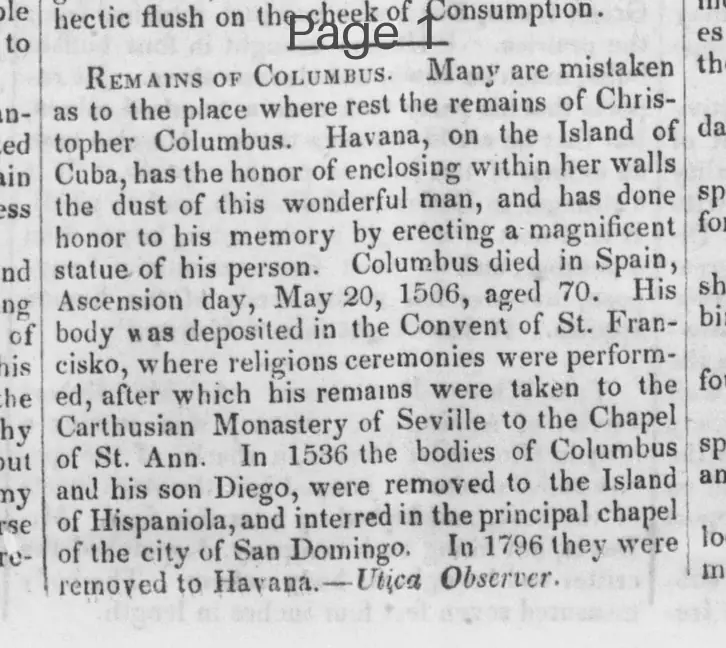
as to the place where rest the remains of Christopher
Columbus. Havana, on the Island of
Cuba, has the honor of enclosing within her walls
the dust of this wonderful man, and has done
honor to his memory by erecting a magnificent
statue of his person. Columbus died in Spain.
Ascension day, May 20, 1506, aged 70. His
body was deposited in the Convent of St. Francis-
co, where religious ceremonies were performed,
after which his remains were taken to the
Carthusian Monastery of Seville to the Chapel
of St. Ann. In 1536 the bodies of Columbus
and his son Diego, were removed to the Island
of Hispaniola, and interred in the principal chapel
of the city of San Domingo. In 1796 they were
removed to Havana.—Utica Observer.
What sub-type of article is it?
What keywords are associated?
What entities or persons were involved?
Where did it happen?
Domestic News Details
Primary Location
Havana, Island Of Cuba
Event Date
May 20, 1506
Key Persons
Outcome
columbus died aged 70; remains moved multiple times and interred in havana
Event Details
Many are mistaken as to the place where rest the remains of Christopher Columbus. Havana, on the Island of Cuba, has the honor of enclosing within her walls the dust of this wonderful man, and has done honor to his memory by erecting a magnificent statue of his person. Columbus died in Spain. Ascension day, May 20, 1506, aged 70. His body was deposited in the Convent of St. Francisco, where religious ceremonies were performed, after which his remains were taken to the Carthusian Monastery of Seville to the Chapel of St. Ann. In 1536 the bodies of Columbus and his son Diego, were removed to the Island of Hispaniola, and interred in the principal chapel of the city of San Domingo. In 1796 they were removed to Havana.—Utica Observer.