Thank you for visiting SNEWPapers!
Sign up free
The Rhode Island Republican
Newport, Newport County, Rhode Island
What is this article about?
Escaped US pilot Abraham Walter's 1813 affidavit details British capture of sloops Growler and Eagle on Lake Champlain, harsh Quebec imprisonment, forced service of prisoners, seizure of officers under Prince Regent's order, and dire conditions causing deaths. (214 characters)
Merged-components note: Direct text continuation across pages 1 and 2 of a report on the treatment of American prisoners by British forces during the war.
Clippings
1 of 2
OCR Quality
Full Text
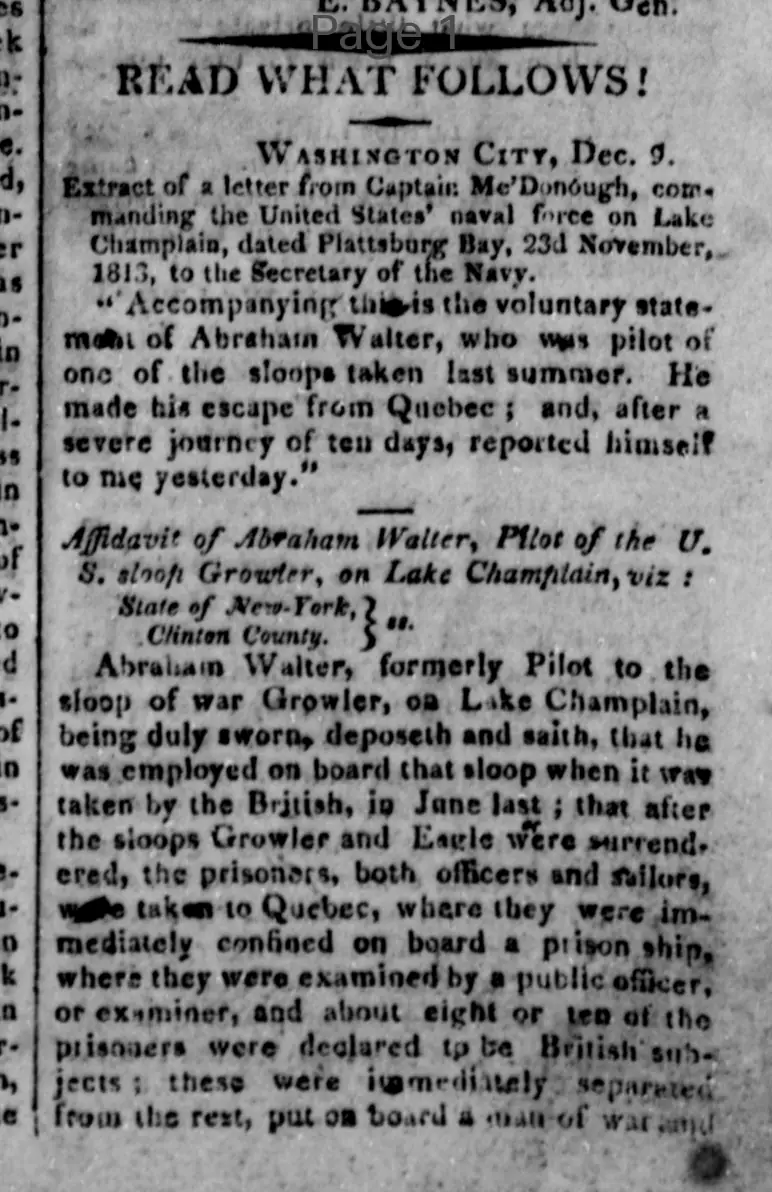
Washington City, Dec. 9.
Extract of a letter from Captain McDonough, commanding the United States' naval force on Lake Champlain, dated Plattsburg Bay, 23d November, 1813, to the Secretary of the Navy.
"Accompanying this is the voluntary statement of Abraham Walter, who was pilot of one of the sloops taken last summer. He made his escape from Quebec; and, after a severe journey of ten days, reported himself to me yesterday."
Affidavit of Abraham Walter, Pilot of the U.S. sloop Growler, on Lake Champlain, viz:
State of New-York,
Clinton County.
Abraham Walter, formerly Pilot to the sloop of war Growler, on Lake Champlain, being duly sworn, deposeth and saith, that he was employed on board that sloop when it was taken by the British, in June last; that after the sloops Growler and Eagle were surrendered, the prisoners, both officers and sailors, were taken to Quebec, where they were immediately confined on board a prison ship, where they were examined by a public officer, or examiner, and about eight or ten of the prisoners were declared to be British subjects; these were immediately, separated from the rest, put on board a man of war and Sent to England, to be tried for treason. One of those was known to be a native of New-Hampshire, by Capt. Herrick, of the New-Hampshire volunteers, who was also a prisoner, and who had known him from his infancy; and several of the rest were declared by others of their acquaintances, to be native citizens of the United States. These representations were unavailing with British officers who commanded, and they were torn thus from their companions, to defend themselves against the charge of treason in England. The residue were still confined to their prison ships, in a situation more disagreeable than can well be imagined. Some time after a number of British vessels were wishing to proceed to Halifax, the crews of which had mostly been pressed out of them to fight the American forces on the Upper Lakes and seamen were wanted to supply their place. Governor Prevost sent an order to General Glasgow, who then commanded there, directing him to proceed on board the prison ship, and to induce the prisoners to volunteer to man their fleet for Halifax, and in case they refused to comply, to force them on board for that purpose. The application was made, but the American prisoners, considering the measure unjustifiable towards their own government, refused to volunteer: And were accordingly forced on board their vessels by a British press gang, whom this deponent understood they had quarters assigned them, and were compelled to assist in navigating British vessels to Halifax, and afterwards to England, as this deponent has since been informed. And further, that not one of the seamen who were prisoners there, were excepted from this proceeding, and that General Winchester made request to write to our government to explain that transaction, but could not obtain permission.
And this deponent further saith, that in the beginning of the present month of November an order was received, in conformity to the Prince Regent's order or proclamation, to seize forty-six American officers and non-commission officers, who were not prisoners of war, and to imprison them to be kept in close confinement agreeably to the tenor of that proclamation. Prisoners to that number, most of whom were officers there on their parole, many of them in a delicate state of health, were immediately put under arrest, and marched guarded, to the public prison, and immersed, for what fate to him unknown. Among those destined for close confinement, are Lieut. Smith, then in a declining state of health; and Dr. James W. Wood, a citizen of Champlain, who was taken from his house, while in the employment of the Revenue, but as this deponent believes, no way connected with the army; they were imprisoned on the 5th Nov. inst.
This deponent further saith, that the enemy has uniformly, at that place, treated American prisoners, both officers and privates, with extreme rigour; that sometime since an American midshipman and two master's mates, merely for having proceeded on a party, for pleasure, about half a mile beyond the limits assigned them, though they immediately returned within them, were seized and put into prison, and kept in irons till the general imprisonment of officers and non-commissioned officers, as above related, took place; and this deponent further saith, that all that was allowed for the Americans on board the prison-ship, was daily one pound of old wormy bread, which the inhabitants declared had been twice in the West-Indies, and condemned for spoiled bread; and one pound of exceedingly bad meat, which in almost any situation would be absolutely not eatable: No liquor; no soap, to prevent themselves from becoming lousy; no candles, and none of the other comforts of life; And it was the opinion of all the prisoners there, that many of them who had died, had actually starved to death, not being able to eat the provisions.
And further, that on the receipt of the Prince Regent's Proclamation, Capt. Gardner, the American Agent there, who had been occupied in paying the sick and privates for their services, was immediately ordered by Gov. Prevost. to consider himself confined to the same limits which were assigned for the officers at Beauharnois; and when this deponent left the place, he was still compelled to remain with Gen. Winchester and others, and was not permitted to visit the prisoners, who were in distress on board the prison ship, or to go into town to negotiate his bills for the relief of officers. And had already been obliged to share what little private money he had with him among them for their temporary relief.
This deponent further saith, that he started from the neighborhood of Quebec, and came by the way of Derby in Vermont, and arrived at this place two days since; and further this deponent saith not.
ABRAHAM WALTER.
Sworn before me, this 23d day of November, 1813.
HENRY DELERY,
One of the Judges of the Court of Common Pleas in and for the County of Clinton.
What sub-type of article is it?
What themes does it cover?
What keywords are associated?
What entities or persons were involved?
Where did it happen?
Story Details
Key Persons
Location
Lake Champlain, Quebec, Halifax, England, Derby In Vermont, Clinton County, New York
Event Date
June 1813 To November 1813
Story Details
Abraham Walter, pilot of the US sloop Growler captured by British in June 1813 on Lake Champlain, describes imprisonment in Quebec, separation of alleged British subjects for trial in England, forced conscription of prisoners into British service to Halifax and England, seizure of 46 American officers and non-commissioned officers for close confinement per Prince Regent's proclamation in early November 1813, harsh conditions including spoiled food leading to starvation deaths, and restrictions on the American Agent; Walter escaped after ten days' journey and reported on 23 November 1813.