Thank you for visiting SNEWPapers!
Sign up free
Vermont Watchman And State Journal
Montpelier, Washington County, Vermont
What is this article about?
British House of Commons committee reports that Jamaica's apprenticeship system post-slavery is progressing favorably, with apprentices showing good conduct and effective labor. Joseph Sturge's letter from Antigua praises immediate abolition's success after two years, noting improvements despite remaining issues like provisions for the aged.
Clipping
OCR Quality
Full Text
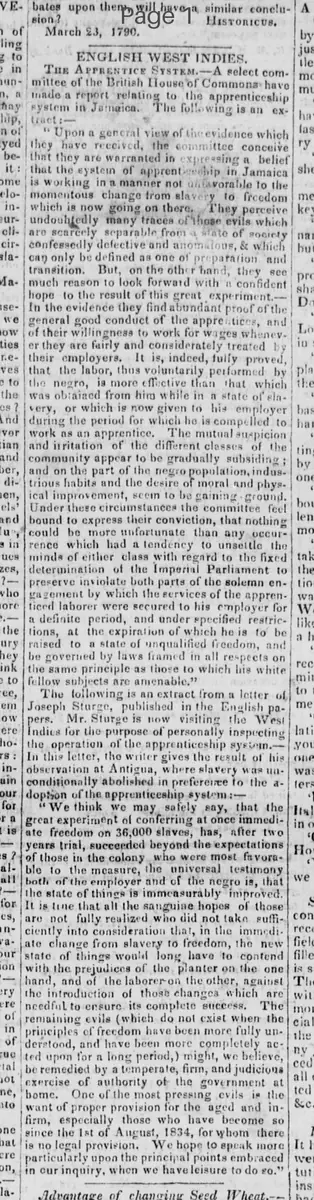
The Apprentice System.-A select committee of the British House of Commons have made a report relating to the apprenticeship system in Jamaica. The following is an extract:-
" Upon a general view of the evidence which they have received, the committee conceive that they are warranted in expressing a belief that the system of apprenticeship in Jamaica is working in a manner not unfavorable to the momentous change from slavery to freedom which is now going on there. They perceive undoubtedly many traces of those evils which are scarcely separable from a state of society confessedly defective and anomalous, & which can only be defined as one of preparation and transition. But, on the other hand, they see much reason to look forward with a confident hope to the result of this great experiment.- In the evidence they find abundant proof of the general good conduct of the apprentices, and of their willingness to work for wages whenever they are fairly and considerately treated by their employers. It is, indeed, fully proved, that the labor, thus voluntarily performed by the negro, is more effective than that which was obtained from him while in a state of slavery, or which is now given to his employer during the period for which he is compelled to work as an apprentice. The mutual suspicion and irritation of the different classes of the community appear to be gradually subsiding: and on the part of the negro population, industrious habits and the desire of moral and physical improvement, seem to be gaining ground. Under these circumstances the committee feel bound to express their conviction, that nothing could be more unfortunate than any occurrence which had a tendency to unsettle the minds of either class with regard to the fixed determination of the Imperial Parliament to preserve inviolate both parts of the solemn engagement by which the services of the apprenticed laborer were secured to his employer for a definite period, and under specified restrictions, at the expiration of which he is to be raised to a state of unqualified freedom, and be governed by laws framed in all respects on the same principle as those to which his white fellow subjects are amenable."
The following is an extract from a letter of Joseph Sturge, published in the English papers. Mr. Sturge is now visiting the West Indies for the purpose of personally inspecting the operation of the apprenticeship system.-- In this letter, the writer gives the result of his observation at Antigua, where slavery was unconditionally abolished in preference to the adoption of the apprenticeship system:-
"We think we may safely say, that the great experiment of conferring at once immediate freedom on 36,000 slaves, has, after two years trial, succeeded beyond the expectations of those in the colony who were most favorable to the measure, the universal testimony both of the employer and of the negro is, that the state of things is immeasurably improved. It is true that all the sanguine hopes of those are not fully realized who did not take sufficiently into consideration that, in the immediate change from slavery to freedom, the new state of things would long have to contend with the prejudices of the planter on the one hand, and of the laborer-on the other, against the introduction of those changes which are needful to ensure its complete success. The remaining evils (which do not exist when the principles of freedom have been more fully understood, and have been more completely acted upon for a long period,) might, we believe, be remedied by a temperate, firm, and judicious exercise of authority of the government at home. One of the most pressing evils is the want of proper provision for the aged and infirm, especially those who have become so since the 1st of August, 1834, for whom there is no legal provision. We hope to speak more particularly upon the principal points embraced in our inquiry, when we have leisure to do so."
What sub-type of article is it?
What keywords are associated?
What entities or persons were involved?
Where did it happen?
Foreign News Details
Primary Location
English West Indies
Key Persons
Outcome
apprenticeship system in jamaica working favorably toward freedom; immediate abolition in antigua succeeded beyond expectations after two years, with improvements in labor and conduct, though issues like provisions for aged remain.
Event Details
British House of Commons committee reports on Jamaica's apprenticeship system, noting good apprentice conduct, effective voluntary labor, subsiding tensions, and hopes for success in transition from slavery. Joseph Sturge's letter from Antigua describes successful immediate emancipation of 36,000 slaves, with universal testimony of improvement despite prejudices and need for government remedies on provisions for aged and infirm since August 1, 1834.