Thank you for visiting SNEWPapers!
Sign up free
Story
April 6, 1877
The Wheeling Daily Register
Wheeling, Ohio County, West Virginia
What is this article about?
Curious Chinese remedies from animal parts, like dried lizards for skin diseases and tiger skulls for typhoid, selected from drugs at the Centennial Exposition, as reported in the New York Tribune.
Clipping
OCR Quality
95%
Excellent
Full Text
After Blue Glass—What?
From the New York Tribune.
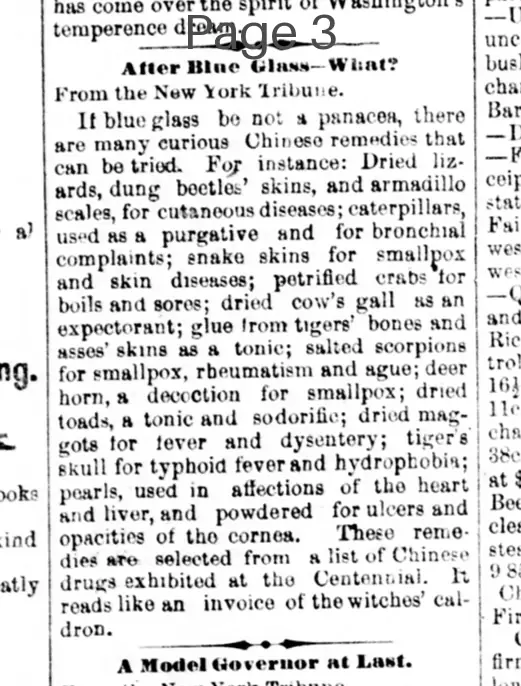
If blue glass be not a panacea, there are many curious Chinese remedies that can be tried. For instance: Dried lizards, dung beetles' skins, and armadillo scales, for cutaneous diseases; caterpillars, used as a purgative and for bronchial complaints; snake skins for smallpox and skin diseases; petrified crabs for boils and sores; dried cow's gall as an expectorant; glue from tigers' bones and asses' skins as a tonic; salted scorpions for smallpox, rheumatism and ague; deer horn, a decoction for smallpox; dried toads, a tonic and sudorific; dried maggots for fever and dysentery; tiger's skull for typhoid fever and hydrophobia; pearls, used in affections of the heart and liver, and powdered for ulcers and opacities of the cornea.
These remedies are selected from a list of Chinese drugs exhibited at the Centennial. It reads like an invoice of the witches' caldron.
From the New York Tribune.
If blue glass be not a panacea, there are many curious Chinese remedies that can be tried. For instance: Dried lizards, dung beetles' skins, and armadillo scales, for cutaneous diseases; caterpillars, used as a purgative and for bronchial complaints; snake skins for smallpox and skin diseases; petrified crabs for boils and sores; dried cow's gall as an expectorant; glue from tigers' bones and asses' skins as a tonic; salted scorpions for smallpox, rheumatism and ague; deer horn, a decoction for smallpox; dried toads, a tonic and sudorific; dried maggots for fever and dysentery; tiger's skull for typhoid fever and hydrophobia; pearls, used in affections of the heart and liver, and powdered for ulcers and opacities of the cornea.
These remedies are selected from a list of Chinese drugs exhibited at the Centennial. It reads like an invoice of the witches' caldron.
What sub-type of article is it?
Curiosity
Medical Curiosity
What themes does it cover?
Recovery
Nature
What keywords are associated?
Chinese Remedies
Dried Lizards
Snake Skins
Tiger Bones
Centennial Exposition
Medical Curiosities
Animal Medicines
Dung Beetles
Salted Scorpions
Dried Toads
Where did it happen?
Centennial
Story Details
Location
Centennial
Event Date
The Centennial
Story Details
List of curious Chinese remedies using animal and insect parts for various diseases, selected from drugs exhibited at the Centennial, including dried lizards for cutaneous diseases, salted scorpions for smallpox and rheumatism, and pearls for heart and liver affections.