Thank you for visiting SNEWPapers!
Sign up free
Imperial Valley Press
El Centro, Imperial County, California
What is this article about?
The Bureau of Labor Statistics reports on 1940 strikes: 2,500 incidents involving 577,000 workers and 6.7 million man-days lost, lower than prior years. Half sought union recognition; 27% won full demands, with government mediation in 43% of cases. Defense industries saw 252 strikes affecting 1 in 17 workers.
Clipping
OCR Quality
Full Text
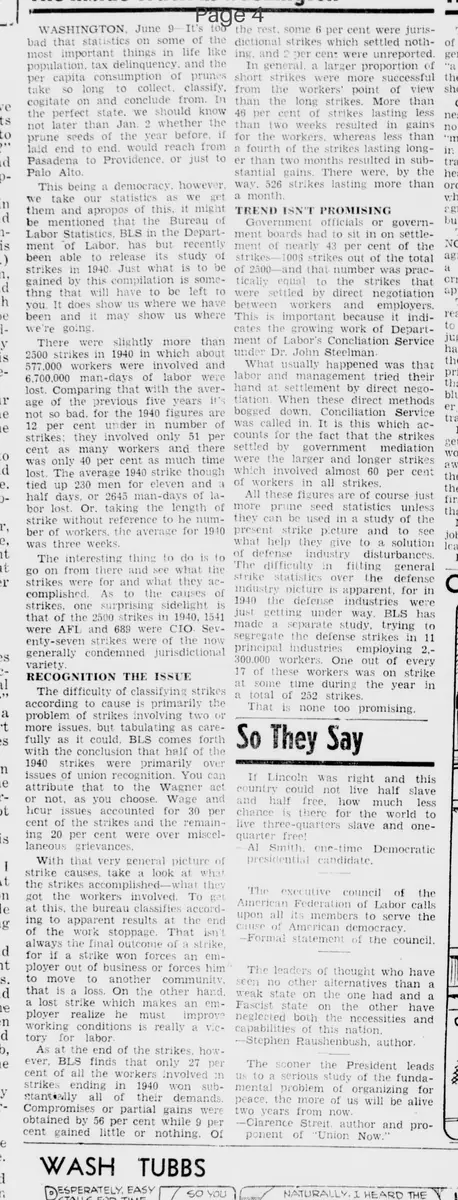
This being a democracy, however, we take our statistics as we get them and apropos of this, it might be mentioned that the Bureau of Labor Statistics, BLS in the Department of Labor, has but recently been able to release its study of strikes in 1940. Just what is to be gained by this compilation is something that will have to be left to you. It does show us where we have been and it may show us where we're going.
There were slightly more than 2500 strikes in 1940 in which about 577,000 workers were involved and 6,700,000 man-days of labor were lost. Comparing that with the average of the previous five years it's not so bad, for the 1940 figures are 12 per cent under in number of strikes; they involved only 51 per cent as many workers and there was only 40 per cent as much time lost. The average 1940 strike though tied up 230 men for eleven and a half days, or 2645 man-days of labor lost. Or, taking the length of strike without reference to the number of workers, the average for 1940 was three weeks.
The interesting thing to do is to go on from there and see what the strikes were for and what they accomplished. As to the causes of strikes, one surprising sidelight is that of the 2500 strikes in 1940, 1541 were AFL and 689 were CIO. Seventy-seven strikes were of the now generally condemned jurisdictional variety.
RECOGNITION THE ISSUE
The difficulty of classifying strikes according to cause is primarily the problem of strikes involving two or more issues, but tabulating as carefully as it could, BLS comes forth with the conclusion that half of the 1940 strikes were primarily over issues of union recognition. You can attribute that to the Wagner act or not, as you choose. Wage and hour issues accounted for 30 per cent of the strikes and the remaining 20 per cent were over miscellaneous grievances.
With that very general picture of strike causes, take a look at what the strikes accomplished—what they got the workers involved. To get at this, the bureau classifies according to apparent results at the end of the work stoppage. That isn't always the final outcome of a strike, for if a strike won forces an employer out of business or forces him to move to another community, that is a loss. On the other hand, a lost strike which makes an employer realize he must improve working conditions is really a victory for labor.
As at the end of the strikes, however, BLS finds that only 27 per cent of all the workers involved in strikes ending in 1940 won substantially all of their demands. Compromises or partial gains were obtained by 56 per cent while 9 per cent gained little or nothing. Of the rest, some 6 per cent were jurisdictional strikes which settled nothing, and 2 per cent were unreported.
In general, a larger proportion of short strikes were more successful from the workers' point of view than the long strikes. More than 46 per cent of strikes lasting less than two weeks resulted in gains for the workers, whereas less than a fourth of the strikes lasting longer than two months resulted in substantial gains. There were, by the way, 526 strikes lasting more than a month.
TREND ISN'T PROMISING
Government officials or government boards had to sit in on settlement of nearly 43 per cent of the strikes—1085 strikes out of the total of 2500—and that number was practically equal to the strikes that were settled by direct negotiation between workers and employers.
This is important because it indicates the growing work of Department of Labor's Conciliation Service under Dr. John Steelman.
What usually happened was that labor and management tried their hand at settlement by direct negotiation. When these direct methods bogged down, Conciliation Service was called in. It is this which accounts for the fact that the strikes settled by government mediation were the larger and longer strikes which involved almost 60 per cent of workers in all strikes.
All these figures are of course just more prune seed statistics unless they can be used in a study of the present strike picture and to see what help they give to a solution of defense industry disturbances.
The difficulty in fitting general strike statistics over the defense industry picture is apparent, for in 1940 the defense industries were just getting under way. BLS has made a separate study, trying to segregate the defense strikes in 11 principal industries employing 2,300,000 workers. One out of every 17 of these workers was on strike at some time during the year in a total of 252 strikes.
That is none too promising.
What sub-type of article is it?
What themes does it cover?
What keywords are associated?
What entities or persons were involved?
Where did it happen?
Story Details
Key Persons
Location
United States
Event Date
1940
Story Details
The BLS study details 2,500 strikes in 1940 involving 577,000 workers, with causes primarily union recognition (50%), wages/hours (30%), and grievances (20%). Outcomes: 27% full wins, 56% partial, 9% losses. Government mediated 43%, especially larger strikes. Defense sector had 252 strikes affecting 1 in 17 workers.