Thank you for visiting SNEWPapers!
Sign up free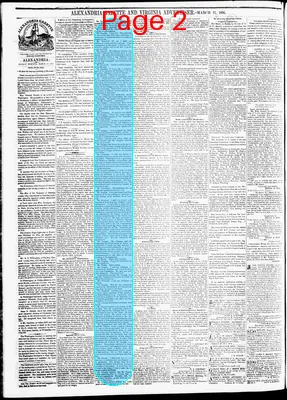
Alexandria Gazette
Alexandria, Alexandria County, District Of Columbia
What is this article about?
U.S. Senate debate on March 11 where Mr. Trumbull defended the Emigrant Aid Society and the minority Kansas report. Heated exchanges ensued between Senators Trumbull and Douglas over Illinois politics, Know-Nothings, Abolitionists, and the Nebraska bill, involving accusations of libel and unfairness. Other senators like Crittenden and Sumner interjected.
Clipping

OCR Quality
Full Text
Mr. Trumbull resumed his remarks, and proceeded to defend the Emigrant Aid Society, sustaining the positions of the minority Kansas report generally.
Mr. Wade asked Mr. Trumbull to yield the floor for an adjournment.
Mr. Douglas. I hope not. The courtesies of the Senate have been taken advantage of on account of my known absence to make an assault on me.
Mr. Trumbull. No, sir; I knew not whether you were present or absent. I was commenting on the report. I did not introduce the subject, nor know that it would come up to-day.
Mr. Douglas. My colleague dares to say in face of fact that he did not know I was absent. He acted with unfairness in attacking the report when I was detained from the Senate by ill health. I would ask him within what reasonable time will his speech be printed?
Mr. Trumbull. I think it will be published by Monday.
Mr. Douglas. If I can ask a postponement of the question till Monday, I will reply to my colleague's speech on Tuesday.
Mr. Seward. Take your own time
Mr. Douglas, quickly-I understand that game. "Take your own time." The Senator from Massachusetts took his own time to write and circulate a libel on me about the time the Nebraska bill was reported. I understood my colleague to say that he came here a Democrat. That will be news to the Democracy of Illinois, and is a libel on the Democracy of that State.
Mr. Crittenden here interposed, saying that the debate was transcending the rules of decorum. The Senator had charged a libel on Mr. Trumbull. Sensation.
Mr. Douglas. I should have been better satisfied if the Senator from Kentucky, had, when the Black Republicans denounced us in coarse terms, rebuked them for want of courtesy.
Mr. Crittenden. To what do you allude?
Mr. Douglas. When they made vulgar, coarse partisan assaults on the Democratic side of the Senate.
Mr. Crittenden. It was no more my business than that of others to call Senators to order for personalties. This is not the place for vituperation. It should be settled elsewhere.
Mr. Douglas. I do not regard the Senator as good authority in Illinois politics. I was speaking of events of which I am better capable of judging than he.
Further colloquy took place, when the Chair decided that Mr. Douglas' remarks were not personal.
Mr. Douglas said that so far as he was advised and believed, his colleague was the candidate of the miserable sect of Abolitionists and Know-Nothings, which are one and the same thing.
Mr. Crittenden. I wish the Senator to understand that I co-operate with the American party. Standing here as a gentleman and Senator in absolute independence and claiming all respect due to honesty as a free man, I repel with scorn every imputation of that kind as intended to embrace me and my political associates.
Mr. Douglas explained-I spoke of what Know-Nothingism is in Illinois, and said it might be otherwise in the South. Every Know-Nothing Lodge in Illinois adopted the abolition creed, and that is the miserable faction that sent my colleague here. The Senator from Kentucky misunderstood me, else he would not have conceived my remark as personal to him.
Mr. Crittenden. The gentleman did not make the qualification he now does.
Mr. Douglas. Every gentleman must have understood me as making the distinction; I said nothing about Southern Know Nothings.
Mr. Trumbull, I shall not permit such remarks as those from my colleague to pass unanswered. I shall suffer no man, here or elsewhere, to state of me things which are absolutely, totally unfounded." If he means to say that I am or ever have been a Know-Nothing or connected with any secret political organization, the charge is basely-I will not violate the rule of the Senate, but I will say untrue! He then proceeded to speak of the politics of Illinois, claiming that she is and always has been a Democratic State; and in the 8th Congressional District, which gave Mr. Pierce nearly five thousand majority, he (Mr. Trumbull) was elected a member of the House by more than 2,600 majority. He ran as an Anti-Nebraska candidate. How did his colleague know that he received every Know Nothing and Abolition vote? He (Mr. Trumbull) did not know it.
Mr. Douglas. My colleague said the reason why he did not accept, at Salem, my proposition to resign our seats last year to test by a re-election whether he or I represented Illinois, was that Governor Mattison would appoint me and another Democrat to fill the vacancies. I tell him I will sign my resignation now to take effect at the next meeting of the Legislature.
Mr. Brown. That's right Douglas.
Mr. Douglas. I'll give till Monday morning to think of it
Mr. Weller. That's better.
Mr. Douglas. I said my colleague received every Abolition and Know-Nothing vote in the Legislature. He dare not deny that statement. Why equivocate?
In his further remarks, Mr. Douglas said that Mr. Trumbull had become the Chief of Black Republicanism.
Mr. Trumbull. I ask my colleague to explain.
Mr. Douglas. Was not the gentleman voted for by Abolitionists and Know-Nothings from all parts of the State?
Mr. Trumbull. I tell him no, to his teeth. I never was a candidate of the Abolition or Know-Nothing party. I may have been voted for by members of the American party with the gentleman-but, that I was their candidate, is not true.
The colloquy was further continued, after which,
Mr. Sumner replied to the remark of Mr. Douglas that the former had obtained a week's delay of the Nebraska bill in order to circulate a libel on the latter. He said that was untrue. He united with other members in sending an address to the people of the United States expressing the true character of that proposition and predicting the many evils which have since ensued.
Mr. Douglas said that both Mr. Chase and Mr. Sumner, on the occasion referred to, came to his seat and asked him to postpone the Nebraska bill one week, in order to give them time to examine it. He did so, but the day after he discovered that they had written an exposition of that measure and scattered it broadcast. It was a false statement that they had not had time to examine the bill of which Mr. Douglas complained. That address attributed to him a base purpose and self-aggrandizement, and not a proper sense of public duty. The Senator from Massachusetts did not consider that libellous. Oh no! This might accord with his ideas of a gentleman and Senator.
Mr. Sumner. I shall enter into no contest here or elsewhere as to the character of a gentleman. This Senate shall decide whether the Senator from Illinois is a proper judge of this matter. It is not true that I went to the Senator's seat to make the request to which he alludes.
Mr. Douglas repeated that Mr. Sumner while pretending that he wanted time to read and examine the Nebraska bill, had previously franked a grossly libellous pamphlet on that subject.
Mr. Sumner said the address was predicated on the first bill and not on the last.
What sub-type of article is it?
What keywords are associated?
What entities or persons were involved?
Domestic News Details
Event Date
March 11
Key Persons
Event Details
Senate debate where Mr. Trumbull defended the Emigrant Aid Society and minority Kansas report. Exchanges between Trumbull and Douglas involved accusations of unfair attacks, libel, Know-Nothing and Abolitionist affiliations in Illinois politics, and the Nebraska bill. Crittenden and Sumner interposed on decorum and prior events.