Thank you for visiting SNEWPapers!
Sign up free
Literary
January 9, 1876
The Morning Star And Catholic Messenger
New Orleans, Orleans County, Louisiana
What is this article about?
Review in the Morning Star and Catholic Messenger of Frederick Oakeley's 'The Lyra Liturgica,' praising its verse reflections on Catholic holy days and seasons, emphasizing liturgical adaptation to nature and faith, with excerpts on Advent, judgment, Immaculate Conception, and 'Stella Matutina' poem on Mary.
Clipping
OCR Quality
95%
Excellent
Full Text
Morning Star and Catholic Messenger,
New Orleans, January 9, 1876.
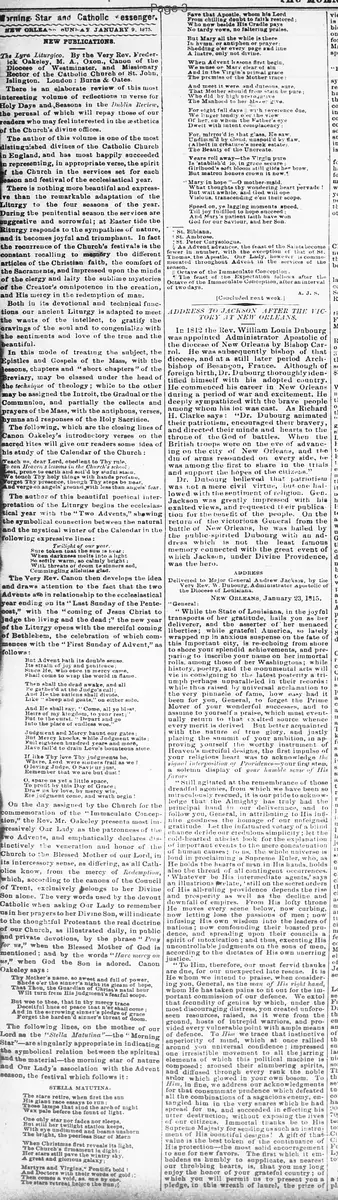
NEW PUBLICATIONS.
The Lyra Liturgica. By the Very Rev. Frederick Oakeley, M. A. Oxon., Canon of the Diocese of Westminster, and Missionary Rector of the Catholic Church of St. John, Islington. London: Burns & Oates.
There is an elaborate review of this most interesting volume of reflections in verse for Holy Days and Seasons in the Dublin Review, the perusal of which will repay those of our readers who may feel interested in the aesthetics of the Church's divine offices.
The author of this volume is one of the most distinguished divines of the Catholic Church in England, and has most happily succeeded in representing, in appropriate verse, the spirit of the Church in the services set for each season and festival of the ecclesiastical year.
There is nothing more beautiful and expressive than the remarkable adaptation of the Liturgy to the four seasons of the year.
During the penitential season the services are suggestive and sorrowful; at Easter tide the Liturgy responds to the sympathies of nature, and it becomes joyful and triumphant. In fact the recurrence of the Church's festivals is the constant recalling to memory the different articles of the Christian faith, the comfort of the Sacraments, and impressed upon the minds of the clergy and laity the sublime mysteries of the Creator's omnipotence in the creation, and His mercy in the redemption of man.
Both in its devotional and technical functions our ancient Liturgy is adapted to meet the wants of the intellect, to gratify the cravings of the soul and to congenialize with the sentiments and love of the true and the beautiful.
In this mode of treating the subject, the Epistles and Gospels of the Mass, with the lessons, chapters and "short chapters" of the Breviary, may be classed under the head of the technique of theology; while to the other may be assigned the Introit, the Gradual or the Communion, and partially the collects and prayers of the Mass, with the antiphons, verses, hymns and responses of the Holy Sacrifice.
The following, which are the closing lines of Canon Oakeley's introductory verses on the sacred rites will give our readers some idea of his study of the Calendar of the Church:
Teach us, dear Lord, obedient to Thy rule.
To con Heaven's lessons in the Church's school:
Lest, prone to earth and soil'd by sinful stain.
We touch Thy holy things with hands profane,
Forget Thy presence, though Thy steps be near,
And verge on angels' ground with less than angels' fear.
The author of this beautiful poetical interpretation of the Liturgy begins the ecclesiastical year with the "Two Advents," showing the symbolical connection between the natural and the mystical winter of the Calendar in the following expressive lines:
Twilight of our year,
Sure token that the sun is near:
When darkness melts into a light
So softly warm, so calmly bright:
With threats of doom to sinners sad,
Commingling alleluias glad.
The Very Rev. Canon then develops the idea and draws attention to the fact that the two Advents bear relationship to the ecclesiastical year ending on its "Last Sunday of the Pentecost," with the "coming of Jesus Christ to judge the living and the dead;" the new year of the Liturgy opens with the merciful coming of Bethlehem, the celebration of which commences with the First Sunday of Advent," as follows:
But Advent hath its double sense,
Its strain of joy and penitence;
Since He, who once in mercy came,
Shall come to wrap the world in flame.
Then shall the dead awake, and all
Be gather'd at the Judge's call;
And He the nations shall divide,
Like "sheep and goats," on either side.
And He shall say, "Come, all ye blest
Heirs of my kingdom, to your rest;
But to the curst, 'Depart and go
Into the place of endless woe.'
Judgment and Mercy haunt our gates;
But Mercy knocks, while Judgment waits;
Full eighteen hundred years and more,
Have fail'd to drain Love's bounteous store
If like Thy love Thy judgments be,
Where, Lord were sinners frail as we?
O loving Judge, O Saviour just,
Remember that we are but dust!
O, spare us yet a little space.
To profit by this Day of Grace;
Draw us by love, by mercy win
Ere judgment come, and wrath begin!
On the day assigned by the Church for the commemoration of the "Immaculate Conception," the Rev. Mr. Oakeley presents most impressively Our Lady as the patroness of the two Advents, and emphatically declares distinctly the veneration and honor of the Church to the Blessed Mother of our Lord, in its intercessory sense, as differing, as all Catholics know, from the mercy of Redemption, which, according to the canons of the Council of Trent, exclusively belongs to her Divine Son alone. The very words used by the devout Catholic when asking Our Lady to remember us in her prayers to her Divine Son, will indicate to the thoughtful Protestant the real doctrine of our Church, as illustrated daily, in public and private devotions, by the phrase "Pray for us," when the Blessed Mother of God is mentioned; and by the words "have mercy on us," when God the Son is adored. Canon Oakeley says:
Thy Mother's name, so sweet and full of power,
Sheds o'er the sinner's night its gleam of hope,
That Thou, the Guardian of Christ's natal hour
Wilt turn from His judgment's fearful scope.
But woe to thee, that in thy mercy trace
Deceitful lines of peace that ne'er shall come;
And in the sorrowing sinner's pledge of grace
Forget the harden'd sinner's threat of doom.
The following lines, on the Mother of our Lord as the "Stella Matutina"-the "Morning Star" -are singularly appropriate in indicating the symbolical relation between the spiritual and the material-the morning star of nature and Our Lady's association with the Advent season, the festival which follows it:
STELLA MATUTINA.
The stars retire, when first the sun
His giant race essays to run;
Those lamps that stud the arch of night
Wax pale before the fount of light.
One only star nor fades nor sleeps,
But still her twilight station keeps,
With eye undimmed and beams unshorn
The bright, the peerless Star of Morn
When Christmas first reveals its light,
The Church's firmament in dight;
Her stars still pave the wintry sky,
A great and glorious galaxy;
Martyrs and Virgins, Pontiff bold
And Doctors with their words of gold;
There comes a void, all eyed by one,
The stars retreat 'ere the dawn;
Save that Apostle, whom his Lord
From chilling doubt to faith restored:
Who now beside His Cradle pays
No tardy vows, no faltering praise.
But Mary all the while is there
In hymn, or antiphon or prayer:
Shedding o'er every page and line
A lustre, only not divine.
When Advent lessons first begin,
We muse on Mary clear of sin
And in the Virgin's primal grace
The promise of the Mother race:
And meet it were and duteous, sure,
That Mother should from stain be pure;
Who did by high prerogative
The Manhood to her Maker give.
For eight full days it with reverence due.
We linger fondly o'er the view
Of her, on whom the Father's eye
Dwelt with intent complacency;
For, mirror'd in that glass. He saw
Undimm'd by cloud. unspoil'd by daw,
(Albeit in creature's meek estate).
The Beauty of the Uncreate.
Years roll away-the Virgin pure
Is 'stablish'd lo, in grace secure:
Girlhood's soft bloom still gilds her brow,
But matron honors crown it now.
"Mary in hope"-O mother-maid.
What thoughts thy wondering heart pervade!
But wait a while, and God will ope
Visions, transcending e'en their scope.
Speed on, ye lagging moments speed
Till joy fulfill'd to hope succeed;
And Mary's patient faith have won
God for our Saviour, and her Son.
* St. Bibiana.
t St. Ambrose.
: St. Peter Chrysologus.
As Advent advances, the feast of the Saints become fewer in number, with the exception of that of St. Thomas, the Apostle. Our Lady, however is commemorated throughout Advent in the services of the season.
Octave of the Immaculate Conception.
The feast of the Expectation follows after the Octave of the Immaculate Conception, after an interval of two days.
A. J. S.
[Concluded next week.]
New Orleans, January 9, 1876.
NEW PUBLICATIONS.
The Lyra Liturgica. By the Very Rev. Frederick Oakeley, M. A. Oxon., Canon of the Diocese of Westminster, and Missionary Rector of the Catholic Church of St. John, Islington. London: Burns & Oates.
There is an elaborate review of this most interesting volume of reflections in verse for Holy Days and Seasons in the Dublin Review, the perusal of which will repay those of our readers who may feel interested in the aesthetics of the Church's divine offices.
The author of this volume is one of the most distinguished divines of the Catholic Church in England, and has most happily succeeded in representing, in appropriate verse, the spirit of the Church in the services set for each season and festival of the ecclesiastical year.
There is nothing more beautiful and expressive than the remarkable adaptation of the Liturgy to the four seasons of the year.
During the penitential season the services are suggestive and sorrowful; at Easter tide the Liturgy responds to the sympathies of nature, and it becomes joyful and triumphant. In fact the recurrence of the Church's festivals is the constant recalling to memory the different articles of the Christian faith, the comfort of the Sacraments, and impressed upon the minds of the clergy and laity the sublime mysteries of the Creator's omnipotence in the creation, and His mercy in the redemption of man.
Both in its devotional and technical functions our ancient Liturgy is adapted to meet the wants of the intellect, to gratify the cravings of the soul and to congenialize with the sentiments and love of the true and the beautiful.
In this mode of treating the subject, the Epistles and Gospels of the Mass, with the lessons, chapters and "short chapters" of the Breviary, may be classed under the head of the technique of theology; while to the other may be assigned the Introit, the Gradual or the Communion, and partially the collects and prayers of the Mass, with the antiphons, verses, hymns and responses of the Holy Sacrifice.
The following, which are the closing lines of Canon Oakeley's introductory verses on the sacred rites will give our readers some idea of his study of the Calendar of the Church:
Teach us, dear Lord, obedient to Thy rule.
To con Heaven's lessons in the Church's school:
Lest, prone to earth and soil'd by sinful stain.
We touch Thy holy things with hands profane,
Forget Thy presence, though Thy steps be near,
And verge on angels' ground with less than angels' fear.
The author of this beautiful poetical interpretation of the Liturgy begins the ecclesiastical year with the "Two Advents," showing the symbolical connection between the natural and the mystical winter of the Calendar in the following expressive lines:
Twilight of our year,
Sure token that the sun is near:
When darkness melts into a light
So softly warm, so calmly bright:
With threats of doom to sinners sad,
Commingling alleluias glad.
The Very Rev. Canon then develops the idea and draws attention to the fact that the two Advents bear relationship to the ecclesiastical year ending on its "Last Sunday of the Pentecost," with the "coming of Jesus Christ to judge the living and the dead;" the new year of the Liturgy opens with the merciful coming of Bethlehem, the celebration of which commences with the First Sunday of Advent," as follows:
But Advent hath its double sense,
Its strain of joy and penitence;
Since He, who once in mercy came,
Shall come to wrap the world in flame.
Then shall the dead awake, and all
Be gather'd at the Judge's call;
And He the nations shall divide,
Like "sheep and goats," on either side.
And He shall say, "Come, all ye blest
Heirs of my kingdom, to your rest;
But to the curst, 'Depart and go
Into the place of endless woe.'
Judgment and Mercy haunt our gates;
But Mercy knocks, while Judgment waits;
Full eighteen hundred years and more,
Have fail'd to drain Love's bounteous store
If like Thy love Thy judgments be,
Where, Lord were sinners frail as we?
O loving Judge, O Saviour just,
Remember that we are but dust!
O, spare us yet a little space.
To profit by this Day of Grace;
Draw us by love, by mercy win
Ere judgment come, and wrath begin!
On the day assigned by the Church for the commemoration of the "Immaculate Conception," the Rev. Mr. Oakeley presents most impressively Our Lady as the patroness of the two Advents, and emphatically declares distinctly the veneration and honor of the Church to the Blessed Mother of our Lord, in its intercessory sense, as differing, as all Catholics know, from the mercy of Redemption, which, according to the canons of the Council of Trent, exclusively belongs to her Divine Son alone. The very words used by the devout Catholic when asking Our Lady to remember us in her prayers to her Divine Son, will indicate to the thoughtful Protestant the real doctrine of our Church, as illustrated daily, in public and private devotions, by the phrase "Pray for us," when the Blessed Mother of God is mentioned; and by the words "have mercy on us," when God the Son is adored. Canon Oakeley says:
Thy Mother's name, so sweet and full of power,
Sheds o'er the sinner's night its gleam of hope,
That Thou, the Guardian of Christ's natal hour
Wilt turn from His judgment's fearful scope.
But woe to thee, that in thy mercy trace
Deceitful lines of peace that ne'er shall come;
And in the sorrowing sinner's pledge of grace
Forget the harden'd sinner's threat of doom.
The following lines, on the Mother of our Lord as the "Stella Matutina"-the "Morning Star" -are singularly appropriate in indicating the symbolical relation between the spiritual and the material-the morning star of nature and Our Lady's association with the Advent season, the festival which follows it:
STELLA MATUTINA.
The stars retire, when first the sun
His giant race essays to run;
Those lamps that stud the arch of night
Wax pale before the fount of light.
One only star nor fades nor sleeps,
But still her twilight station keeps,
With eye undimmed and beams unshorn
The bright, the peerless Star of Morn
When Christmas first reveals its light,
The Church's firmament in dight;
Her stars still pave the wintry sky,
A great and glorious galaxy;
Martyrs and Virgins, Pontiff bold
And Doctors with their words of gold;
There comes a void, all eyed by one,
The stars retreat 'ere the dawn;
Save that Apostle, whom his Lord
From chilling doubt to faith restored:
Who now beside His Cradle pays
No tardy vows, no faltering praise.
But Mary all the while is there
In hymn, or antiphon or prayer:
Shedding o'er every page and line
A lustre, only not divine.
When Advent lessons first begin,
We muse on Mary clear of sin
And in the Virgin's primal grace
The promise of the Mother race:
And meet it were and duteous, sure,
That Mother should from stain be pure;
Who did by high prerogative
The Manhood to her Maker give.
For eight full days it with reverence due.
We linger fondly o'er the view
Of her, on whom the Father's eye
Dwelt with intent complacency;
For, mirror'd in that glass. He saw
Undimm'd by cloud. unspoil'd by daw,
(Albeit in creature's meek estate).
The Beauty of the Uncreate.
Years roll away-the Virgin pure
Is 'stablish'd lo, in grace secure:
Girlhood's soft bloom still gilds her brow,
But matron honors crown it now.
"Mary in hope"-O mother-maid.
What thoughts thy wondering heart pervade!
But wait a while, and God will ope
Visions, transcending e'en their scope.
Speed on, ye lagging moments speed
Till joy fulfill'd to hope succeed;
And Mary's patient faith have won
God for our Saviour, and her Son.
* St. Bibiana.
t St. Ambrose.
: St. Peter Chrysologus.
As Advent advances, the feast of the Saints become fewer in number, with the exception of that of St. Thomas, the Apostle. Our Lady, however is commemorated throughout Advent in the services of the season.
Octave of the Immaculate Conception.
The feast of the Expectation follows after the Octave of the Immaculate Conception, after an interval of two days.
A. J. S.
[Concluded next week.]
What sub-type of article is it?
Essay
What themes does it cover?
Religious
What keywords are associated?
Liturgical Poetry
Catholic Liturgy
Advent Season
Immaculate Conception
Ecclesiastical Year
Mary Morning Star
Religious Verse
What entities or persons were involved?
A. J. S.
Literary Details
Title
New Publications.
Author
A. J. S.
Subject
Review Of The Lyra Liturgica By Frederick Oakeley
Form / Style
Prose Review With Embedded Poetic Excerpts On Catholic Liturgy
Key Lines
Teach Us, Dear Lord, Obedient To Thy Rule.
To Con Heaven's Lessons In The Church's School:
Lest, Prone To Earth And Soil'd By Sinful Stain.
We Touch Thy Holy Things With Hands Profane,
Forget Thy Presence, Though Thy Steps Be Near,
And Verge On Angels' Ground With Less Than Angels' Fear.
Twilight Of Our Year,
Sure Token That The Sun Is Near:
When Darkness Melts Into A Light
So Softly Warm, So Calmly Bright:
With Threats Of Doom To Sinners Sad,
Commingling Alleluias Glad.
But Advent Hath Its Double Sense,
Its Strain Of Joy And Penitence;
Since He, Who Once In Mercy Came,
Shall Come To Wrap The World In Flame.
Then Shall The Dead Awake, And All
Be Gather'd At The Judge's Call;
And He The Nations Shall Divide,
Like "Sheep And Goats," On Either Side.
And He Shall Say, "Come, All Ye Blest
Heirs Of My Kingdom, To Your Rest;
But To The Curst, 'Depart And Go
Into The Place Of Endless Woe.'
Judgment And Mercy Haunt Our Gates;
But Mercy Knocks, While Judgment Waits;
Full Eighteen Hundred Years And More,
Have Fail'd To Drain Love's Bounteous Store
If Like Thy Love Thy Judgments Be,
Where, Lord Were Sinners Frail As We?
O Loving Judge, O Saviour Just,
Remember That We Are But Dust!
O, Spare Us Yet A Little Space.
To Profit By This Day Of Grace;
Draw Us By Love, By Mercy Win
Ere Judgment Come, And Wrath Begin!
Thy Mother's Name, So Sweet And Full Of Power,
Sheds O'er The Sinner's Night Its Gleam Of Hope,
That Thou, The Guardian Of Christ's Natal Hour
Wilt Turn From His Judgment's Fearful Scope.
But Woe To Thee, That In Thy Mercy Trace
Deceitful Lines Of Peace That Ne'er Shall Come;
And In The Sorrowing Sinner's Pledge Of Grace
Forget The Harden'd Sinner's Threat Of Doom.
Stella Matutina.
The Stars Retire, When First The Sun
His Giant Race Essays To Run;
Those Lamps That Stud The Arch Of Night
Wax Pale Before The Fount Of Light.
One Only Star Nor Fades Nor Sleeps,
But Still Her Twilight Station Keeps,
With Eye Undimmed And Beams Unshorn
The Bright, The Peerless Star Of Morn
When Christmas First Reveals Its Light,
The Church's Firmament In Dight;
Her Stars Still Pave The Wintry Sky,
A Great And Glorious Galaxy;
Martyrs And Virgins, Pontiff Bold
And Doctors With Their Words Of Gold;
There Comes A Void, All Eyed By One,
The Stars Retreat 'Ere The Dawn;
Save That Apostle, Whom His Lord
From Chilling Doubt To Faith Restored:
Who Now Beside His Cradle Pays
No Tardy Vows, No Faltering Praise.
But Mary All The While Is There
In Hymn, Or Antiphon Or Prayer:
Shedding O'er Every Page And Line
A Lustre, Only Not Divine.
When Advent Lessons First Begin,
We Muse On Mary Clear Of Sin
And In The Virgin's Primal Grace
The Promise Of The Mother Race:
And Meet It Were And Duteous, Sure,
That Mother Should From Stain Be Pure;
Who Did By High Prerogative
The Manhood To Her Maker Give.
For Eight Full Days It With Reverence Due.
We Linger Fondly O'er The View
Of Her, On Whom The Father's Eye
Dwelt With Intent Complacency;
For, Mirror'd In That Glass. He Saw
Undimm'd By Cloud. Unspoil'd By Daw,
(Albeit In Creature's Meek Estate).
The Beauty Of The Uncreate.
Years Roll Away The Virgin Pure
Is 'Stablish'd Lo, In Grace Secure:
Girlhood's Soft Bloom Still Gilds Her Brow,
But Matron Honors Crown It Now.
"Mary In Hope" O Mother Maid.
What Thoughts Thy Wondering Heart Pervade!
But Wait A While, And God Will Ope
Visions, Transcending E'en Their Scope.
Speed On, Ye Lagging Moments Speed
Till Joy Fulfill'd To Hope Succeed;
And Mary's Patient Faith Have Won
God For Our Saviour, And Her Son.