Thank you for visiting SNEWPapers!
Sign up free
Virginia Argus
Richmond, Virginia
What is this article about?
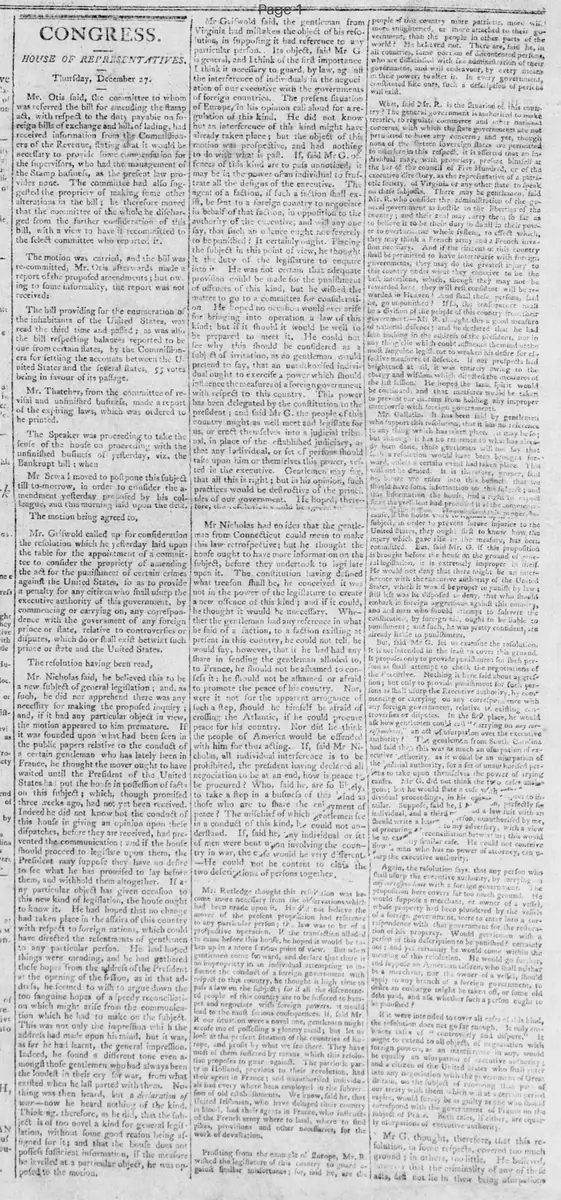
On December 27, the U.S. House of Representatives recommitted a stamp act amendment bill, passed census and state balances bills, reported expiring laws, postponed the Bankrupt bill, and debated a resolution to appoint a committee on punishing citizens for unauthorized foreign correspondence on U.S. disputes.
Merged-components note: These components form a single continuous article on congressional proceedings in the House of Representatives, spanning multiple columns on page 1 and continuing to page 2.
Clippings
1 of 2
OCR Quality
Full Text
HOUSE OF REPRESENTATIVES.
Thursday, December 27.
Mr. Otis said, The committee to whom
was referred the bill for amending the stamp
act, with respect to the duty payable on fo-
reign bills of exchange and bills of lading, had
received information from the Commissioners
of the Revenue, stating that it would be
necessary to provide some compensation for
the supervisors, who had the management of
the Stamp business, as the present law pro-
vides none. The committee had also sug-
gested the propriety of making some other
alterations in the bill; he therefore moved
that the committee of the whole be dischar-
ged from the farther consideration of this
bill, with a view to have it re-committed to
the select committee who reported it.
The motion was carried, and the bill was
re-committed, Mr. Otis afterwards made a
report of the proposed amendments; but ow-
ing to some informality, the report was not
received:
The bill providing for the enumeration of
the inhabitants of the United States, was
read the third time and passed: as was also
the bill respecting balances reported to be
due from certain states. by the Commission-
ers for settling the accounts between the U.
nited States and the several states, 55 votes
being in favour of its passage.
Mr. Thatcher, from the committee of re-
visal and unfinished business, made a report
of the expiring laws, which was ordered to
be printed.
The Speaker was proceeding to take the
sense of the house on proceeding with the
unfinished business of yesterday, viz. the
Bankrupt bill ; when
Mr Sewall moved to postpone this subject
till to-morrow, in order to consider the a-
mendment yesterday proposed by his col-
league, and this morning laid upon the desk.
The motion being agreed to,
Mr. Griswold called up for consideration
the resolution which he yesterday laid upon
the table for the appointment of a commit-
tee to consider the propriety of amending
the act for the punishment of certain crimes
against the United States, so as to provide
a penalty for any citizen who shall usurp the
executive authority of this government, by
commencing or carrying on, any correspon-
dence with the government of any foreign
prince or state, relative to controversies or
disputes, which do or shall exist betwixt such
prince or state and the United States.
The resolution having been read,
Mr. Nicholas said, he believed this to be
a new subject of general legislation; and, as
such, he did not apprehend there was any
necessity for making the proposed inquiry ;
and, if it had any particular object in view,
the motion appeared to him premature. If
it was founded upon what had been seen in
the public papers relative to the conduct of
a certain gentleman who has lately been in
France, he thought the mover ought to have
waited until the President of the United
States had put the house in possession of fa@ts
on this subject; which, though promised
three weeks ago, had not yet been received.
Indeed he did not know but the conduct of
this house in giving an opinion upon these
dispatches, before they are received, had pre-
vented the communication ; and if the house
should proceed to legislate upon them, the
President may suppose they have no desire
to see what he has promised to lay before
them, and withhold them altogether. If a
ny particular object has given occasion to
this new kind of legislation, the house ought
to know it. He had hoped that no change
had taken place in the affairs of this country
with respect to foreign nations, which could
have directed the resentments of gentlemen
to any particular person. He had hoped
things were mending, and he had gathered
these hopes from the address of the President
at the opening of the session, as in that ad.
dress, he seemed to wish to argue down the
too sanguine hopes of a speedy reconciliati-
on which might arise from the communica-
tion which he had to make on the subject.
This was not only the impression whi h the
address had made upon his mind, but it was,
as far he had learnt, the general impression.
Indeed, he found a different tone even a-
mongst those gentlemen who had always been
the loudest in their cry for war. from what
existed when he last parted with them. No-
thing was then heard, but a declaration of
war -now he heard nothing of the kind.
Thinking, therefore, as he did, that the sub-
ject is of too novel a kind for general legil-
lation, without some good reason being as-
signed for it: and that the house does not
possess sufficient information, if the measure
be levelled at a particular object, he was op-
posed to the motion.
Mr Griswold said, the gentleman from
Virginia had mistaken the object of his reso-
lution, in supposing it had reference to any
particular person.. Its object, said Mr G
is general, and I think of the first importance
I think it necessary to guard, by law, against
the interference of individuals in the negociation
of our executive with the governments
of foreign countries. The present situation
of Europe. in his opinion calls aloud for a re-
gulation of this kind, He did not know
but an interference of this kind might have
already taken place; but the object of this
motion was prospective, and had nothing
to do with what is past. If. said Mr G. of-
fences of this kind are to pass unnoticed, it
may be in the power of an individual to frus-
trate all the designs of the executive. The
agent of a faction, if such a faction shall ex.
ist, be sent to a foreign country to negotiate
in behalf of that faction, in opposition to the
authority of the executive, and will any one
say, that such an offence ought not severely
to be punished? It certainly ought. Placing
the subject in this point of view, he thought
it the duty of the legislature to enquire
into it. He was not certain that adequate
provision could be made for the punishment
of offences of this kind, but he wished the
matter to go to a committee for considera-
tion He hoped no occasion would ever arise
for bringing into operation a law of this
kind: but if it should it would be well to
be prepared to meet it. He could not
see why this should be considered as a
subject of irritation, as no gentleman would
pretend to say, that an unauthorised indivi-
dual ought to exercise a power which should
influence the measures of a foreign government
with respect to this country. This power
has been delegated by the constitution to the
president ; and said Mr G. the people of this
country might as well meet and legislate for
us, or erect themselves into a judicial tribu-
nal, in place of the established judiciary, as
that any individual, or set of persons should
take upon him or themselves this power, ves-
ted in the executive. Gentlemen may say
that all this is right : but in his opinion, such
practices would be destructive of the princi.
ples of our government. He hoped, there-
fore, the motion would be agreed:
Mr Nicholas had no idea that the gentle-
man from Connecticut could mean to make
this law retrospective; but he thought the
house ought to have more information on the
subject, before they undertook to legislate
upon it. The constitution having defined
what treason shall be, he conceived it was
not in the power of the legislature to create
a new offence of this kind; and if it could,
he thought it would be unnecessary. Whe-
ther the gentleman had any reference in what
he said of a faction, to a faction existing at
present in this country, he could not tell, he
would say, however, that if he had had any
share in sending the gentleman alluded to,
to France, he should not be ashamed to con-
fess it: he should not be ashamed or afraid
to promote the peace of his country. Nor,
were it not for the apparent arrogance of
such a step, should he himself be afraid of
crossing the Atlantic, if he could procure
peace for his country. Nor did he think
the people of America would be offended
with him for thus acting. If, said Mr Ni.
cholas, all individual interference is to be
prohibited, the president having declared all
negotiation to be at an end, how is peace to
be procured? Who, said he, are so likely,
to take a step in a business of this kind as
those who are to share the enjoyment of
peace ? The mischief which gentlemen see
in a conduct of this kind, he could not un-
derstand. If, said he, any individual or set
of men were bent upon involving the coun-
try in war, the case would be very different.
—He could not be content to class the
two descriptions of persons together.
Mr. Rutledge thought this resolu-
tion was become more necessary from the obfervations which
had been made upon it. He did not believe the
mover of the present proposition had reference
to any particular person; the law was to be of a
prospective operation. When the transaction alluded
to came before this house, he hoped it would be ta-
ken up in a more serious point of view. But when
gentlemen come forward, and declare that there is
no impropriety in an individual attempting to in-
fluence the conduct of a foreign government with
respect to this country, he thought it high time to
pass a law on the subject ;for if all the dissentient-
ed people of this country are to be suffered to ham-
per and negotiate with foreign powers. it would
lead to the most serious consequences. If, said Mr
R our situation were a novel one, gentlemen might
accuse me of possessing a gloomy mind; but let us
look at the present situation of the countries of Eu-
rope, and profit by what we see there. They have
most of them suffered by means which this resolu-
tion proposes to guard against. The patriotic par-
ty in Holland, previous to their revolution, had
their agent in France; and unauthorised individu-
als had every where been employed in the subver-
sion of old establishments. We know, said he, that
United Irishmen, who have deluged their country
in blood, had their agents in France, who instru@t-
ed the French army where to land, where to find
pikes, provisions and other necessaries, for the
work of devastation.
Profiting from the example of Europe, Mr. R
wished the legislature of this country to guard
gainst similar misfortunes; for, said he, are the
people of this country more patriotic, more wise
inore enlightened, or more attached to their go-
vernment, than the people in other parts of the
world? He believed not. There are, said he, in
all countries, some portion of discontented persons,
who are dissatisfied with the administration of their
government, and will endeavour, by every means
in their power, to alter it. In every government,
constituted like ours, such a description of people
will exist.
What, said Mr. R. is the Situation of this coun-
try ? The general government is authorised to make
treaties, to regulate commerce and other national
concerns, with which the state governments are not
permitted to have any concern; and yet, though
none of the sixteen sovereign states are permitted
to interfere in this respect, it is asserted that an indi-
vidual may, with propriety, present himself as
the bar of the council of Five Hundred, or of the
executive directory, as the representative of a patri-
otic society, of Virginia of any other state to speak
on these subjects. There may be gentlemen, said
Mr. R. who consider the administration of the ge-
neral government as hostile to the liberties of the
country: and their zeal may carry them so far as
to believe it to be their duty to do all in their pow-
er to overturn the whole system, to effect which,
they may think a French army and a French inva-
sion necessary. And if the citizens of this country
shall be permitted to have intercourse with foreign
governments, they may do the greatest injury to
this country under what they conceive to be the
best intentions, which, though they may not be
rewarded here they will rest confident will be re-
warded in Heaven' And shall these persons. said
he, go unpunished? If so, the consequence must
be a division of the people of this country from their
government.-Mr R. thought this a good measure
of national defence; and he declared that he had
seen nothing in the address of the president, nor in
any thing else which could influence the mind with
the most sanguine legislator to weaken his desire for ef-
fective measures of defence. if our prospects had
brightened at all, it was entirely owing to the
energy and wisdom which directed the measures of
the Last Session. He hoped the same spirit would
be continued, and that measures would be taken
to prevent our citizens from holding any improper
intercourse with foreign governments.
Mr. Gallatin. It has been said by gentlemen
who support this resolution, that it has no reference
to any thing which has taken place. it may be;
but though it has no reference to what has alrea-
dy been done, those gentlemen will still say that
such a resolution would have been brought for-
ward, unless a certain event had taken place. This
will not be denied. it is therefore, proper, said
he, before we enter into this business that we
should have some information on the subject; and
that information the house, he had a right to expect
since the president had promised it at the com-
mencement of the session. He remarked his proper ne-
cessity of having it, if the house were to legislate up-
on the subject, in order to prevent future injuries to the
United States, they ought first to know how the
injury which gave rise to the measure, has been.
committed. But, said Mr. G. if this proposition
is brought before the house on the ground of gene-
ral legislation, it is extremely improper in itself.
He would not deny that there might be an inter-
ference with the executive authority of the United
States, which it would be proper to punish by law;
still less was he disposed to deny, that who should
embark in foreign aggressions against this country,
and men who should attempt to subvert the
constitution, by foreign aid, ought to be liable to
punishment; and such, he was pretty confident, are
already liable to punishment.
But, said Mr G. let us examine the resolution.
It is not intended in the least to cover this ground.
It proposes only to provide punishment for such per-
sons as shall attempt to check the negotiations of
the Executive. Nothing is here said about aggres-
sion; but only to provide punishment for such per-
sons as shall usurp the Executive authority, by com-
mencing or carrying on any correspondence with
any foreign government, relative to existing con-
troversies or disputes. In the first place, he would
ask how gentlemen could call carrying on any cor-
respondence," an act of usurpation over the executive
authority? The gentlemen from South Carolina
had said that this was as much an usurpation of ex-
ecutive authority, as it would be an usurpation of
the judicial authority, for a set of unauthorised per-
sons to take upon themselves the power of trying
causes. Mr G. did not think the two cases anal-
logous; but he would state a case with re-
spect to indi-
vidual proceedings, in his opinion cer to the
similar. Suppose, said he, A
n, perfectly
individual, and a third per-
son, unauthorised by me,
should write a letter
to my adversary, with a view
of procuring a
reconciliation betwixt us; this would
be an exa-
cy similar case. He could not conceive
how a man who has no power of attorney, can u-
urpthe executive authority.
Again, the resolution says. that any person who
shall usurp the executive authority, by carrying on
any correspondence with a foreign government. The
proposition here covers far too much ground. He
would suppose a merchant, or owner of a vessel,
whose property had been plundered by the vessels
of a foreign. government, were to enter into a cor-
respondence with that government for the restora-
tion of his property. Would gentlemen wish a
person of this description to be punished? certainly
not ; and yet certainly he would come within the
meaning of this resolution. He would go further,
and suppose an American citizen, who shall neither
be a merchant, nor the owner of a vessel, should
apply to any branch of a foreign government, to
desire an embargo might be taken off, or some old
debt paid, and ask whether such a person ought to
be punished?
If it were intended to cover all cases of this kind,
the resolution does not go far enough. It only en-
compasses case of "controversy and dispute," It
ought to extend to all objects of negotiation with
foreign powers, as an interference in any, would
be equally an usurpation of executive authority:
and a citizen of the United States who shall enter
into any negotiation with the government of Great
Britain, on the subject of renewing that part of
our treaty with them which was at a certain period
expired, would surely be as guilty as one who should
correspond with the government of France on the
subject of Peace. Both cases, if either, are equa-
ly usurpations of executive authority
Mr G. thought. therefore. that this re-
solution, in some respects, covered too much
ground ; in others, too little. He believed,
that the criminality of any of these
acts, did not lie in their being usurpations
of the executive authority, but in the nature of the crime committed.
There is, said he, another difficulty in this resolution. In the general manner in which it is brought before the house, it is quite a novel subject of legislation. All nations punish citizens who carry on correspondences of a criminal nature with foreign governments. Of this nature would be an invitation of a foreign power to invade a country. Thus, to add one instance more to those adduced by the gentleman from S. Carolina, he would mention the case of Switzerland, where the armies of France were called in by certain individuals to overturn the country. The resolution ought, therefore, to be made general, and confined to cases of a criminal nature. He did not know that any nation ever passed a law to punish persons for holding a correspondence with foreign governments. He believed, in certain situations, such a correspondence would be highly improper. In our situation, for instance, said he, it would be extremely improper for a member of this house to enter into a correspondence with the French Republic, because this country is at present in a peculiar situation; for, though we are not at war with France, an offence of this kind would not be high treason, yet it would be as criminal an act, as if we were at war, but, as he had already stated, the nature of the correspondence must constitute the crime, and not the act of correspondence. Thus, our Constitution has said, to adhere to the enemies of the United States, and to afford them aid and comfort, is treason: but as we are not at war with France, an act of this kind could not be treason. It might therefore, be declared, that though a crime of this kind cannot be considered as treason, it should nevertheless be considered as a high crime. Not that he was convinced it was proper to legislate upon the subject at all; but if at all, it ought to be upon the nature of the crime.
But with respect to the conduct of an individual, he agreed with the gentleman from Virginia, that if a man of his own accord, out of a pure love for his country, cut off a sincere desire for peace, or out of his hatred for war, were to go over to France to use his endeavors to prevail upon the Government not to undertake the subjugation of our country, and to exert his endeavors, however weak they might be, to prevail upon that government to put an end to their depredations upon our commerce or to prevail upon persons in power there to offer such terms of accommodation to our Government, as he is persuaded would be accepted, he saw nothing either criminal or improper in such a conduct, but the contrary. Whether such a man had existed, he could not at present say, as he wanted information upon the subject; but if there had, he would say, he thought there was nothing either criminal or improper. He was willing, however, to suspend his judgment on the case alluded to, until he had the expected information before him. With respect to the resolution, if it was properly modified, he did not know that he should have much objection to it; but he could by no means agree to it in its present form.
Mr. Dana could not subscribe to the opinion of the gentleman from Pennsylvania, that the resolution before the house is either inaccurately or improperly expressed. That gentleman did not seem fully to understand the import of the words used. He objects to the word usurpation, though no other word could have been used with so much propriety. It was not intended, by this resolution, to provide against all correspondence with foreign governments, but against such only as ought to be carried on by the Executive; and when an individual undertakes to correspond in such a manner, it is then, and then only, that he usurps the executive authority. The word is, therefore, a necessary part of the general definition of the resolution. In the details of the law, it might be said more particularly in what this usurpation should consist; and the gentleman from Pennsylvania himself cannot deny, that all usurpations of the executive authority ought to be punished, and this is all that is proposed by the resolution. The gentleman says, a correspondence ought to be judged of by its nature, which alone rendered it criminal, or otherwise. This opinion every one must subscribe to. And what correspondence is most likely to be criminal? The gentleman objects to the case which has been alluded to being criminal, yet he allows it might be proper, in our present situation, to punish persons who should correspond with the French Government.
Mr. Gallatin said, he made use of the words, "afford aid and comfort."
Mr. D. thought the gentleman had spoken as he had stated. At any rate, said he, this position is true; and this unauthorized correspondence must have led to an opinion in the French Government that they had numerous friends in this country, and have encouraged them in their measures against us.
Mr. D. thought the instance which the gentleman from Pennsylvania had alluded to as an individual writing a letter was not in point. He would give him one, in his opinion, much more so. Where two hostile armies are in the field, the general officer who suffers his troops to negotiate with the enemy, would not, he believed be considered as either very careful or skillful. But the gentleman from Pennsylvania has supposed that very worthy individuals might carry on a correspondence with a foreign government so as to deserve praise, instead of censure. It is possible, indeed, great and eminent characters, whose individual opinions might be known to have great weight in this country—that of General Washington, for instance—might be much respected in Europe; but any great and respectable character, who regarded the honor of his country, who filled a great space in the view of mankind, would never go abroad in an obscure, mean, and sly manner, without the knowledge of his own government, to settle differences with a foreign nation. Could there be found, indeed, an individual without any public character, or reputation for public services, who would be willing to go on such an errand, every man of sense would laugh at the ridiculous vanity of such a man. No individual of America, undistinguished by eminent services, if he had the ordinary abilities of the American character, would ever undertake such an embassy; if he did, he would certainly be despised for the weakness of his intellects and his inflamed vanity: besides being considered as having some other object in view, and as making this a mere cover for other designs. Mr. D. would not disgrace the American character by supposing that ever such a man can be found; such an one would merit being confined in a mad house, and be supposed to go forward as an agent of a French Faction in this country. (If the gentleman from Pennsylvania does not like this term, he must give him another: it expressed his own idea.) And in every instance of this kind, the person thus employed must be considered as acting in direct hostility with the authority of our government, and against the general character of our country. It is proclaiming to the enemy, the division of your country. It is a crime of serious magnitude, as the person thus acting, must be considered as the agent of a faction, waiting only for an opportunity of joining the enemies of their country. He did not believe such a faction has really existence. He knew there had been reports to this effect, which had placed a man high in rank in this government at its head: but he could not believe in this place that men in so exalted a situation could be guilty of such conduct; he was not authorized to listen to any such suggestions and therefore would not.
The gentleman from Pennsylvania supposes the house ought not to legislate on this subject, until they receive information from the President relative to our foreign affairs; but as this was intended as a general provision, unconnected with any particular case, it was wholly unnecessary in his opinion, to wait for this communication.
Mr. Pinckney said, he should not have troubled the house on this occasion, had it not been for the doctrine which had fallen from the gentleman from Virginia (Mr. Nicholas) which he considered as extremely dangerous in a republican government, and which had a tendency to subvert all order and good government under whatever form they may exist. If he understood the gentleman rightly, he said, he should not be ashamed of having been concerned in any negotiation which has lately taken place, provided he had, by that means, obtained peace for this country; and that he believed one people of this country would be satisfied with such an embassy, provided peace was the result. He thought this doctrine subversive of every principle of republican government, the great and leading doctrine of which is, that the sense of the majority shall govern; that when this sense is proclaimed by the proper organs, it shall be absolute: that no one can pretend to interfere so as to counteract the proceedings of the people of this country as expressed by its legal organs. This doctrine, said Mr. P. cannot be controverted. He believed the gentleman's good intentions for the peace of his country had dimmed his better judgment. Peace is desirable, is most welcome to every country, and highly essential to its welfare. This wish of the gentleman for peace may have induced his better judgment to have brought forward a sentiment more prejudicial than the bitterest war.
Upon what principle is it, said Mr. P. that an individual should interfere in the general management of the affairs of his country, even to procure peace to it? It must be upon the ground that his private sentiments ought to prevail over the legal government of his country; and it would not be confined to the idea of giving peace to the country; because, if it was the opinion of this individual, or of any party, that the country ought to go to war, the same reasoning would hold good; since it will be thought more beneficent, at some times, to enter into war than to remain at peace. Times may come—they have come in all countries—when it will be more essential to engage in a war, under all its disadvantages than to remain at peace.
Mr. P. knew of no case, no situation in which it could be lawful or right for an individual to interfere with a foreign government at the time when any negotiation is going forward by legal authority. Such an interference can have but a bad effect. It shows at least, that there is a party in the country divided from the government, who take upon themselves a separate negotiation, and set up a distinct power, which they wish to be paramount to the legal authority.
He did not think the gentleman from Virginia had formed a correct idea of the sentiment of the American people, when he said, he believed, on his return from an unauthorized embassy, of the kind alluded to, he should have received their thanks for having given peace to the country. Under the present circumstances, he thought the gentleman calculated ill; as his calculation was founded on an idea of the pusillanimity of the people: that they are afraid of war, and glad to have peace upon any terms, or by whatever means. He did not think that this is the sentiment of the American people. They love peace, and would go as far as any people to preserve it, but he believed when they have exhausted every means of conciliation in vain; when these conciliatory measures have produced nothing but new aggression, and no prospect of an honourable adjustment of differences remains, in such circumstances, he believed they would choose war rather than peace.
The gentleman from Pennsylvania had himself agreed that it would be wrong for any party to hold correspondence with France under our present circumstances: but that gentleman draws a distinction between a party and an individual, which he did not understand, as he could not conceive why an individual was not equally justified with a party in holding any such correspondence. If it was an usurpation, it matters not whether it be by an individual or a party—both are alike criminal. A party might be more dangerous; but an individual is equally criminal.
The gentleman from Pennsylvania has made several objections to the motion, on the ground of its interfering with individual negotiations about their own private concerns. These had been fully answered by the gentleman from Connecticut, by saying that these resolutions had no reference to any other negotiations but those of peace or war between a foreign nation and the United States.
He might add, that it is merely an instruction for a committee to report a bill, and if any fear existed with respect to an interference with private business, when the bill came in, this could be easily guarded against. He hoped, therefore, the measure would be agreed to.
(To be continued.)
What sub-type of article is it?
What keywords are associated?
What entities or persons were involved?
Where did it happen?
Domestic News Details
Primary Location
United States
Event Date
Thursday, December 27.
Key Persons
Outcome
bill to amend stamp act recommitted; bill for enumeration of inhabitants passed; bill respecting balances due from states passed (55 votes); report of expiring laws ordered printed; motion to postpone bankrupt bill agreed; debate on resolution for committee to amend act on crimes against us regarding foreign correspondence.
Event Details
The House considered and recommitted a bill amending the stamp act for compensation to supervisors; passed bills for census and state balances; reported expiring laws; postponed Bankrupt bill; debated Mr. Griswold's resolution to punish unauthorized citizen correspondence with foreign governments on US disputes, with speeches by Nicholas, Griswold, Rutledge, Gallatin, Dana, and Pinckney.