Thank you for visiting SNEWPapers!
Sign up free
The Cordova Daily Times
Cordova, Alaska
What is this article about?
Berlin report on Soviet Russia's planned currency reform: abolish zeros by exchanging 1 new ruble for 10,000 old ones, aiming to deflate prices and restore financial stability. New law offers 5-6% monthly interest to draw in hoarded cash from peasants.
Clipping
OCR Quality
Full Text
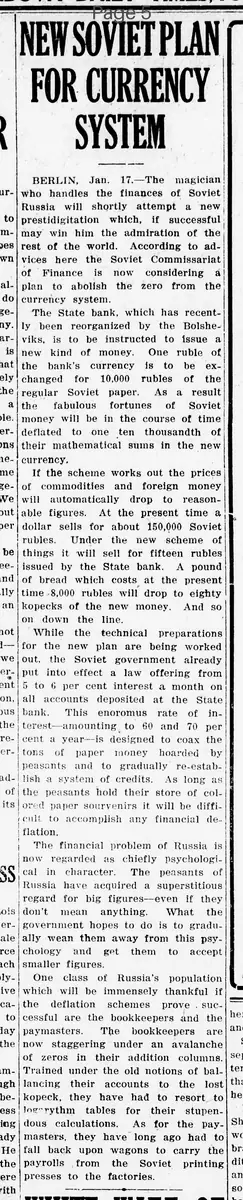
BERLIN, Jan. 17.-The magician who handles the finances of Soviet Russia will shortly attempt a new prestidigitation which, if successful may win him the admiration of the rest of the world. According to advices here the Soviet Commissariat of Finance is now considering a plan to abolish the zero from the currency system.
The State bank, which has recently been reorganized by the Bolsheviks, is to be instructed to issue a new kind of money. One ruble of the bank's currency is to be exchanged for 10,000 rubles of the regular Soviet paper. As a result the fabulous fortunes of Soviet money will be in the course of time deflated to one ten thousandth of their mathematical sums in the new currency.
If the scheme works out the prices of commodities and foreign money will automatically drop to reasonable figures. At the present time a dollar sells for about 150,000 Soviet rubles. Under the new scheme of things it will sell for fifteen rubles issued by the State bank. A pound of bread which costs at the present time 8,000 rubles will drop to eighty kopecks of the new money. And so on down the line.
While the technical preparations for the new plan are being worked out, the Soviet government already put into effect a law offering from 5 to 6 per cent interest a month on all accounts deposited at the State bank. This enormous rate of interest-amounting to 60 and 70 per cent a year--is designed to coax the tons of paper money hoarded by peasants and to gradually re-establish a system of credits. As long as the peasants hold their store of colored paper souvenirs it will be difficult to accomplish any financial deflation.
The financial problem of Russia is now regarded as chiefly psychological in character. The peasants of Russia have acquired a superstitious regard for big figures--even if they don't mean anything. What the government hopes to do is to gradually wean them away from this psychology and get them to accept smaller figures.
One class of Russia's population which will be immensely thankful if the deflation schemes prove successful are the bookkeepers and the paymasters. The bookkeepers are now staggering under an avalanche of zeros in their addition columns. Trained under the old notions of balancing their accounts to the last kopeck, they have had to resort to logarithm tables for their stupendous calculations. As for the paymasters, they have long ago had to fall back upon wagons to carry the payrolls from the Soviet printing presses to the factories.
What sub-type of article is it?
What keywords are associated?
Where did it happen?
Foreign News Details
Primary Location
Soviet Russia
Event Date
Jan. 17
Outcome
prices and foreign money values to drop to reasonable figures (e.g., dollar from 150,000 to 15 rubles; bread from 8,000 to 80 kopecks); 5-6% monthly interest on deposits to coax hoarded money and re-establish credits.
Event Details
Soviet Commissariat of Finance considering plan to abolish zero from currency; State bank to issue new money where 1 ruble exchanges for 10,000 old rubles, deflating fortunes to one ten-thousandth; technical preparations ongoing; new law effective offering 5-6% monthly interest on State bank deposits to draw peasants' hoarded paper money; financial problem seen as psychological, aiming to wean peasants from big figures; bookkeepers and paymasters burdened by zeros, using logs and wagons for payrolls.