Thank you for visiting SNEWPapers!
Sign up free
Gazette Of The United States And Daily Evening Advertiser
Philadelphia, Philadelphia County, Pennsylvania
What is this article about?
On February 13, the U.S. House of Representatives debated a bill to continue and regulate the military establishment, completing the legion to 4,800 men. Amendments by Madison and Giles were discussed and mostly rejected; the bill was ordered engrossed after votes.
Merged-components note: Continuation of the report on House of Representatives proceedings on the bill for continuing and regulating the military establishment.
Clippings
1 of 2
OCR Quality
Full Text
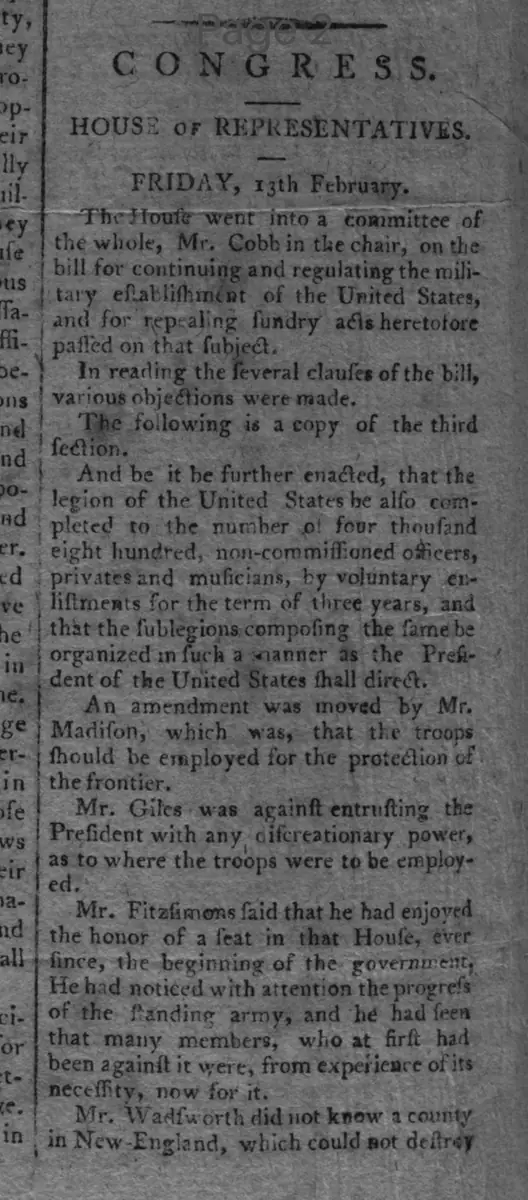
HOUSE OF REPRESENTATIVES.
FRIDAY, 13th February.
The House went into a committee of the whole, Mr. Cobb in the chair, on the bill for continuing and regulating the military establishment of the United States, and for repealing sundry acts heretofore passed on that subject.
In reading the several clauses of the bill, various objections were made.
The following is a copy of the third section.
And be it further enacted, that the legion of the United States be also completed to the number of four thousand eight hundred, non-commissioned officers, privates and musicians, by voluntary enlistments for the term of three years, and that the sublegions composing the same be organized in such a manner as the President of the United States shall direct.
An amendment was moved by Mr. Madison, which was, that the troops should be employed for the protection of the frontier.
Mr. Giles was against entrusting the President with any discretionary power, as to where the troops were to be employed.
Mr. Fitzsimons said that he had enjoyed the honor of a seat in that House, ever since the beginning of the government. He had noticed with attention the progress of the standing army, and he had seen that many members, who at first had been against it were, from experience of its necessity, now for it.
Mr. Wadsworth did not know a county in New-England, which could not destroy the little standing army of America in an hour. He had at first been the only man for regular troops, and now gentlemen who had been against this army were for it. There is a good militia in Massachusetts, but some time ago there has passed a milk and water law in Congress, with hardly a New-England vote to it, and since that time there have been no hopes of a good militia. As to the present amendment, it had been inserted in former laws, and never had hindered the regulars from marching anywhere that was thought proper. The amendment had done no good before, and he had no hopes of its doing any now. He was sorry for this little standing army, for it never comes before the House without meeting a rub. It has more to fear from its friends than from its enemies. Some people pretended to be jealous of the New-England members, as attached to a standing army. The reason why they are so is, that they despair of ever seeing a militia, that will be worth one farthing. It had been said by Mr. Giles, that a party in the house wanted to employ the army as an instrument for executing the laws. If by this was meant preventing the whites from encroaching upon the Indians, and for suppressing insurrections he hoped that it would always be so, but if this meant that the standing army should aid in the ordinary execution of the law, he hoped that it would not be needful, and that they would not do it. He would not say again what he had said yesterday, as to the militia, but only this, that a militia raised by individual influence was more formidable to the United States than a standing army ever could be. He thanked God that the government of the country was not left entirely to the house of representatives, or he believed that they should make most wretched work of it. There were other branches likewise. As to weakening the army for fear that it should enslave us, he thought it like a man blunting the edge of his axe, for fear that he should cut his own throat with it.
On dividing on this amendment, there were only twenty-six ayes.
Mr. Giles then moved, as an amendment at the third section, that no enlistment shall be made after three years from the time of passing this bill.
Mr. Hillhouse could see no harm, in this motion of Mr. Giles. It was agreed to.
The committee rose. The bill with the amendments were reported.
The House then went upon the amendments.
Mr. Nicholas moved, as an amendment to the bill, "that the legion shall be reduced to two thousand five hundred men, upon a peace with the Indians." The yeas and nays were called for, and the amendment lost by a great majority.
Mr. Madison renewed his amendment proposed in the committee in order. The substance was, that vigor ought not be used against citizens enforcing the laws of the United States, but only for protection against foreign invasion, and the Indian war. The yeas and nays were called for on this question also, and it was negatived by a great majority.
The bill was then ordered to be engrossed for a third reading.
Adjourned at four o'clock.
What sub-type of article is it?
What keywords are associated?
What entities or persons were involved?
Where did it happen?
Domestic News Details
Primary Location
House Of Representatives
Event Date
Friday, 13th February
Key Persons
Outcome
amendments by madison and nicholas rejected by majority votes; giles' amendment on enlistment term limit agreed to; bill ordered engrossed for third reading.
Event Details
The House debated a bill to regulate the U.S. military establishment, including completing the legion to 4,800 men for three years under presidential direction. Objections raised on troop employment; speeches by members on standing army necessity, militia, and amendments limiting use to frontiers and Indian wars.