Thank you for visiting SNEWPapers!
Sign up free
Editorial
January 30, 1799
The Providence Journal, And Town And Country Advertiser
Providence, Providence County, Rhode Island
What is this article about?
This editorial from the Providence Journal reflects on shifting American sympathies from the French Revolution to resentment against French aggressions, urging caution in European relations, promotion of neutrality, national unity under federalism, and reliance on divine providence for security.
Clipping
OCR Quality
98%
Excellent
Full Text
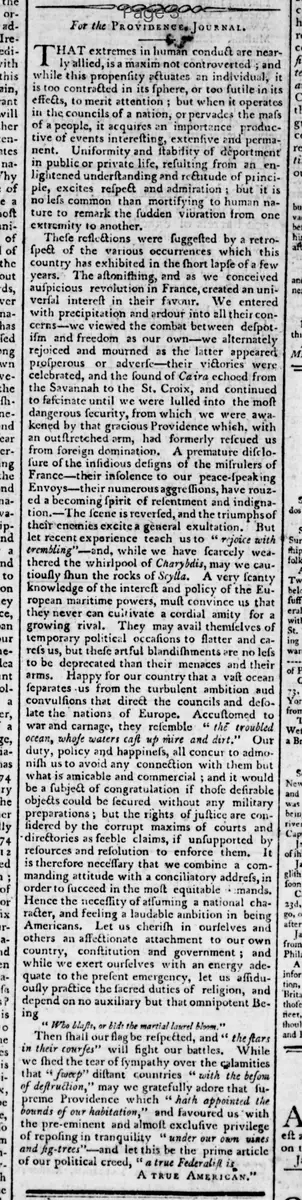
For the Providence Journal.
Self-love allied, is a maxim not controverted; and while this propensity actuates an individual, it is too contracted in its sphere, or too futile in its effects, to merit attention; but when it operates in the councils of a nation, or pervades the mass of a people, it acquires an importance productive of events interesting, extensive and permanent. Uniformity and stability of deportment in public or private life, resulting from an enlightened understanding and rectitude of principle, excites respect and admiration; but it is no less common than mortifying to human nature to remark the sudden vibration from one extremity to another.
These reflections were suggested by a retrospect of the various occurrences which this country has exhibited in the short lapse of a few years. The astonishing, and as we conceived auspicious revolution in France, created an universal interest in their favour. We entered with precipitation and ardour into all their concerns—we viewed the combat between despotism and freedom as our own—we alternately rejoiced and mourned as the latter appeared prosperous or adverse—their victories were celebrated, and the sound of Cairo echoed from the Savannah to the St. Croix, and continued to fascinate until we were lulled into the most dangerous security, from which we were awakened by that gracious Providence which, with an outstretched arm, had formerly rescued us from foreign domination. A premature disclosure of the insidious designs of the misrulers of France—their insolence to our peace-speaking Envoys—their numerous aggressions, have roused a becoming spirit of resentment and indignation. The scene is reversed, and the triumphs of their enemies excite a general exultation. But let recent experience teach us to "rejoice with trembling"—and, while we have scarcely weathered the whirlpool of Charybdis, may we cautiously shun the rocks of Scylla. A very scanty knowledge of the interest and policy of the European maritime powers, must convince us that they never can cultivate a cordial amity for a growing rival. They may avail themselves of temporary political occasions to flatter and caress us, but these artful blandishments are no less to be deprecated than their menaces and their arms.
Happy for our country that a vast ocean separates us from the turbulent ambition and convulsions that direct the councils and desolate the nations of Europe. Accustomed to war and carnage, they resemble "the troubled ocean, whose waters cast up mire and dirt." Our duty, policy and happiness, all concur to admonish us to avoid any connection with them but what is amicable and commercial; and it would be a subject of congratulation if those desirable objects could be secured without any military preparations; but the rights of justice are considered by the corrupt maxims of courts and directories as feeble claims, if unsupported by resources and resolution to enforce them. It is therefore necessary that we combine a commanding attitude with a conciliatory address, in order to succeed in the most equitable demands. Hence the necessity of assuming a national character, and feeling a laudable ambition in being Americans. Let us cherish in ourselves and others an affectionate attachment to our own country, constitution and government; and while we exert ourselves with an energy adequate to the present emergency, let us assiduously practice the sacred duties of religion, and depend on no auxiliary but that omnipotent Being
"Who blasts, or bids the martial laurel bloom."
Then shall our flag be respected, and "the stars in their courses" will fight our battles. While we shed the tear of sympathy over the calamities that "sweep" distant countries "with the besom of destruction," may we gratefully adore that supreme Providence which "hath appointed the bounds of our habitation," and favoured us with the pre-eminent and almost exclusive privilege of reposing in tranquility "under our own vines and fig-trees"—and let this be the prime article of our political creed, "a true Federalist is A true American."
Self-love allied, is a maxim not controverted; and while this propensity actuates an individual, it is too contracted in its sphere, or too futile in its effects, to merit attention; but when it operates in the councils of a nation, or pervades the mass of a people, it acquires an importance productive of events interesting, extensive and permanent. Uniformity and stability of deportment in public or private life, resulting from an enlightened understanding and rectitude of principle, excites respect and admiration; but it is no less common than mortifying to human nature to remark the sudden vibration from one extremity to another.
These reflections were suggested by a retrospect of the various occurrences which this country has exhibited in the short lapse of a few years. The astonishing, and as we conceived auspicious revolution in France, created an universal interest in their favour. We entered with precipitation and ardour into all their concerns—we viewed the combat between despotism and freedom as our own—we alternately rejoiced and mourned as the latter appeared prosperous or adverse—their victories were celebrated, and the sound of Cairo echoed from the Savannah to the St. Croix, and continued to fascinate until we were lulled into the most dangerous security, from which we were awakened by that gracious Providence which, with an outstretched arm, had formerly rescued us from foreign domination. A premature disclosure of the insidious designs of the misrulers of France—their insolence to our peace-speaking Envoys—their numerous aggressions, have roused a becoming spirit of resentment and indignation. The scene is reversed, and the triumphs of their enemies excite a general exultation. But let recent experience teach us to "rejoice with trembling"—and, while we have scarcely weathered the whirlpool of Charybdis, may we cautiously shun the rocks of Scylla. A very scanty knowledge of the interest and policy of the European maritime powers, must convince us that they never can cultivate a cordial amity for a growing rival. They may avail themselves of temporary political occasions to flatter and caress us, but these artful blandishments are no less to be deprecated than their menaces and their arms.
Happy for our country that a vast ocean separates us from the turbulent ambition and convulsions that direct the councils and desolate the nations of Europe. Accustomed to war and carnage, they resemble "the troubled ocean, whose waters cast up mire and dirt." Our duty, policy and happiness, all concur to admonish us to avoid any connection with them but what is amicable and commercial; and it would be a subject of congratulation if those desirable objects could be secured without any military preparations; but the rights of justice are considered by the corrupt maxims of courts and directories as feeble claims, if unsupported by resources and resolution to enforce them. It is therefore necessary that we combine a commanding attitude with a conciliatory address, in order to succeed in the most equitable demands. Hence the necessity of assuming a national character, and feeling a laudable ambition in being Americans. Let us cherish in ourselves and others an affectionate attachment to our own country, constitution and government; and while we exert ourselves with an energy adequate to the present emergency, let us assiduously practice the sacred duties of religion, and depend on no auxiliary but that omnipotent Being
"Who blasts, or bids the martial laurel bloom."
Then shall our flag be respected, and "the stars in their courses" will fight our battles. While we shed the tear of sympathy over the calamities that "sweep" distant countries "with the besom of destruction," may we gratefully adore that supreme Providence which "hath appointed the bounds of our habitation," and favoured us with the pre-eminent and almost exclusive privilege of reposing in tranquility "under our own vines and fig-trees"—and let this be the prime article of our political creed, "a true Federalist is A true American."
What sub-type of article is it?
Foreign Affairs
War Or Peace
Moral Or Religious
What keywords are associated?
French Revolution
American Neutrality
European Powers
Federalism
Divine Providence
National Character
What entities or persons were involved?
France
European Maritime Powers
Providence Journal
Federalist
Editorial Details
Primary Topic
Caution Against European Entanglements And Promotion Of American Neutrality And Federalism
Stance / Tone
Cautionary, Patriotic, And Providential
Key Figures
France
European Maritime Powers
Providence Journal
Federalist
Key Arguments
National Self Love Can Lead To Dangerous Policy Shifts
American Sympathies Shifted From French Revolution Support To Resentment Due To French Aggressions
Avoid Deep Connections With Turbulent Europe Beyond Amicable Commerce
Maintain Military Preparedness And National Unity To Enforce Justice
Rely On Divine Providence And Federal Government For Security