Thank you for visiting SNEWPapers!
Sign up free
Virginia Argus
Richmond, Virginia
What is this article about?
Lucien Bonaparte, refusing Napoleon's demands to divorce and accept a crown, sought asylum in England via British diplomats after fleeing Italy. His daughter rejected a proposed marriage to Ferdinand VII. Lucien and family arrive in England, to reside in Shropshire.
Clipping
OCR Quality
Full Text
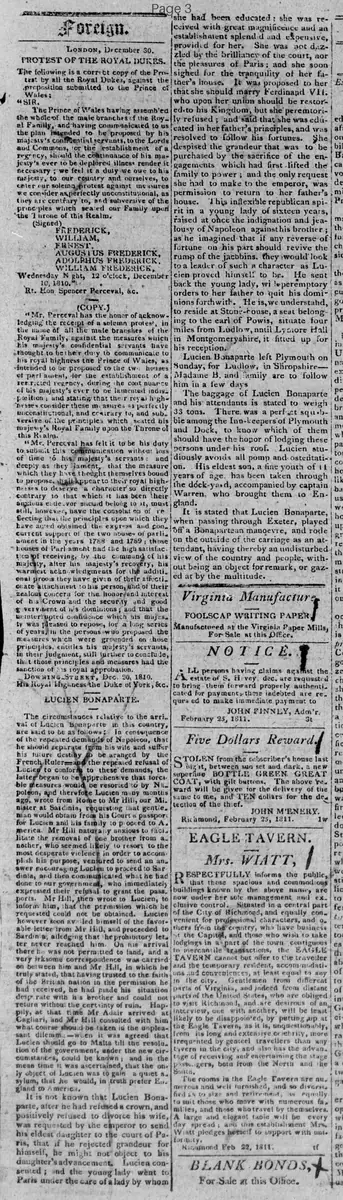
The circumstances relative to the arrival of Lucien Bonaparte in this country, are said to be as follows; In consequence of the repeated demands of Napoleon, that he should separate from his wife and suffer his future destiny to be arranged by the French Ruler-and the repeated refusal of Lucien to conform to these demands, the latter began to be apprehensive that forcible measures would be resorted to by Napoleon, and therefore Lucien many months ago, wrote from Rome to Mr Hill, our Minister at Sardinia, requesting that gentleman would obtain from his Court a passport for Lucien and his family to proceed to America. Mr Hill naturally anxious to facilitate the removal of one brother from another, who seemed likely to resort to the most desperate violence in order to accomplish his purpose, ventured to send an answer encouraging Lucien to proceed to Sardinia, and then communicated what he had done to our government, who immediately expressed their refusal to grant the passports. Mr Hill, then wrote to Lucien, to inform him, that the permission which he requested could not be obtained. Lucien however soon availed himself of the favorable letter from Mr Hill, and proceeded to Sardinia, alleging that he prohibitory letter never reached him. On his arrival there he was not permitted to land, and a very irksome correspondence was carried on between him and Mr Hill, in which he truly stated, that having trusted to the faith of the British nation in the permission he had received, he had made his situation desperate with his brother and could not return without the certainty of ruin. Happily, at that time Mr Adair arrived at Cagliari, and Mr Hill consulted with him what course should be taken in the unpleasant dilemma-when it was agreed that Lucien should go to Malta till the resolution of the government, under the new circumstances, could be known; and in the mean time it was ascertained, that the only object of Lucien was to gain a quiet asylum, that he would, in truth prefer England to America.
It is not known that Lucien Bonaparte, after he had refused a crown, and positively refused to divorce his wife, was requested by the emperor to send his eldest daughter to the court of Paris, that if he rejected grandeur for himself, he might not object to his daughter's advancement. Lucien consented; and the young lady went to Paris under the care of a lady by whom she had been educated; she was received with great magnificence and an establishment splendid and expensive, provided for her. She was not dazzled by the brilliancy of the court, nor the pleasures of Paris; and she soon sighed for the tranquility of her father's house. It was proposed to her that she should marry Ferdinand VII. who upon her union should be restored to his Kingdom, but she peremptorily refused; and said that she was educated in her father's principles, and was resolved to follow his fortunes. She despised the grandeur that was to be purchased by the sacrifice of the engagements which had first lifted the family to power; and the only request she had to make to the emperor, was permission to return to her father's house. This inflexible republican spirit in a young lady of sixteen years, raised at once the indignation and jealousy of Napoleon against his brother; as he imagined that if any reverse of fortune on his part should revive the stump of the jacobins, they would look to a leader of such a character as Lucien proved himself to be. He sent back the young lady, with peremptory orders to her father to quit his dominions forthwith. He is, we understand, to reside at Stone-house, a seat belonging to the earl of Powis, situate four miles from Ludlow, until Lymore Hall in Montgomeryshire, is fitted up for his reception.
Lucien Bonaparte left Plymouth on Sunday, for Ludlow, in Shropshire-Madame B. and family are to follow him in a few days
The baggage of Lucien Bonaparte and his attendants is stated to weigh 33 tons. There was a perfect squabble among the Inn-keepers of Plymouth and Dock, to know which of them should have the honor of lodging these persons under his roof. Lucien studiously avoids all pomp and ostentation. His eldest son, a fine youth of 11 years of age, has been taken through the dock-yard, accompanied by captain Warren, who brought them to England.
It is stated that Lucien Bonaparte, when passing through Exeter, played off a Bonapartean manoeuvre, and rode on the outside of the carriage as an attendant, having thereby an undisturbed view of the country and people, without being an object for remark, or gazed at by the multitude.
What sub-type of article is it?
What keywords are associated?
What entities or persons were involved?
Where did it happen?
Foreign News Details
Primary Location
England
Key Persons
Outcome
lucien granted asylum in england, to reside at stone-house near ludlow and later lymore hall in montgomeryshire.
Event Details
Lucien Bonaparte fled Napoleon's demands to divorce his wife and accept arranged destiny, seeking British passport via Mr Hill to go to America but preferring England. After complications in Sardinia and Malta, he arrives in England with family, avoiding pomp.