Thank you for visiting SNEWPapers!
Sign up free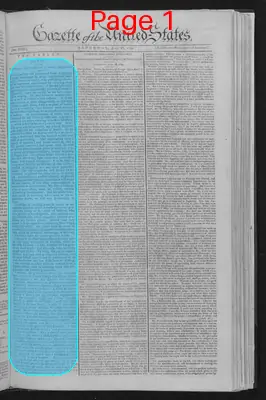
Literary
June 27, 1789
Gazette Of The United States
New York, New York County, New York
What is this article about?
This essay, numbered No. XXII, critiques the misuse of time in trivial reading and research, illustrated by an anecdote of a friend's library obsessed with obscure topics like Noah's Ark. It emphasizes acquiring useful, practical knowledge over pointless curiosities, closing with an extract on prioritizing moral and philosophical wisdom.
Clipping
OCR Quality
95%
Excellent
Full Text
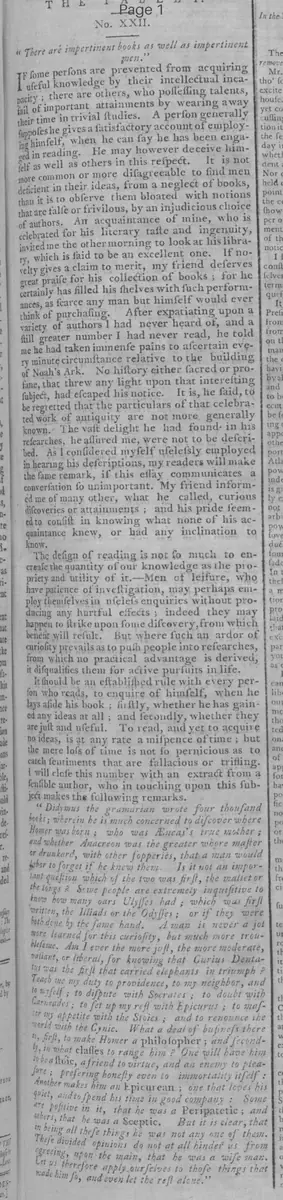
No. XXII.
"There are impertinent books as well as impertinent men."
Some persons are prevented from acquiring capacity; there are others, who possessing talents, fail of useful knowledge by their intellectual incapacity; others fail of important attainments by wearing away their time in trivial studies. A person generally esteems himself as well as others in this respect. It is not judged in reading. He may however deceive himself, as he supposes he gives a satisfactory account of employing himself, when he can say he has been engaged in reading.
It is more common or more disagreeable to find men deficient in their ideas, from a neglect of books, than it is to observe them bloated with notions of authors. An acquaintance of mine, who is celebrated for his literary taste and ingenuity, invited me the other morning to look at his library, which is said to be an excellent one. If novelty gives a claim to merit, my friend deserves great praise for his collection of books; for he certainly has filled his shelves with such performances, as scarce any man but himself would ever think of purchasing. After expatiating upon a variety of authors I had never heard of, and a still greater number I had never read, he told me he had taken immense pains to ascertain every minute circumstance relative to the building of Noah's Ark. No history either sacred or profane, that threw any light upon that interesting subject, had escaped his notice. It is, he said, to be regretted that the particulars of that celebrated work of antiquity are not more generally known. The vast delight he had found in his researches, he assured me, were not to be described. As I considered myself uselessly employed in hearing his descriptions, my readers will make the same remark, if this essay communicates a conversation so unimportant. My friend informed me of many other, what he called, curious discoveries or attainments; and his pride seemed to consist in knowing what none of his acquaintance knew, or had any inclination to know.
The design of reading is not so much to increase the quantity of our knowledge as the propriety and utility of it. Men of leisure, who have patience of investigation, may perhaps employ themselves in useless enquiries without producing any hurtful effects; indeed they may happen to strike upon some discovery, from which benefit will result. But where such an ardor of curiosity prevails as to push people into researches, from which no practical advantage is derived, it disqualifies them for active pursuits in life.
It should be an established rule with every person who reads, to enquire of himself, when he lays aside his book; firstly, whether he has gained any ideas at all; and secondly, whether they are just and useful. To read, and yet to acquire no ideas, is at any rate a mispence of time; but the mere loss of time is not so pernicious as to catch sentiments that are fallacious or trifling.
I will close this number with an extract from a sensible author, who in touching upon this subject makes the following remarks.
"Didymus the grammarian wrote four thousand books; wherein he is much concerned to discover where Homer was born; who was Aeneas's true mother; and whether Anacreon was the greater whore-master or drunkard, with other fopperies, that a man would labor to forget if he knew them. Is it not an important question which of the two was first, the mallet or the tongs? Some people are extremely inquisitive to know how many oars Ulysses had: which was first written, the Iliads or the Odyssey; or if they were both done by the same hand. A man is never a jot more learned for this curiosity, but much more troublesome. Am I ever the more just, the more moderate, valiant, or liberal, for knowing that Gurius Dentatus was the first that carried elephants in triumph? Teach me my duty to providence, to my neighbor, and to myself; to dispute with Socrates; to doubt with Carneades; to set up my rest with Epicurus; to master my appetite with the Stoics; and to renounce the world with the Cynic. What a deal of business there is, first, to make Homer a philosopher; and secondly, in what class to range him? One will have him to be a Stoic, a friend to virtue, and an enemy to pleasure; preferring honesty even to immortality itself: Another makes him an Epicurean; one that loves his quiet, and to spend his time in good company: Some are positive in it, that he was a Peripatetic; and others, that he was a Sceptic. But it is clear, that in being all these things he was not any one of them. These divided opinions do not at all hinder us from agreeing, upon the main, that he was a wise man. Let us therefore apply ourselves to those things that made him so, and even let the rest alone."
"There are impertinent books as well as impertinent men."
Some persons are prevented from acquiring capacity; there are others, who possessing talents, fail of useful knowledge by their intellectual incapacity; others fail of important attainments by wearing away their time in trivial studies. A person generally esteems himself as well as others in this respect. It is not judged in reading. He may however deceive himself, as he supposes he gives a satisfactory account of employing himself, when he can say he has been engaged in reading.
It is more common or more disagreeable to find men deficient in their ideas, from a neglect of books, than it is to observe them bloated with notions of authors. An acquaintance of mine, who is celebrated for his literary taste and ingenuity, invited me the other morning to look at his library, which is said to be an excellent one. If novelty gives a claim to merit, my friend deserves great praise for his collection of books; for he certainly has filled his shelves with such performances, as scarce any man but himself would ever think of purchasing. After expatiating upon a variety of authors I had never heard of, and a still greater number I had never read, he told me he had taken immense pains to ascertain every minute circumstance relative to the building of Noah's Ark. No history either sacred or profane, that threw any light upon that interesting subject, had escaped his notice. It is, he said, to be regretted that the particulars of that celebrated work of antiquity are not more generally known. The vast delight he had found in his researches, he assured me, were not to be described. As I considered myself uselessly employed in hearing his descriptions, my readers will make the same remark, if this essay communicates a conversation so unimportant. My friend informed me of many other, what he called, curious discoveries or attainments; and his pride seemed to consist in knowing what none of his acquaintance knew, or had any inclination to know.
The design of reading is not so much to increase the quantity of our knowledge as the propriety and utility of it. Men of leisure, who have patience of investigation, may perhaps employ themselves in useless enquiries without producing any hurtful effects; indeed they may happen to strike upon some discovery, from which benefit will result. But where such an ardor of curiosity prevails as to push people into researches, from which no practical advantage is derived, it disqualifies them for active pursuits in life.
It should be an established rule with every person who reads, to enquire of himself, when he lays aside his book; firstly, whether he has gained any ideas at all; and secondly, whether they are just and useful. To read, and yet to acquire no ideas, is at any rate a mispence of time; but the mere loss of time is not so pernicious as to catch sentiments that are fallacious or trifling.
I will close this number with an extract from a sensible author, who in touching upon this subject makes the following remarks.
"Didymus the grammarian wrote four thousand books; wherein he is much concerned to discover where Homer was born; who was Aeneas's true mother; and whether Anacreon was the greater whore-master or drunkard, with other fopperies, that a man would labor to forget if he knew them. Is it not an important question which of the two was first, the mallet or the tongs? Some people are extremely inquisitive to know how many oars Ulysses had: which was first written, the Iliads or the Odyssey; or if they were both done by the same hand. A man is never a jot more learned for this curiosity, but much more troublesome. Am I ever the more just, the more moderate, valiant, or liberal, for knowing that Gurius Dentatus was the first that carried elephants in triumph? Teach me my duty to providence, to my neighbor, and to myself; to dispute with Socrates; to doubt with Carneades; to set up my rest with Epicurus; to master my appetite with the Stoics; and to renounce the world with the Cynic. What a deal of business there is, first, to make Homer a philosopher; and secondly, in what class to range him? One will have him to be a Stoic, a friend to virtue, and an enemy to pleasure; preferring honesty even to immortality itself: Another makes him an Epicurean; one that loves his quiet, and to spend his time in good company: Some are positive in it, that he was a Peripatetic; and others, that he was a Sceptic. But it is clear, that in being all these things he was not any one of them. These divided opinions do not at all hinder us from agreeing, upon the main, that he was a wise man. Let us therefore apply ourselves to those things that made him so, and even let the rest alone."
What sub-type of article is it?
Essay
Satire
What themes does it cover?
Moral Virtue
What keywords are associated?
Reading
Useful Knowledge
Trivial Studies
Intellectual Curiosity
Moral Wisdom
Library
Noahs Ark
Classical Authors
Literary Details
Title
No. Xxii.
Subject
On The Utility Of Reading And Avoiding Trivial Studies
Key Lines
"There Are Impertinent Books As Well As Impertinent Men."
The Design Of Reading Is Not So Much To Increase The Quantity Of Our Knowledge As The Propriety And Utility Of It.
"Didymus The Grammarian Wrote Four Thousand Books; Wherein He Is Much Concerned To Discover Where Homer Was Born; Who Was Aeneas's True Mother; And Whether Anacreon Was The Greater Whore Master Or Drunkard, With Other Fopperies, That A Man Would Labor To Forget If He Knew Them."