Thank you for visiting SNEWPapers!
Sign up free
Literary
December 8, 1838
Northern Watchman
Hartford, Hartford County, Connecticut
What is this article about?
Continuation of a biographical essay on William Wilberforce's religious conversion, from his initial aversion to evangelical views, travels with Isaac Milner leading to scriptural study, inner turmoil, and seeking guidance from John Newton, resulting in a transformed life of piety.
Clipping
OCR Quality
98%
Excellent
Full Text
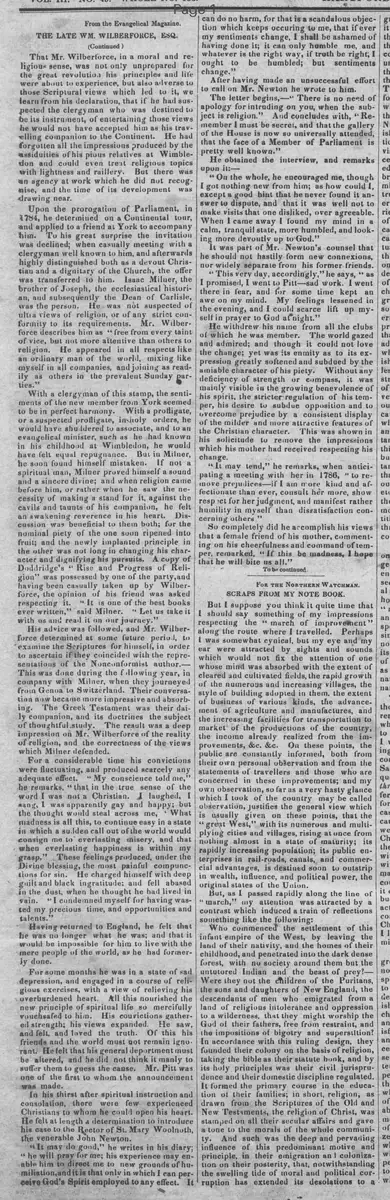
From the Evangelical Magazine.
THE LATE WM. WILBERFORCE, ESQ.
(Continued)
That Mr. Wilberforce, in a moral and religious sense, was not only unprepared for the great revolution his principles and life were about to experience, but also adverse to those Scriptural views which led to it, we learn from his declaration, that if he had suspected the clergyman who was destined to be its instrument, of entertaining those views he would not have accepted him as his travelling companion to the Continent. He had forgotten all the impressions produced by the assiduities of his pious relatives at Wimbledon and could even treat religious topics with lightness and raillery. But there was an agency at work which he did not recognise, and the time of its development was drawing near.
Upon the prorogation of Parliament, in 1784, he determined on a Continental tour and applied to a friend at York to accompany him. To his great surprise the invitation was declined; when casually meeting with a clergyman well known to him, and afterwards highly distinguished both as a devout Christian and a dignitary of the Church, the offer was transferred to him. Isaac Milner, the brother of Joseph, the ecclesiastical historian, and subsequently the Dean of Carlisle, was the person. He was not suspected of ultra views of religion, or of any strict conformity to its requirements. Mr. Wilberforce describes him as "free from every taint of vice, but not more attentive than others to religion. He appeared in all respects like an ordinary man of the world, mixing like myself in all companies, and joining as readily as others in the prevalent Sunday parties."
With a clergyman of this stamp, the sentiments of the new member from York seemed to be in perfect harmony. With a profligate, or a suspected profligate, in holy orders, he would have shuddered to associate, and to an evangelical minister, such as he had known in his childhood at Wimbledon, he would have felt equal repugnance. But in Milner, he soon found himself mistaken. If not a spiritual man, Milner proved himself a sound and a sincere divine; and when religion came before him, or rather when he saw the necessity of making a stand for it, against the cavils and taunts of his companion, he felt an awakening reverence in his heart. Discussion was beneficial to them both; for the nominal piety of the one soon ripened into fruit; and the newly implanted principle in the other was not long in changing his character and dignifying his pursuits. A copy of Doddridge's "Rise and Progress of Religion" was possessed by one of the party, and having been casually taken up by Wilberforce, the opinion of his friend was asked respecting it. "It is one of the best books ever written," said Milner. "Let us take it with us and read it on our journey."
His advice was followed, and Mr. Wilberforce determined at some future period, to examine the Scriptures for himself, in order to ascertain if they coincided with the representations of the Nonconformist author.—This was done during the following year, in company with Milner, when they journeyed from Genoa to Switzerland. Their conversation now became more impressive and absorbing. The Greek Testament was their daily companion, and its doctrines the subject of thoughtful study. The result was a deep impression on Mr. Wilberforce of the reality of religion, and the correctness of the views which Milner defended.
For a considerable time his convictions were fluctuating, and produced scarcely any adequate effect. "My conscience told me," he remarks, "that in the true sense of the word I was not a Christian. I laughed, I sang, I was apparently gay and happy; but the thought would steal across me, What madness is all this, to continue easy in a state in which a sudden call out of the world would consign me to everlasting misery, and that when everlasting happiness is within my grasp." These feelings produced, under the Divine blessing, the most painful compunctions for sin. He charged himself with deep guilt and black ingratitude: and fell abased in the dust, when he thought he had lived in vain. "I condemned myself for having wasted my precious time, and opportunities and talents."
Having returned to England, he felt that he was no longer what he was; and that it would be impossible for him to live with the mere people of the world, as he had formerly done.
For some months he was in a state of sad depression, and engaged in a course of religious exercises, with a view of relieving his overburdened heart. All this nourished the new principle of spiritual life so mercifully vouchsafed to him. His convictions gathered strength; his views expanded. He saw, and felt, and loved the truth. Of this his friends and the world must not remain ignorant. He felt that his general deportment must be altered, and he did not think it manly to suffer them to guess the cause. Mr. Pitt was one of the first to whom the announcement was made.
In his thirst after spiritual instruction and consolation, there were few experienced Christians to whom he could open his heart. He felt at length a determination to introduce his case to the Rector of St. Mary Woolnoth, the venerable John Newton.
"It may do good," he writes in his diary: "he will pray for me; his experience may enable him to direct me to new grounds of humiliation, and it is that only in which I can perceive God's Spirit employed to any effect. It can do no harm, for that is a scandalous objection which keeps occurring to me, that if ever my sentiments change, I shall be ashamed of having done it; it can only humble me, and whatever is the right way, if truth be right, I ought to be humbled; but sentiments change."
After having made an unsuccessful effort to call on Mr. Newton he wrote to him. The letter begins,—"There is no need of apology for intruding on you, when the subject is religion." And concludes with, "Remember I must be secret, and that the gallery of the House is now so universally attended, that the face of a Member of Parliament is pretty well known."
He obtained the interview, and remarks upon it:
"On the whole, he encouraged me, though I got nothing new from him; as how could I, except a good hint that he never found it answer to dispute, and that it was well not to make visits that one disliked, over agreeable. When I came away I found my mind in a calm, tranquil state, more humbled, and looking more devoutly up to God."
It was part of Mr. Newton's counsel that he should not hastily form new connexions, nor widely separate from his former friends.
"This very day, accordingly," he says, "as I promised, I went to Pitt—sad work. I went there in fear, and for some time kept an awe on my mind. My feelings lessened in the evening, and I could scarce lift up myself in prayer to God at night."
He withdrew his name from all the clubs of which he was member. The world gazed and admired; and though it could not love the change; yet was its enmity as to its expression greatly softened and subdued by the amiable character of his piety. Without any deficiency of strength or compass, it was mainly visible in the growing benevolence of his spirit, the stricter regulation of his temper, his desire to subdue opposition and to overcome prejudice by a consistent display of the milder and more attractive features of the Christian character. This was shown in his solicitude to remove the impressions which his mother had received respecting his change.
"It may tend," he remarks, when anticipating a meeting with her in 1786, "to remove prejudices—if I am more kind and affectionate than ever, consult her more, show respect for her judgment, and manifest rather humility in myself than dissatisfaction concerning others"
So completely did he accomplish his views that a female friend of his mother, commenting on his cheerfulness and command of temper, remarked, "If this be madness, I hope that he will bite us all."
To be continued.
THE LATE WM. WILBERFORCE, ESQ.
(Continued)
That Mr. Wilberforce, in a moral and religious sense, was not only unprepared for the great revolution his principles and life were about to experience, but also adverse to those Scriptural views which led to it, we learn from his declaration, that if he had suspected the clergyman who was destined to be its instrument, of entertaining those views he would not have accepted him as his travelling companion to the Continent. He had forgotten all the impressions produced by the assiduities of his pious relatives at Wimbledon and could even treat religious topics with lightness and raillery. But there was an agency at work which he did not recognise, and the time of its development was drawing near.
Upon the prorogation of Parliament, in 1784, he determined on a Continental tour and applied to a friend at York to accompany him. To his great surprise the invitation was declined; when casually meeting with a clergyman well known to him, and afterwards highly distinguished both as a devout Christian and a dignitary of the Church, the offer was transferred to him. Isaac Milner, the brother of Joseph, the ecclesiastical historian, and subsequently the Dean of Carlisle, was the person. He was not suspected of ultra views of religion, or of any strict conformity to its requirements. Mr. Wilberforce describes him as "free from every taint of vice, but not more attentive than others to religion. He appeared in all respects like an ordinary man of the world, mixing like myself in all companies, and joining as readily as others in the prevalent Sunday parties."
With a clergyman of this stamp, the sentiments of the new member from York seemed to be in perfect harmony. With a profligate, or a suspected profligate, in holy orders, he would have shuddered to associate, and to an evangelical minister, such as he had known in his childhood at Wimbledon, he would have felt equal repugnance. But in Milner, he soon found himself mistaken. If not a spiritual man, Milner proved himself a sound and a sincere divine; and when religion came before him, or rather when he saw the necessity of making a stand for it, against the cavils and taunts of his companion, he felt an awakening reverence in his heart. Discussion was beneficial to them both; for the nominal piety of the one soon ripened into fruit; and the newly implanted principle in the other was not long in changing his character and dignifying his pursuits. A copy of Doddridge's "Rise and Progress of Religion" was possessed by one of the party, and having been casually taken up by Wilberforce, the opinion of his friend was asked respecting it. "It is one of the best books ever written," said Milner. "Let us take it with us and read it on our journey."
His advice was followed, and Mr. Wilberforce determined at some future period, to examine the Scriptures for himself, in order to ascertain if they coincided with the representations of the Nonconformist author.—This was done during the following year, in company with Milner, when they journeyed from Genoa to Switzerland. Their conversation now became more impressive and absorbing. The Greek Testament was their daily companion, and its doctrines the subject of thoughtful study. The result was a deep impression on Mr. Wilberforce of the reality of religion, and the correctness of the views which Milner defended.
For a considerable time his convictions were fluctuating, and produced scarcely any adequate effect. "My conscience told me," he remarks, "that in the true sense of the word I was not a Christian. I laughed, I sang, I was apparently gay and happy; but the thought would steal across me, What madness is all this, to continue easy in a state in which a sudden call out of the world would consign me to everlasting misery, and that when everlasting happiness is within my grasp." These feelings produced, under the Divine blessing, the most painful compunctions for sin. He charged himself with deep guilt and black ingratitude: and fell abased in the dust, when he thought he had lived in vain. "I condemned myself for having wasted my precious time, and opportunities and talents."
Having returned to England, he felt that he was no longer what he was; and that it would be impossible for him to live with the mere people of the world, as he had formerly done.
For some months he was in a state of sad depression, and engaged in a course of religious exercises, with a view of relieving his overburdened heart. All this nourished the new principle of spiritual life so mercifully vouchsafed to him. His convictions gathered strength; his views expanded. He saw, and felt, and loved the truth. Of this his friends and the world must not remain ignorant. He felt that his general deportment must be altered, and he did not think it manly to suffer them to guess the cause. Mr. Pitt was one of the first to whom the announcement was made.
In his thirst after spiritual instruction and consolation, there were few experienced Christians to whom he could open his heart. He felt at length a determination to introduce his case to the Rector of St. Mary Woolnoth, the venerable John Newton.
"It may do good," he writes in his diary: "he will pray for me; his experience may enable him to direct me to new grounds of humiliation, and it is that only in which I can perceive God's Spirit employed to any effect. It can do no harm, for that is a scandalous objection which keeps occurring to me, that if ever my sentiments change, I shall be ashamed of having done it; it can only humble me, and whatever is the right way, if truth be right, I ought to be humbled; but sentiments change."
After having made an unsuccessful effort to call on Mr. Newton he wrote to him. The letter begins,—"There is no need of apology for intruding on you, when the subject is religion." And concludes with, "Remember I must be secret, and that the gallery of the House is now so universally attended, that the face of a Member of Parliament is pretty well known."
He obtained the interview, and remarks upon it:
"On the whole, he encouraged me, though I got nothing new from him; as how could I, except a good hint that he never found it answer to dispute, and that it was well not to make visits that one disliked, over agreeable. When I came away I found my mind in a calm, tranquil state, more humbled, and looking more devoutly up to God."
It was part of Mr. Newton's counsel that he should not hastily form new connexions, nor widely separate from his former friends.
"This very day, accordingly," he says, "as I promised, I went to Pitt—sad work. I went there in fear, and for some time kept an awe on my mind. My feelings lessened in the evening, and I could scarce lift up myself in prayer to God at night."
He withdrew his name from all the clubs of which he was member. The world gazed and admired; and though it could not love the change; yet was its enmity as to its expression greatly softened and subdued by the amiable character of his piety. Without any deficiency of strength or compass, it was mainly visible in the growing benevolence of his spirit, the stricter regulation of his temper, his desire to subdue opposition and to overcome prejudice by a consistent display of the milder and more attractive features of the Christian character. This was shown in his solicitude to remove the impressions which his mother had received respecting his change.
"It may tend," he remarks, when anticipating a meeting with her in 1786, "to remove prejudices—if I am more kind and affectionate than ever, consult her more, show respect for her judgment, and manifest rather humility in myself than dissatisfaction concerning others"
So completely did he accomplish his views that a female friend of his mother, commenting on his cheerfulness and command of temper, remarked, "If this be madness, I hope that he will bite us all."
To be continued.
What sub-type of article is it?
Essay
What themes does it cover?
Religious
Moral Virtue
What keywords are associated?
Wilberforce
Religious Conversion
Isaac Milner
John Newton
Evangelicalism
Spiritual Awakening
Piety
Literary Details
Title
The Late Wm. Wilberforce, Esq.
Subject
Biographical Account Of William Wilberforce's Religious Conversion
Form / Style
Biographical Prose Essay
Key Lines
"My Conscience Told Me," He Remarks, "That In The True Sense Of The Word I Was Not A Christian. I Laughed, I Sang, I Was Apparently Gay And Happy; But The Thought Would Steal Across Me, What Madness Is All This, To Continue Easy In A State In Which A Sudden Call Out Of The World Would Consign Me To Everlasting Misery, And That When Everlasting Happiness Is Within My Grasp."
"It May Do Good," He Writes In His Diary: "He Will Pray For Me; His Experience May Enable Him To Direct Me To New Grounds Of Humiliation, And It Is That Only In Which I Can Perceive God's Spirit Employed To Any Effect."
"If This Be Madness, I Hope That He Will Bite Us All."