Thank you for visiting SNEWPapers!
Sign up free
Wheeling Compiler
Wheeling, Ohio County, West Virginia
What is this article about?
Description of Washington, D.C.'s scattered layout due to separation of Capitol and public offices, causing inconvenience for residents and Congress members, with an example of burdensome travel for simple requests.
Clipping
OCR Quality
Full Text
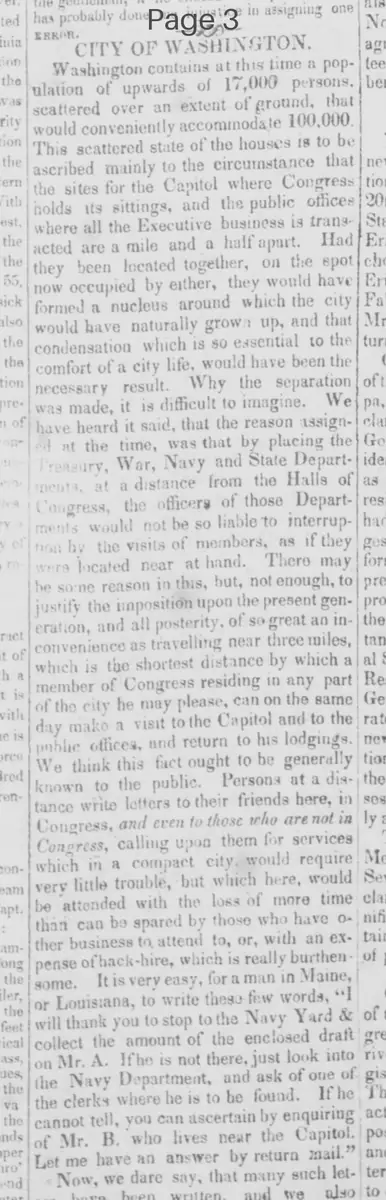
Washington contains at this time a population of upwards of 17,000 persons, scattered over an extent of ground, that would conveniently accommodate 100,000. This scattered state of the houses is to be ascribed mainly to the circumstance that the sites for the Capitol where Congress holds its sittings, and the public offices where all the Executive business is transacted are a mile and a half apart. Had they been located together, on the spot now occupied by either, they would have formed a nucleus around which the city would have naturally grown up, and that condensation which is so essential to the comfort of a city life, would have been the necessary result. Why the separation was made, it is difficult to imagine. We have heard it said, that the reason assigned at the time, was that by placing the Treasury, War, Navy and State Departments, at a distance from the Halls of Congress, the officers of those Departments would not be so liable to interruption by the visits of members, as if they were located near at hand. There may be some reason in this, but not enough, to justify the imposition upon the present generation, and all posterity, of so great an inconvenience as travelling near three miles, which is the shortest distance by which a member of Congress residing in any part of the city he may please, can on the same day make a visit to the Capitol and to the public offices, and return to his lodgings.
We think this fact ought to be generally known to the public. Persons at a distance write letters to their friends here, in Congress, and even to those who are not in Congress, calling upon them for services which in a compact city would require very little trouble, but which here, would be attended with the loss of more time than can be spared by those who have other business to attend to, or, with an expense of hack-hire, which is really burdensome. It is very easy, for a man in Maine, or Louisiana, to write these few words, "I will thank you to step to the Navy Yard & collect the amount of the enclosed draft on Mr. A. If he is not there, just look into the Navy Department, and ask of one of the clerks where he is to be found. If he cannot tell, you can ascertain by enquiring of Mr. B. who lives near the Capitol. Let me have an answer by return mail."
Now, we dare say, that many such letters have been written, and we also dare say, that the writers thought, that in making a simple request, they were imposing a very trifling service upon their correspondents. And yet, to execute such a commission, in strict conformity with the orders, a distance would have to be travelled, if not less than seven miles, and if the unfortunate victim of so unreasonable a request, should happen to live in the part of the city, where some of the Foreign Ministers reside, he could not execute the service, and take his letter to the post-office, and return home, with less than nine miles travel.
What sub-type of article is it?
What keywords are associated?
Where did it happen?
Domestic News Details
Primary Location
Washington
Outcome
inconvenience of traveling up to nine miles for routine tasks, burden on congress members and residents.
Event Details
Washington has over 17,000 residents scattered over space for 100,000 due to Capitol and public offices being 1.5 miles apart, hindering city compactness; speculated reason is to reduce interruptions to department officers; results in excessive travel for members of Congress and others fulfilling requests from afar, exemplified by a letter requiring multi-mile errands.