Thank you for visiting SNEWPapers!
Sign up free
Story
January 4, 1885
The Indianapolis Sentinel
Indianapolis, Marion County, Indiana
What is this article about?
Account of James Buchanan's 1857 inauguration in Washington, D.C., detailing his travel from Pennsylvania, reception, procession with outgoing President Pierce, oath-taking at the Capitol, and celebratory ball amid a growing city population.
Clipping
OCR Quality
95%
Excellent
Full Text
INAUGURATING
Scenes Attending the Induction Into Office of the Last of the Old-Timers
["Carp," in Cleveland Leader]
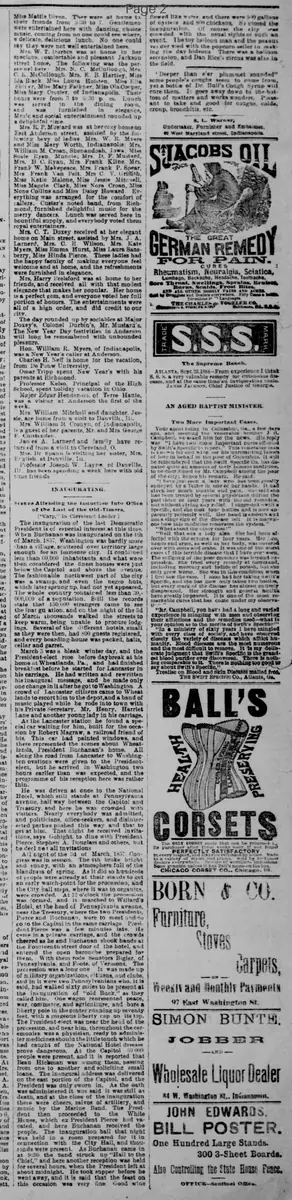
The inauguration of the last Democratic President is of especial interest at this time. When Buchanan was inaugurated on the 4th of March, 1857, Washington was hardly more than a village, scattered over territory large enough for an immense city. It contained less than 60,000 inhabitants, and what were then considered the finest houses were just below the Capitol and above the avenue. The fashionable northwest part of the city was a swamp, and even the negro huts, which later sprung up, had not yet appeared. The whole country contained less than 30,000,000 of a population. Still the records state that 150,000 strangers came to see the inauguration, and on the night of the 3d of March thousands walked the streets to keep warm, being unable to procure lodgings. Several of the different hotels, small as they were then, had 500 guests registered, and every boarding-house was packed, halls, cellar and garret. March 3 was a bleak winter day, and the President-elect rose before daybreak at his home at Wheatlands, Pa., and had finished breakfast before he started for Lancaster in his carriage. He had written and rewritten his inaugural message, and he made only one change in it after he got to Washington. A crowd of Lancaster citizens came to Wheatlands to escort him to the depot, and a band of music played while he rode into town with his Private Secretary, Mr. Henry, Harriet Lane and another young lady in his carriage. At the Lancaster station he found a special car waiting for him, built for the occasion by Robert Magraw, a railroad friend of his. This car had painted windows, and these represented the scenes about Wheatlands, President Buchanan's home. All along the road from Lancaster to Washington ovations were given to the President-elect, but he arrived in Washington two hours earlier than was expected, and the programme of his reception here was rather thin. He was driven at once to the National Hotel, which still stands at Pennsylvania avenue, half way between the Capitol and Treasury, and here he was crowded with visitors. Nearly everybody was admitted, and politicians, office-seekers, and disinterested parties pushed this way and that to get at him. That night he received invitations, says Goright, to dine with President Pierce, Stephen A. Douglas and others, but he declined all invitations. All night of the 3d of March, 1857, Congress was in session. The 4th broke bright and sunny, with an atmosphere full of the blandness of spring. As it did so hundreds of people were already at their stands to get an early watch-point for the procession, and the City Hall steps, where it was to organize, were crowded. At 12 o'clock the procession was formed, and it marched to Willard's Hotel, at the head of Pennsylvania avenue, near the Treasury, where the two Presidents, Pierce and Buchanan, were to meet and to go to the Capitol in the same carriage. President Pierce was a few minutes late. He came in a private carriage, and the crowds cheered as he and Buchanan shook hands at the Fourteenth street door of the hotel, and entered the open barouche prepared for them. With them rode Senators Bigler, of Pennsylvania, and Foot, of Vermont. The procession was a long one. It was made up of military organizations, citizens, and clubs, and in it were two Pennsylvanians who, it is said, had walked sixty miles to be present at the inauguration of "old Buck," as they called him. One wagon represented peace, war, commerce, and agriculture, and bore a liberty pole in the center running up seventy feet, with a gorgeous liberty cap on its top. The President-elect was near the head of the procession, and near him, throughout the ceremonies, was a physician, ready to administer medicines should the little touch which he had caught of the National Hotel disease prove dangerous. At the Capitol 50,000 people were present, and it is reported that Ben. Hickman was among them, passing from one to another and soliciting small loans. The inaugural address was delivered on the east portico of the Capitol, and the President was duly sworn in. As the oath was administered it was said it was still aglow with death, and at the close of the inauguration there were cheers, salvos of artillery, and music by the Marine Band. The President then proceeded to the White House, which ex-President Pierce had vacated, and here Buchanan received the people. The inauguration ball that night was held in a room prepared for it in connection with the City Hall, and thousands were present. As Buchanan came in at 9:30 the band struck up "Hail to the Chief," and here another reception was held for several hours, when the President left at about midnight. He took supper before he went away, and it is said that the feast on this occasion was very fine. Good wine flowed like water, and there were 5 gallons of oysters and sunny chickens. It closed the inauguration. Of course the city crowded with the usual sights of such an event. The toy balloon man and the peanut vendor vied with the popcorn seller in making the day hideous. There was a balloon ascension, and Dan Rice's circus was also in the field.
Scenes Attending the Induction Into Office of the Last of the Old-Timers
["Carp," in Cleveland Leader]
The inauguration of the last Democratic President is of especial interest at this time. When Buchanan was inaugurated on the 4th of March, 1857, Washington was hardly more than a village, scattered over territory large enough for an immense city. It contained less than 60,000 inhabitants, and what were then considered the finest houses were just below the Capitol and above the avenue. The fashionable northwest part of the city was a swamp, and even the negro huts, which later sprung up, had not yet appeared. The whole country contained less than 30,000,000 of a population. Still the records state that 150,000 strangers came to see the inauguration, and on the night of the 3d of March thousands walked the streets to keep warm, being unable to procure lodgings. Several of the different hotels, small as they were then, had 500 guests registered, and every boarding-house was packed, halls, cellar and garret. March 3 was a bleak winter day, and the President-elect rose before daybreak at his home at Wheatlands, Pa., and had finished breakfast before he started for Lancaster in his carriage. He had written and rewritten his inaugural message, and he made only one change in it after he got to Washington. A crowd of Lancaster citizens came to Wheatlands to escort him to the depot, and a band of music played while he rode into town with his Private Secretary, Mr. Henry, Harriet Lane and another young lady in his carriage. At the Lancaster station he found a special car waiting for him, built for the occasion by Robert Magraw, a railroad friend of his. This car had painted windows, and these represented the scenes about Wheatlands, President Buchanan's home. All along the road from Lancaster to Washington ovations were given to the President-elect, but he arrived in Washington two hours earlier than was expected, and the programme of his reception here was rather thin. He was driven at once to the National Hotel, which still stands at Pennsylvania avenue, half way between the Capitol and Treasury, and here he was crowded with visitors. Nearly everybody was admitted, and politicians, office-seekers, and disinterested parties pushed this way and that to get at him. That night he received invitations, says Goright, to dine with President Pierce, Stephen A. Douglas and others, but he declined all invitations. All night of the 3d of March, 1857, Congress was in session. The 4th broke bright and sunny, with an atmosphere full of the blandness of spring. As it did so hundreds of people were already at their stands to get an early watch-point for the procession, and the City Hall steps, where it was to organize, were crowded. At 12 o'clock the procession was formed, and it marched to Willard's Hotel, at the head of Pennsylvania avenue, near the Treasury, where the two Presidents, Pierce and Buchanan, were to meet and to go to the Capitol in the same carriage. President Pierce was a few minutes late. He came in a private carriage, and the crowds cheered as he and Buchanan shook hands at the Fourteenth street door of the hotel, and entered the open barouche prepared for them. With them rode Senators Bigler, of Pennsylvania, and Foot, of Vermont. The procession was a long one. It was made up of military organizations, citizens, and clubs, and in it were two Pennsylvanians who, it is said, had walked sixty miles to be present at the inauguration of "old Buck," as they called him. One wagon represented peace, war, commerce, and agriculture, and bore a liberty pole in the center running up seventy feet, with a gorgeous liberty cap on its top. The President-elect was near the head of the procession, and near him, throughout the ceremonies, was a physician, ready to administer medicines should the little touch which he had caught of the National Hotel disease prove dangerous. At the Capitol 50,000 people were present, and it is reported that Ben. Hickman was among them, passing from one to another and soliciting small loans. The inaugural address was delivered on the east portico of the Capitol, and the President was duly sworn in. As the oath was administered it was said it was still aglow with death, and at the close of the inauguration there were cheers, salvos of artillery, and music by the Marine Band. The President then proceeded to the White House, which ex-President Pierce had vacated, and here Buchanan received the people. The inauguration ball that night was held in a room prepared for it in connection with the City Hall, and thousands were present. As Buchanan came in at 9:30 the band struck up "Hail to the Chief," and here another reception was held for several hours, when the President left at about midnight. He took supper before he went away, and it is said that the feast on this occasion was very fine. Good wine flowed like water, and there were 5 gallons of oysters and sunny chickens. It closed the inauguration. Of course the city crowded with the usual sights of such an event. The toy balloon man and the peanut vendor vied with the popcorn seller in making the day hideous. There was a balloon ascension, and Dan Rice's circus was also in the field.
What sub-type of article is it?
Historical Event
What themes does it cover?
Triumph
What keywords are associated?
Buchanan Inauguration
1857
Washington Dc
Procession
Inaugural Ball
President Pierce
What entities or persons were involved?
Buchanan
Pierce
Harriet Lane
Stephen A. Douglas
Bigler
Foot
Where did it happen?
Washington
Story Details
Key Persons
Buchanan
Pierce
Harriet Lane
Stephen A. Douglas
Bigler
Foot
Location
Washington
Event Date
March 4, 1857
Story Details
Description of James Buchanan's inauguration as the last Democratic President, including his journey from Wheatlands, Pa., arrival in Washington, procession with Pierce, oath at the Capitol, and inauguration ball.