Thank you for visiting SNEWPapers!
Sign up free
The Emporia News
Emporia, Lyon County, Kansas
What is this article about?
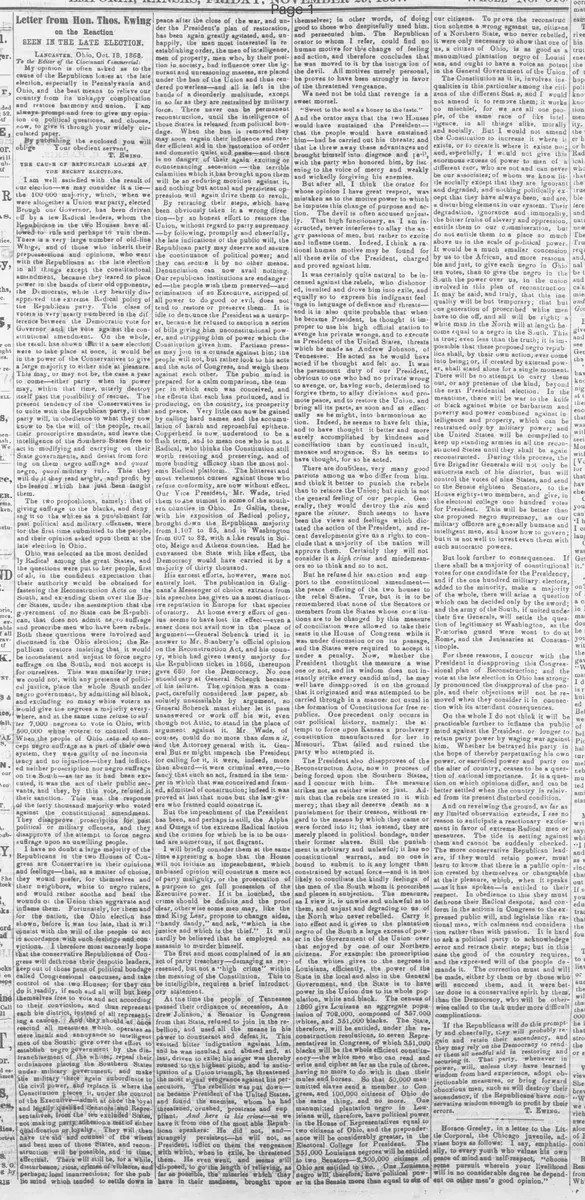
In a letter dated Oct. 18, 1868, from Lancaster, Ohio, Hon. Thomas Ewing analyzes Republican losses in recent Ohio and Pennsylvania elections, attributing them to radical Reconstruction policies, proscription of Southern whites, and forced negro suffrage. He urges conservative Republicans to moderate, defend President Johnson's actions, and restore union without partisan vengeance.
Clipping
OCR Quality
Full Text
on the Reaction
SEEN IN THE LATE ELECTION.
Lancaster, Ohio, Oct. 18, 1868.
To the Editor of the Cincinnati Commercial:
My opinion is often asked as to the
cause of the Republican losses at the late
election, especially in Pennsylvania and
Ohio, and the best means to relieve our
country from its unhappy complication
and restore harmony and union. I am
always prompt and free to give my opinion on political questions, and choose,
now, to give it through your widely circulated paper.
By publishing
the enclosed you will
oblige
Your obedient servant,
T. EWING.
THE CAUSE OF REPUBLICAN LOSSES AT
THE RECENT ELECTIONS.
I am well satisfied with the result of
our election—we may consider it a tie—
the 100,000 majority, which, when we
were altogether a Union war party, elected
Brough our Governor, has been driven
off by a few Radical leaders, whom the
Republicans in the two Houses have all.
lowed to rule and perhaps to ruin them.
There is a very large number of old-line
Whigs, and of those who inherit their
prejudices and opinions, who went
with the Republicans at the late election
in all things except the constitutional
amendment, because they feared to place
power in the hands of their old opponents,
the Democrats, while they heartily dis-
approved the extreme Radical policy of
the Republican party. This class of
voters is very nearly numbered in the difference between the Democratic vote for
Governor and the vote against the constitutional amendment. On the whole,
the result has shown that if a new election
were to take place at once, it would be
in the power of the Conservatives to give
a large majority to either side at pleasure.
This may, or may not be, the case a year
to come—either party when in power
may, within that time, utterly destroy
itself past the possibility of rescue. The
present tendency of the Conservatives is
to unite with the Republican party, if that
party will, in obedience to what they now
know to be the will of the people, recall
their proscriptive mandate, and leave the
intelligence of the Southern States free to
act in modifying and carrying on their
State governments, and desist from forcing on them negro suffrage and quasi
negro, quasi-military rule. This they
will do if they read aright, and profit by
the lesson which has just been taught
them.
The two propositions, namely: that of
giving suffrage to the blacks, and denying it to the whites as a punishment for
past political and military offenses, were
for the first time submitted to the people,
and their opinion asked upon them at the
late election in Ohio.
Ohio was selected as the most decidedly Radical among the great States, and
the questions were put to her people, first
of all, in the confident expectation that
their authority would be obtained for
fastening the Reconstruction Acts on the
South, and extending them over the Border States, under the assumption that the
government of no State can be Republican, that does not admit negro suffrage
and proscribe men who have been rebels.
Both these questions were involved and
discussed in the Ohio election; the Republican orators insisting that it would
be inconsistent and unjust to force negro
suffrage on the South, and not accept it
for ourselves. This was manifestly true;
we could not, with any pretense of political justice, place the whole South under
negro government, by admitting all blacks,
and excluding so many white voters as
would give the negroes a majority everywhere, and at the same time refuse to suffer 7,000 negroes to vote in Ohio, with
500,000 white voters to control them.
When the people of Ohio refused to accept negro suffrage as a part of their own
system, they were guilty of no inconsistency and no injustice—they had inflicted neither proscription nor negro suffrage on the South—as far as it had been executed, it was the act of their public servants, and they, by this vote, refused it
their sanction. This was the response
of the forty thousand majority who voted
against the constitutional amendment.
They disapprove proscription for past
political or military offenses, and they
disapprove of the attempt to force negro
suffrage upon an unwilling people.
I have no doubt a large majority of the
Republicans in the two Houses of Congress are Conservative in their opinions
and feelings—that, as a matter of choice,
they would prefer, for themselves and
their neighbors, white to negro rulers,
and would rather soothe and heal the
wounds of the Union than aggravate and
inflame them. Fortunately, for them and
for the Nation, the Ohio election has
shown, before it was too late, that it will
consist with the will of the people to act
in accordance with such feelings and convictions. I therefore most earnestly hope that the conservative Republicans of Congress will dethrone their despotic leaders,
keep out of those pens of political bondage called Congressional caucuses, and take
control of the two Houses; for they can
do it readily, if each and all will but keep
themselves free to vote and act according
to their conviction, and thus represent
each his district, instead of all representing a caucus. And they should at once
rescind all measures which operate as
mere insult and annoyance to intelligent
men of the South; give over the effort to
establish negro government by the disfranchisement of the whites; repeal their
ordinances placing the Southern States
under military government, and make
the military there again subordinate to
the civil power, and replace it where the
Constitution places it, under the control
of the Executive—admit at once the loyal
and legally qualified Senators and Representatives, from the ten excluded States,
not making party adhesion test of either
qualification or loyalty. They will then
have the aid and counsel of the wisest
and best men of those States, and reconstruction will be possible, and in time,
effectual. There will still be, for a while,
disturbance, riots, crimes of violence, and
perhaps, local insurrections; for the public mind which tended to settle down in
peace after the close of the war, and under the President's plan of restoration,
has been again greatly agitated, and, unhappily, the men most interested in reestablishing order, the men of intelligence,
men of property, men who, by their position in society, had influence over the ignorant and unreasoning masses, are placed under the ban of the Union and thus rendered powerless—and all is left in the
hands of a disorderly multitude, except
in so far as they are restrained by military force. There never can be permanent reconstruction, until the intelligence of
those States is released from political bondage. When the ban is removed they
may soon regain their influence and render efficient aid in the restoration of order
and domestic quiet and peace and there
is no danger of their again exciting or
countenancing secession—the terrible
calamities which it has brought upon them
will be an enduring monition against it,
and nothing but actual and persistent oppression will again drive them to revolt.
By retracing their steps, which have
direction—by an honest effort to restore the
Union, without regard to party supremacy
—by following, promptly and cheerfully,
the late indications of the public will, the
Republican party may deserve and assure
the continuance of political power; and
they can secure it by no other means.
Denunciation can now avail nothing.
Our republican institutions are endangered—the people wish them preserved—and
crimination of an Executive, stripped of
all power to do good or evil, does not
tend to restore or preserve them. It is
idle to denounce the President as a usurper, because he refused to sanction a series
of bills giving him unconstitutional power, and stripping him of power which the
Constitution gives him. Partisan presses may join in a crusade against him; the
people will not, but rather look to his acts
and the acts of Congress, and weigh them
against each other. The public mind is
prepared for a calm comparison, the temper in which each was conceived, and
the effects that each has produced, and is
producing, on the country, its prosperity
and peace. Very little can now be gained
by calling hard names and the accumulation of harsh and reproachful epithets.
Copperhead is now understood to be a
flash term, and to mean one who is not a
Radical, who thinks the Constitution still
worth restoring and preserving, and of
more binding efficacy than the most solemn Radical platform. The bitterest and
most vehement curses against those who
refuse conformity, are now without effect.
Our Vice President, Mr. Wade, tried
them to the utmost in some of the southern counties in Ohio. In Gallia, these,
with his exposition of Radical policy,
brought down the Republican majority
from 1,107 to 85, and in Washington
from 607 to 85, with a like result in Scioto, Meigs and Athens counties. Had he
canvassed the State with like effect, the
Democracy would have carried it by a
majority of thirty thousand.
His earnest efforts, however, were not
entirely lost. The publication in Gallia-
nana's Messenger of choice extracts from
his speeches has given us a most distinctive reputation in Europe for that species
of oratory. At home every effort of genius seems to have lost its effect—even a
sneer does not avail now in the place of
argument—General Schenck tried it in
answer to Mr. Stanbery's official opinion
on the Reconstruction Act, and his county, which had given twenty majority for
the Republican ticket in 1866, thereupon
gave 680 for the Democracy. No one
should carp at General Schenck because
of his failure. The opinion was a compact, carefully considered law paper, absolutely unassailable by argument, so
General Schenck must either let it pass
unanswered or work off his wit, even
though not Attic, to stand in the place of
argument against it. Mr. Wade, of
course, could do no more than damn it,
and the Attorney General with it. General Butler might impeach the President
for calling for it, it were, indeed, more
than absurd—it were criminal even, to
fancy that such an act, framed in the temper in which that was conceived and framed, admitted of construction; indeed it was
proved at last that none but the law-givers who framed could construe it.
But the impeachment of the President
has been, and perhaps is still, the Alpha
and Omega of the extreme Radical faction and the crimes for which he is to be ousted are numerous, if not flagrant.
I will briefly consider them at the same
time expressing a hope that the House
will not initiate an impeachment, which
unbiased opinion will construe a mere act
of party malignity, or the prosecution of
a purpose to get full possession of the
Executive power. If it be touched, the
crime should be definite and the proof
clear, otherwise some men may, like the
mad King Lear, propose to change sides,
"bandy dandy," and ask, "which is the
justice and which is the thief." It will
hardly be believed that he employed an
assassin to murder himself.
The first and most complained of is an
act of party treachery—damaging as represented, but not a "high crime" within
the meaning of the Constitution. This to
be intelligible, requires a brief introductory statement.
At the time the people of Tennessee
passed their ordinance of secession, Andrew Johnson, a Senator in Congress
from that State, refused to join in the rebellion, and used all the means in his
power to counteract and defeat it. This
excited bitter indignation against him,
and he was insulted and abused and, at
last, driven to exile; his anger was thereby roused to the highest pitch, and in anticipation of a Union triumph, he threatened the most signal vengeance against his persecutors. The rebellion was put down—he became President of the United States,
and found the enemies, whom he had
threatened, crushed, prostrate and sup-
pliant. And here is his crime as we
have it from one of the most able Republican speakers: He did not, and—
strangely persistent—he will not, as
President, inflict on them the vengeance
with which, when in exile, he threatened
them. He even went, and seems still
disposed, to go the length of relieving, as
far as possible, the miseries which they
have in their madness, brought upon
themselves; in other words, of doing
good to those who despitefully used him,
and persecuted him. The Republican
orator to whom I refer, could find no
human motive for this change of feeling
and action, and therefore concludes that
he was moved to it by the instigation of
the devil. All motives merely personal,
he proves to have been strongly in favor
of the threatened vengeance.
We need not be told that revenge is a
sweet morsel.
"Sweet to the soul as honey to the taste."
And the orator says that the two Houses
would have sustained the President—
that the people would have sustained
him—had he carried out his threats; and
that he threw away these advantages and
brought himself into disgrace and leagued with the party who honored him, by listening to the voice of mercy and weakly
and wickedly forgiving his enemies.
But after all, I think the orator for
whose opinion I have great respect, was
mistaken as to the motive power to which
he imputes this change of purpose and action. The devil is often accused unjustly. That high functionary, as I am instructed, never interferes to allay the anger passions of men, but rather to excite
and inflame them. Indeed, I think a rational human motive may be found for
all these evils of the President, charged
and proved against him.
It was certainly quite natural to be incensed against the rebels, who dishonored, insulted and drove him into exile, and
equally so to express his indignant feelings in language of defiance and threats—
and it is also quite probable that when
he became President, he thought it improper to use his high official station to
avenge his private wrongs, and to execute as President of the United States, threats
which he made as Andrew Johnson, of
Tennessee. He acted as he would have
acted if he thought and felt so. It was
the paramount duty of our President,
obvious to one who had no private wrong to avenge, or, having such, determined to forgive them, to allay divisions and promote peace, and to restore the Union, and
bring all its parts, as soon and as effectually as he might, into harmonious action. Indeed, he seems to have felt this,
and to have thought it better and more
surely accomplished by kindness and
conciliation than by continued insult
menace and arrogance. So he seems to
have thought, for so he acted.
There are doubtless, very many good
patriots among us who differ from him.
and think it better to punish the rebels
than to restore the Union; but such is not the general feeling of our people. Generally, they would destroy the sin and
spare the sinner. Such seems to have
been the views and feelings which dictated the action of the President, and recent developments give us a right to conclude that a majority of the nation will
approve them. Certainly they will not
consider it a high crime and misdemeanor so to think and so to act.
But he refused his sanction and support to the constitutional amendment—
the peace offering of the two houses to
the rebel States. True, but it is to be
remembered that none of the Senators or
members from the States whose constitutions are to be changed by this measure
of conciliation were allowed to take their
seats in the House of Congress while it
was under discussion or on its passage,
and the States were required to accept it
under a penalty. Now, whether the
President thought the measure a wise
one or not, and its wisdom does not instantly strike every candid mind, he may
well have disapproved it on the ground
that it originated and was attempted to be carried through in a manner not usual in the formation of Constitutions for free republics. One precedent only occurs in
our political history, namely: the attempt to force upon Kansas a proslavery
constitution manufactured for her in
Missouri. That failed and ruined the
party who attempted it.
The President also disapproves of the
Reconstruction Acts, now in process of
being forced upon the Southern States.
and I concur with him. The measure
strikes me as neither wise or just. Admit that the rebels are treated in it with
mercy; that they all deserve death as a
punishment for their treason, without regard to the means by which they came or
were forced into it; that instead, they are
merely placed in political bondage, under
their former slaves. Still the punishment is arbitrary and unlawful; it has no
constitutional warrant, and no one is
bound to submit to it any longer than
constrained by actual force—and it is not likely to conciliate the kindly feelings of
the men of the South whom it proscribes
and places in subjection. The measure,
as I view it, is unwise and unlawful as to
them, and unjust and degrading to us of
the North who never rebelled. Carry it
into effect and it gives to the plantation
negro of the South a large excess of power in the Government of the Union over
that enjoyed by one of our Northern
citizens. For example: the proscription
of the whites gives to the negroes in
Louisiana, efficiently, the power of the
State in the local and also in the General
Government, and the State is to have
power in the Union due to its whole population, white and black. The census of
1860 give Louisiana an aggregate population of 708,000, composed of 357,000
whites, and 351,000 blacks. The State,
therefore, will be entitled, under the reconstruction resolutions, to seven Representatives in Congress, of which 351,000
blacks will be the whole efficient constituency—the white men who can read and
write and cipher as far as the rule of three, having no more to do with it than their
mules and horses. So that 50,000 manumitted slaves send a member to Congress, and 100,000 citizens of Ohio do
the same thing, and no more.
One
manumitted plantation negro in Louisiana will, therefore, have political power
in the House of Representatives equal to
two citizens of Ohio, and the preponderance will be considerably greater, in the
351,000 Louisiana negroes will be entitled
to two Senators—2,300,000 citizens of
Ohio are entitled to two. One Louisiana
negro will, therefore, have political power in the Senate more than equal to six of
our citizens. To prove the reconstruction scheme a wrong against us, citizens
of a Northern State, who never rebelled,
it were only necessary to show that one of
us, a citizen of Ohio, is as good as a
manumitted plantation negro of Louisiana, and ought to have a voice as potent
in the General Government of the Union.
The Constitution as it is, involves inequalities in this particular among the citizens of the different States, and I would
not amend it to remove them; it works
no mischief, for we are all one people, of the same race of like intelligence, in all things alike, morally
and socially. But I would not amend
the Constitution to increase it where it
exists, or to create it where it exists not;
and, especially, I would not give this
enormous excess of power to men of a
different race, who are not and can never
be our associates; of whom we know little socially except that they are ignorant and degraded, and nothing politically except that they have always been, and are,
a disturbing element in our system. Their degradation, ignorance and immorality,
the bitter fruits of slavery and oppression,
entitle them to our commiseration, but
do not entitle them to a place so much
above us in the scale of political power.
It would be a much smaller concession
by us to the African, and more reasonable and just, to give each negro in Ohio
ten votes, than to give the negro in the
South the power over us, in the Union
involved in this plan of reconstruction.
It may be said, and truly, that this inequality will be but temporary; that but
one generation of proscribed white men
have to die off, and all will be right; a
white man in the North will at length become equal to a negro in the South. This
is true; even less than the truth; it is impossible that these proposed negro republics shall, by their own action, ever come
into being; or, if created by external power, shall stand alone for a single moment.
There will be no attempt to carry them
out, or any pretense of the kind, beyond
the next Presidential election. In the meantime, there will be war to the knife
of black against white or barbarism and
poverty and power combined against intelligence and property, which can be
restrained only by military power; and
the United States will be compelled to
keep up standing armies in all the reconstructed States until they shall be again
reconstructed. During this process, the
five Brigadier Generals will not only be
autocrats each of his district, but will
control the votes of nine States, and send
to the Senate eighteen Senators, to the
House eighty-two members, and give, in
the electoral college one hundred votes
for President. This will be better than
the proposed negro supremacy, as our
military officers are generally humane and
intelligent men, and know how to govern;
but it is not well to invest even them with
such autocratic powers.
But look further to consequences.
If
there shall be a majority of constitutional votes for one candidate for the Presidency,
and if the one hundred military electors,
added to the minority, make a majority
of the whole, there will arise a question
which can be decided only by the sword;
and the army of the South, if united under their five Generals, will settle the question of legitimacy at Washington, as the
Prætorian guard were wont to do at
Rome, and the Janissaries at Constantinople.
For these reasons, I concur with the
President in disapproving this Congressional plan of Reconstruction; and the
vote at the late election in Ohio has strongly pronounced the disapproval of the people, and their objections will not be removed when they consider it in connection with its attendant consequences.
On the whole I do not think it will be
practicable further to inflame the public
mind against the President, or longer to
retain party power by waging war against
him. Whether he betrayed his party in
the hope of thereby perpetuating his own
power, or sacrificed power and party on
the altar of country, ceases to be a question of national importance. It is a question on which opinions differ, and can be
better settled when the country is relieved from its present disturbed condition.
And on reviewing the ground, as far as
my limited observation extends, I see no
reason to anticipate a reactionary excitement in favor of extreme Radical men or
measures.
The tide is setting against
them and cannot be suddenly checked.
The more conservative Republican leaders, if they would retain power, must
learn to know that there is a public opinion created by themselves or changeable
at their pleasure, which, when it speaks
—as it has spoken—is entitled to their
respect. In obedience to this they must
dethrone their Radical despots, and conform in the actions in Congress to the expressed public will, and legislate like rational men, with calmness and consideration rather than with passion. It is hard
to ask a political party to acknowledge
error and retrace their steps; but in this
case the good of the country requires,
and the expressed will of the people demands it. "The correction must and will
be made, either by them or by those who
will succeed them, and it were better
done in a conservative spirit by them,
than the Democracy, who will be otherwise called to the task under more difficult complications.
If the Republicans will do this promptly and cheerfully, they will probably retain their ascendency, and
they may rely on the Democracy to render them all needful aid in restoring and
securing it. That party, whenever in
power, will, unless they have learned
wisdom from hard experience, adopt objectionable measures, or bring forward
obnoxious men, such as will destroy their
ascendancy, if the Republicans have conservative wisdom enough to profit by their
errors.
T. EWING.
What sub-type of article is it?
What themes does it cover?
What keywords are associated?
What entities or persons were involved?
Where did it happen?
Story Details
Key Persons
Location
Lancaster, Ohio; Pennsylvania; Southern States
Event Date
Oct. 18, 1868; Late Election In Ohio And Pennsylvania
Story Details
Thomas Ewing's letter attributes Republican electoral losses to radical policies on Reconstruction, proscription of Southern whites, and imposition of negro suffrage; defends President Johnson's merciful approach; urges conservative Republicans to rescind extreme measures, restore civil governance, and admit Southern representatives to achieve union without vengeance.