Thank you for visiting SNEWPapers!
Sign up free
The Virginia Gazette
Richmond, Williamsburg, Richmond County, Virginia
What is this article about?
At the last Kingston Assize, the case between Shipley and Mears was decided contrary to Lord Mansfield's prior verdict. Baron Perrott delivered a detailed opinion emphasizing strict adherence to written agreements over parole evidence, praising judicial caution.
Clipping
OCR Quality
Full Text
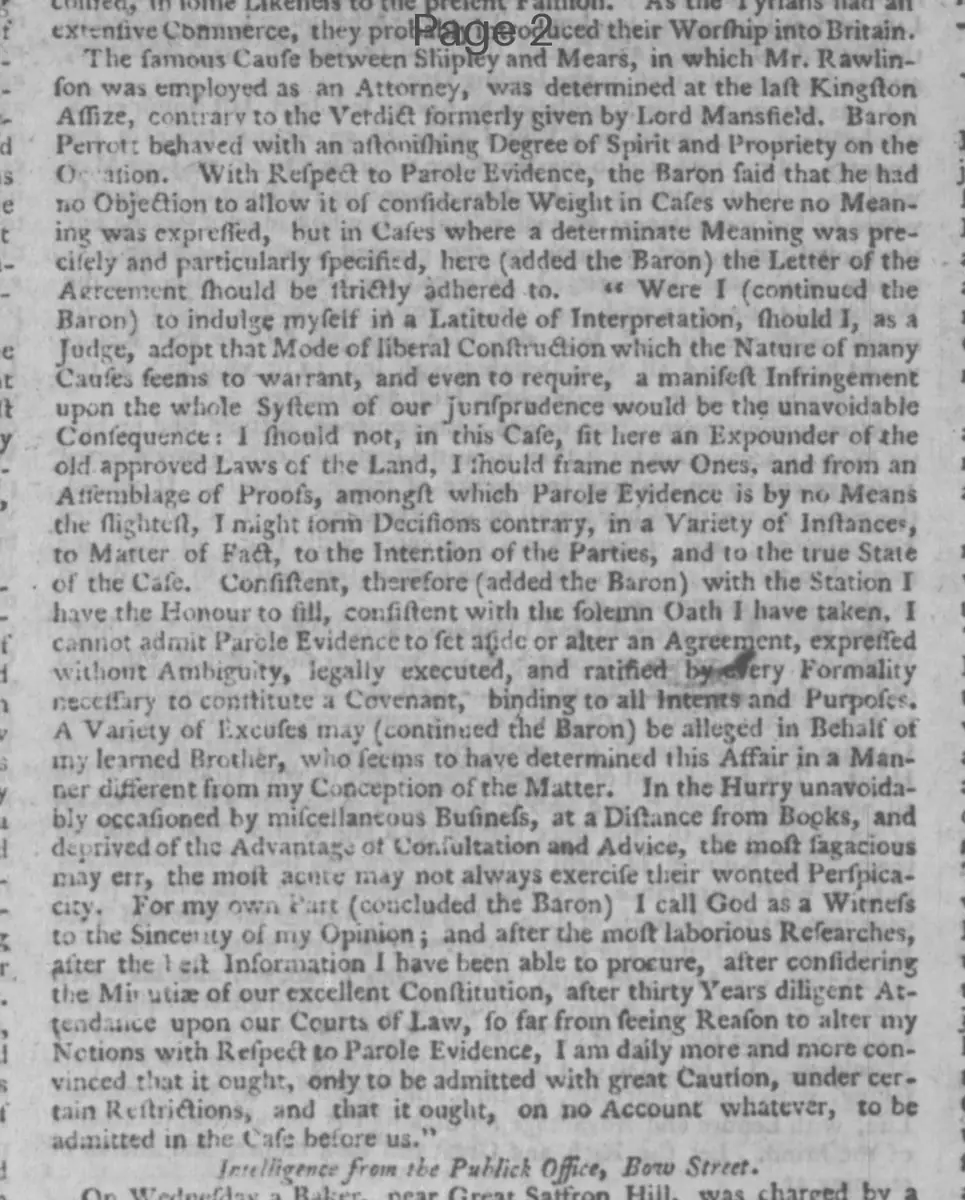
With Respect to Parole Evidence, the Baron said that he had no Objection to allow it of considerable Weight in Cases where no Meaning was expressed, but in Cases where a determinate Meaning was precisely and particularly specified, there (added the Baron) the Letter of the Agreement should be strictly adhered to. "Were I (continued the Baron) to indulge myself in a Latitude of Interpretation, should I, as a Judge, adopt that Mode of liberal Construction which the Nature of many Causes seems to warrant, and even to require, a manifest Infringement upon the whole System of our Jurisprudence would be the unavoidable Consequence: I should not, in this Case, be mere an Expounder of the old approved Laws of the Land, I should frame new Ones. and from an Assemblage of Proofs, amongst which Parole Evidence is by no Means the slightest, I might form Decisions contrary, in a Variety of Instances, to Matter of Fact, to the Intention of the Parties, and to the true State of the Case. Consistent, therefore (added the Baron) with the Station I have the Honour to fill, consistent with the solemn Oath I have taken, I cannot admit Parole Evidence to set aside or alter an Agreement, expressed without Ambiguity, legally executed, and ratified by every Formality necessary to constitute a Covenant, binding to all Intents and Purposes. A Variety of Excuses may (continued the Baron) be alleged in Behalf of my learned Brother, who seems to have determined this Affair in a Manner different from my Conception of the Matter. In the Hurry unavoidably occasioned by miscellaneous Business, at a Distance from Books, and deprived of the Advantages of Consultation and Advice, the most sagacious may err, the most acute may not always exercise their wonted Perpicacity. For my own Part (concluded the Baron) I call God as a Witness to the Sincerity of my Opinion; and after the most laborious Researches, after the best Information I have been able to procure, after considering the Minutiae of our excellent Constitution, after thirty Years diligent Attendance upon our Courts of Law, so far from seeing Reason to alter my Notions with Respect to Parole Evidence, I am daily more and more convinced that it ought, only to be admitted with great Caution, under certain Restrictions, and that it ought, on no Account whatever, to be admitted in the Case before us."
What sub-type of article is it?
What keywords are associated?
What entities or persons were involved?
Where did it happen?
Foreign News Details
Primary Location
Kingston
Event Date
Last Kingston Assize
Key Persons
Outcome
determined contrary to the verdict formerly given by lord mansfield
Event Details
The case between Shipley and Mears, with Mr. Rawlinson as attorney, was decided at the last Kingston Assize. Baron Perrott ruled against admitting parole evidence to alter a clear written agreement, emphasizing strict adherence to the letter of the law and judicial caution, differing from Lord Mansfield's prior verdict.