Thank you for visiting SNEWPapers!
Sign up free
Story
March 19, 1878
The Sedalia Weekly Bazoo
Sedalia, Pettis County, Missouri
What is this article about?
In 1877, John Durbin murdered William L. White in Bates County, Missouri, stole his wagon and horses, and fled. Arrested in Indiana, Durbin pleaded guilty to second-degree murder in March 1878, receiving a ten-year sentence amid community uproar over the light punishment.
Clipping
OCR Quality
95%
Excellent
Full Text
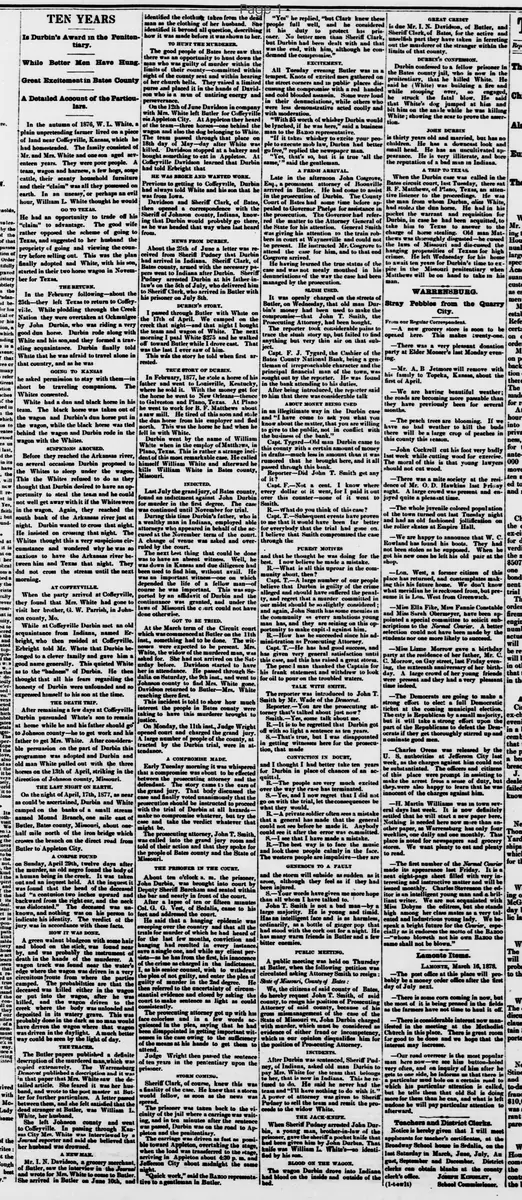
TEN YEARS Is Durbin's Award in the Penitentiary.
While Better Men Have Hung
Great Excitement in Bates County
A Detailed Account of the Particulars.
In the autumn of 1876, W. L. White, a plain unpretending farmer lived on a piece of land near Coffeyville, Kansas, which he had homesteaded. The family consisted of Mr. and Mrs. White and one son aged seventeen years. They were poor people. A team, wagon and harness, a few hogs, some cattle, their scanty household furniture and their "claim" was all they possessed on earth. In an uneasy, or perhaps an evil hour, William L. White thought he would GO TO TEXAS. He had an opportunity to trade off his "claim" to advantage. The good wife rather opposed the scheme of going to Texas, and suggested to her husband the propriety of going and viewing the country before selling out. This was the plan finally adopted and White, with his son, started in their two horse wagon in November for Texas.
THE RETURN.
In the February following-about the 25th-they left Texas to return to Coffeyville. While plodding through the Creek Nation they were overtaken at Ockmulgee by John Durbin, who was riding a very good dun horse. Durbin rode along with White and his son, and they formed a traveling acquaintance. Durbin finally told White that he was afraid to travel alone in that country, and as he was GOING TO Kansas he asked permission to stay with them-in short be traveling companions. The Whites consented. White had a dun and black horse in his team. The black horse was taken out of the wagon and Durbin's dun horse put in the wagon, while the black horse was tied behind the wagon and Durbin rode in the wagon with the Whites.
SUSPICIONS AROUSED
Before they reached the Arkansas river, on several occasions Durbin proposed to the Whites to sleep under the wagon. This the Whites refused to do as they thought that Durbin desired to have an opportunity to steal the team and he could not well get away with it if the Whites were in the wagon. Again, they reached the south bank of the Arkansas river just at night. Durbin wanted to cross that night. He insisted on crossing that night. The Whites thought this a very suspicious circumstance and wondered why he was so anxious to have the Arkansas river between him and Texas that night. They did not cross the stream until the next morning.
AT COFFEYVILLE.
When the party arrived at Coffeyville, they found that Mrs. White had gone to visit her brother, G. W. Parrish, in Johnson county, Mo. While at Coffeyville Durbin met an old acquaintance from Indiana, named Erbright, who then resided at Coffeyville. Erbright told Mr. White that Durbin belonged to a clever family and gave him a good name generally. This quieted White as to the "badness" of Durbin. He then thought that all his fears regarding the honesty of Durbin were unfounded and so expressed himself to his son at the time.
THE DEATH TRIP.
After remaining a few days at Coffeyville Durbin persuaded White's son to remain at home while he and his father should go to Johnson county-he to get work and his father to get Mrs. White. After considerable persuasion on the part of Durbin this programme was adopted and Durbin and old man White pulled out with the three horses on the 13th of April, striking in the direction of Johnson county, Missouri.
THE LAST NIGHT ON EARTH.
On the night of April, 17th, 1877, as near as could be ascertained, Durbin and White camped on the banks of a small stream named Mound Branch, one mile east of Butler, Bates county, Missouri, about one-half mile north of the iron bridge which crosses the branch on the direct road from Butler to Appleton City.
A CORPSE FOUND
On Sunday, April 29th, twelve days after the murder, an old negro found the body of a human being in the creek. It was taken out and an inquest held. At the inquest it was found that the head of the deceased had "a contusion two inches upward and backward from the right ear, and the neck was dislocated." The deceased was unknown, and nothing was on his person to indicate his identity. The verdict of the jury was in accordance with these facts.
HOW IT WAS DONE,
A green walnut bludgeon with some hair and blood on the stick, was found near by, and was probably the instrument of death in the hands of the murderer. A wagon track was found near the water's edge where the wagon was driven in a very circuitous route from where the parties camped. The probabilities are that the deceased was killed either in the wagon or put into the wagon, after he was killed, and the wagon driven to the creek where the body was unloaded and deposited in its watery grave. This was probably done in the dark as no man would have driven the wagon where that wagon was driven in the daylight. A much better way could be seen by the light of day.
THE TRACER
The Butler papers published a definite description of the murdered man, which was copied extensively. The Warrensburg Democrat published a description and it was in that paper that Mrs. White saw the detailed article. She feared it was her husband, and wrote to the post master at Butler for further particulars. A letter passed between them, and she felt satisfied that the dead stranger at Butler, William L. White, her husband. She left Johnson county and went to Coffeyville. In passing through Kansas City Mrs. White was interviewed by a Journal reporter and said she believed that her husband was drowned.
Mrs. White identified the clothing taken from the dead man as the clothing of her husband. She identified it beyond all question, describing how it was made before it was shown to her.
TO HUNT THE MURDERER
The good people of Bates here saw that there was an opportunity to hunt down the man who was guilty of murder within the limits of their county-committed within sight of the county seat and within hearing of her church bells. They raised a limited purse and placed it in the hands of Davidson who is a man of untiring energy and perseverance. On the 12th of June Davidson in company with Mrs. White left Butler for Coffeyville via Appleton City. At Appleton they heard of the team-three horses-one behind the wagon and also the dog belonging to White. The team passed through that place on 18th day of May-day after White was killed. Davidson stopped at a bakery and bought something to eat in Appleton. At Coffeyville Davidson learned that Durbin had told Erbright that He was broke and wanted work. Previous to getting to Coffeyville, Durbin had always told White and his son that he was from Iowa. Davidson and Sheriff Clark, of Bates then opened a correspondence with the Sheriff of Johnson county, Indiana, knowing that Durbin would probably go there, as he was headed that way when last heard from.
NEWS FROM DURBIN.
About the 25th of June a letter was received from Sheriff Pudney that Durbin had arrived in Indiana. Sheriff Clark, of Bates county, armed with the necessary papers went to Indiana after Durbin. Sheriff Pudney arrested Durbin at his father-in-law's on the 5th of July, who delivered him to Sheriff Clark, who arrived in Butler with his prisoner on July 8th.
DURBIN'S STORY.
I passed through Butler with White on the 17th of April. We camped on the creek that night-and that night I bought the team and wagon of White. The next morning I paid White $275 and he walked off toward Butler while I drove east. That was the last I ever saw of him.
This was the story he told when first arrested.
TRUE STORY OF DURBIN.
In February, 1877, he stole a horse of his father and went to Louisville, Kentucky, where he sold it. With the money got for the horse he went to New Orleans-thence to Galveston and Plano, Texas. At Plano he went to work for B. F. Matthews about a saw mill. He tired of this soon and stole the dun horse from his employer and fled north. This was the horse he had when he fell in with White. Durbin went by the name of William White when in the employ of Matthews, in Plano, Texas. This is rather a strange incident of this most remarkable case. He called himself William White and afterward he kills William White in Bates county, Missouri.
INDICTED.
Last July the grand jury, of Bates county, found an indictment against John Durbin for murder in the first degree. The case was continued until November for trial. During this time Durbin's father, who is a wealthy man in Indiana, employed able attorneys who appeared in behalf of the accused at the November term of the court. A change of venue was asked and over-ruled by the court. The next best thing that could be done was to have an absent witness. Well, he was down in Kansas and due diligence had been used to find him, without avail. He was an important witness-one on which depended the life of a fellow man-of course he was important. This was supported by an affidavit of Durbin and the continuance was granted, and under the Laws of Missouri the court could not have done otherwise.
GOT TO BE TRIED.
At the March term of the Circuit court which was commenced at Butler on the 11th inst., something had to be done. The witnesses were expected to be present. Mrs. White, the widow of the murdered man, was asked for. She had not arrived on the Saturday before. Davidson started to have her in attendance. He passed through Sedalia on Saturday, the 9th inst., and went to Johnson county to find Mrs. White gone. Davidson returned to Butler-Mrs. White reaching there first. This incident is told to show how much interest the people in Bates county were taking to have this murderer brought to justice. On Monday, the 11th inst., Judge Wright opened court and charged the grand jury. A large number of people of the county, attracted by the Durbin trial, were in attendance.
A COMPROMISE MADE.
Early Tuesday morning it was whispered that a compromise was about to be effected between the prosecuting attorney and the defendant. The story came to the ears of the grand jury. That body discussed the case and finally voted unanimously that the prosecution should be instructed to proceed with the trial of Durbin at all hazards-make no compromise whatever, but try the case and take the verdict whatever that might be. The prosecuting attorney, John T. Smith, was called into the grand jury room and told of their action and that they spoke for the people of Bates county and the State of Missouri.
About ten o'clock a. m. the prisoner, John Durbin, was brought into court by Deputy Sheriff Burcham and seated within the bar and nearly in front of the court. After a lapse of ten or fifteen minutes Col. G. G. Vest, of Sedalia, came to his feet and addressed the court. He said that a hanging epidemic was sweeping over the country and that all the trials for murder of which he had heard of for the last few months, conviction and hanging had resulted in every instance, save a single one, and while my client persists-as he has from the first, his innocence of the crime as charged in the indictment. I, as his senior counsel, wish to withdraw the plea of not guilty, and enter the plea of guilty of murder in the 2nd degree. He then referred to the uncertainty of circumstantial evidence and closed by asking the court to make sentence as light as could consistently. The prosecuting attorney got up with his face colorless and in a few words acquiesced in the plea, saying that he had been disappointed in getting important witnesses in the case owing to the sufficiency of the means at his hands to get them to attend. Judge Wright then passed the sentence of ten years in the penitentiary upon the prisoner.
STORM COMING.
Sheriff Clark, of course, knew this was a finality of the case. He knew that a storm would follow, as soon as the news was spread. The prisoner was taken back to the vicinity of the jail where a carriage was waiting, and in ten minutes after the sentence was passed, Durbin was on the road to Appleton and the penitentiary. The carriage was driven as fast as possible toward Appleton, overtaking the stage, when the load was transferred to the stage, arriving in Appleton about 4:30 p. m. and Jefferson City about midnight the same night. "Quick work," said the Bazoo representative to a gentleman in Butler.
"Yes" he replied. "but Clark knew these people full well, and he considered it his duty to protect his prisoner. No better man than Sheriff Clark, but Durbin had been dealt with and that was the end, with him, although he condemned the compromise."
EXCITEMENT.
All Tuesday evening Butler was in a tempest. Knots of excited men gathered on the street corners and in public places discussing the compromise with a red handed and cold blooded assassin. Some were loud in their denunciations, while others who were less demonstrative acted coolly and with moderation.
"With $5 worth of whiskey Durbin would be lynched, if he was here," said a business man to the Bazoo representative.
"If it takes whiskey to excite your people to execute mob law, Durbin had better go free." replied the newspaper man.
"Yes, that's so, but it is true 'all the same,'" said the gentleman.
A FRESH ARRIVAL.
Late in the afternoon John Cosgrove, Esq., a prominent attorney of Boonville arrived in Butler. He had come to assist in the prosecution of Durbin. The County Court of Bates had some time before appealed to Governor Phelps for assistance in the prosecution. The Governor had referred the matter to the Attorney General of the State for his attention. General Smith was giving his attention to the train robbers in court at Waynesville and could not be present. He instructed Mr. Cosgrove to attend the case for him, and to that end Cosgrove arrived. He having learned the true status of the case and was not mealy mouthed in his denunciations of the way the case had been managed by the prosecution.
It was openly charged on the streets of Butler, on Wednesday, that old man Durbin's money had been used to make the compromise-that John T. Smith, the Prosecuting Attorney, had been bought. The reporter took considerable pains to trace the slush story up, but failed to find anything but very thin air on that subject. Capt. F. J. Tygard, the Cashier of the Bates County National Bank, being a gentleman of irreproachable character and the principal financial man of the town, was sought out by the reporter. He was found in the bank attending to his duties. After being introduced, the reporter said to him that there was considerable talk ABOUT MONEY BEING USED in an illegitimate way in the Durbin case and "I have come to ask you what you know about the matter, that you are willing to give to the public, not in conflict with the business of the bank."
Capt. Tygard-Old man Durbin came to this county with a certain amount of money in drafts--much less in amount than it was rumored that he brought here, and it all passed through this bank.
Reporter-Did John T. Smith get any of it?
Capt. F-Not a cent. I know where every dollar of it went, for I paid it out over this counter-none of it went to Smith.
R.-What do you think of this case?
Capt. T.-Subsequent events have proven to me that it would have been far better for everybody that the trial had gone on. I believe that Smith compromised the case through the PUREST MOTIVES and that he thought he was doing for the best. I now believe he made a mistake.
R--What is all this uproar in the community about, then?
Capt. T.-A large number of our people believe that Durbin is guilty of the crime alleged and should have suffered the penalty, and regret that a murder committed in our midst should be so slightly considered; and again, John Smith has some enemies in the community as every ambitious young man has, and they are seizing on this opportunity to make capital against him.
R.-How has he succeeded since his administration as Prosecuting Attorney.
Capt. T.-He has had good success, and has given very general satisfaction until this case, and this has raised a great storm. The penman thanked the Captain for his frank statement and withdrew to look for oil to pour on the troubled waters.
TALK WITH SMITH.
The reporter was introduced to John T. Smith by Mr. Wade of the Democrat.
Reporter.-You are the prosecuting attorney that's talked about just now?
Smith.-Yes, come talk about me.
R.-It is to be regretted that Durbin got off with so light a sentence as ten years.
S.-That's true, but I was disappointed in getting witnesses here for the prosecution, that made CONVICTION IN DOUBT, and I thought I had better take ten years for Durbin in place of chances of an acquittal.
R.-The people are very much excited over the way the case has terminated.
S.-Yes, and I now regret that I did not go on with the trial, let the consequences be what they would.
R-A private soldier often sees a mistake that a general has made that the general could not see before he made it. Anybody could see it after the error was committed.
S.-I see that I have made a mistake.
R-The best way is to face the music and look these people calmly in the face. The western people are impulsive-they are GENEROUS TO A FAULT and the storm will subside as sudden as it arose, although they feel as if they had been injured.
S.-Your words have given me more hope than all whom I have talked to.
John T. Smith is not a bad man-by a large majority. He is young and timid. Has an intelligent face and is as harmless, ordinarily, as a bottle of ginger pop that had stood with the cork out for a night. He has many warm friends in Butler and a few bitter enemies.
PUBLIC MEETING.
A public meeting was held on Thursday at Butler, when the following petition was circulated asking Attorney Smith to resign:
State of Missouri, County of Bates:
We, the citizens of said county of Bates, do hereby request John T. Smith, of said county, to resign his position of Prosecuting Attorney of said county, because of his gross mismanagement of the case of the State of Missouri vs. John Durbin charged with murder, which must be considered as evidence of either fraud or incompetency, which in our opinion disqualifies him for the position of Prosecuting Attorney.
INCIDENTS.
After Durbin was sentenced, Sheriff Pudney, of Indiana, asked old man Durbin to pay Mrs. White for the team that belongs to her, that is now in Indiana. This he refused to do. He said he never had the team and "I'll have nothing to do with it." A power of attorney was given to Sheriff Pudney to sell the team and remit the proceeds to the widow White.
THE JACK-KNIFE.
When Sheriff Pudney arrested John Durbin, a young man, brother-in-law of the prisoner, gave the sheriff a pocket knife that had been given him by John Durbin. That knife was William L. White's-so identified by his son.
BLOOD ON THE WAGON.
The wagon Durbin drove into Indiana had blood on the inside and outside of the bed.
We are due Mr. I. N. Davidson, of Butler, and Sheriff Clark, of Bates, for the active and unselfish part they have taken in ferreting out the murderer of the stranger within the limits of that county.
DURBIN'S CONFESSION.
Durbin confessed to a fellow prisoner in the Bates county jail, who is now in the penitentiary, that he killed White. He said he (White) was building a fire and while stooping over, so engaged, he struck the fatal blow. He said that White's dog jumped at him and bit him on the ankle while he was killing White; showing the scar to prove the assertion.
JOHN DURBIN
is thirty years old and married, but has no children. He has a downcast look and small head. He has an uncultivated appearance. He is very illiterate, and bore the reputation of a bad man in Indiana.
A TRIP TO TEXAS
When the Durbin case was called in the Bates circuit court, last Tuesday, there sat B. F. Matthews, of Plano, Texas, an attentive listener to the proceedings. He was the man from whom Durbin, alias White, had stole the dun horse. He had in his pocket the warrant and requisition for Durbin, in case he had been acquitted, to take him to Texas to answer to the charge of horse stealing. Old man Matthews was thoroughly disgusted-he cursed the laws of Missouri and discouraged the hanging propensities of Texans for high crimes. He left Wednesday for his home to await ten years for Durbin's time to expire in the Missouri penitentiary when Matthews will be on hand to take his man.
While Better Men Have Hung
Great Excitement in Bates County
A Detailed Account of the Particulars.
In the autumn of 1876, W. L. White, a plain unpretending farmer lived on a piece of land near Coffeyville, Kansas, which he had homesteaded. The family consisted of Mr. and Mrs. White and one son aged seventeen years. They were poor people. A team, wagon and harness, a few hogs, some cattle, their scanty household furniture and their "claim" was all they possessed on earth. In an uneasy, or perhaps an evil hour, William L. White thought he would GO TO TEXAS. He had an opportunity to trade off his "claim" to advantage. The good wife rather opposed the scheme of going to Texas, and suggested to her husband the propriety of going and viewing the country before selling out. This was the plan finally adopted and White, with his son, started in their two horse wagon in November for Texas.
THE RETURN.
In the February following-about the 25th-they left Texas to return to Coffeyville. While plodding through the Creek Nation they were overtaken at Ockmulgee by John Durbin, who was riding a very good dun horse. Durbin rode along with White and his son, and they formed a traveling acquaintance. Durbin finally told White that he was afraid to travel alone in that country, and as he was GOING TO Kansas he asked permission to stay with them-in short be traveling companions. The Whites consented. White had a dun and black horse in his team. The black horse was taken out of the wagon and Durbin's dun horse put in the wagon, while the black horse was tied behind the wagon and Durbin rode in the wagon with the Whites.
SUSPICIONS AROUSED
Before they reached the Arkansas river, on several occasions Durbin proposed to the Whites to sleep under the wagon. This the Whites refused to do as they thought that Durbin desired to have an opportunity to steal the team and he could not well get away with it if the Whites were in the wagon. Again, they reached the south bank of the Arkansas river just at night. Durbin wanted to cross that night. He insisted on crossing that night. The Whites thought this a very suspicious circumstance and wondered why he was so anxious to have the Arkansas river between him and Texas that night. They did not cross the stream until the next morning.
AT COFFEYVILLE.
When the party arrived at Coffeyville, they found that Mrs. White had gone to visit her brother, G. W. Parrish, in Johnson county, Mo. While at Coffeyville Durbin met an old acquaintance from Indiana, named Erbright, who then resided at Coffeyville. Erbright told Mr. White that Durbin belonged to a clever family and gave him a good name generally. This quieted White as to the "badness" of Durbin. He then thought that all his fears regarding the honesty of Durbin were unfounded and so expressed himself to his son at the time.
THE DEATH TRIP.
After remaining a few days at Coffeyville Durbin persuaded White's son to remain at home while he and his father should go to Johnson county-he to get work and his father to get Mrs. White. After considerable persuasion on the part of Durbin this programme was adopted and Durbin and old man White pulled out with the three horses on the 13th of April, striking in the direction of Johnson county, Missouri.
THE LAST NIGHT ON EARTH.
On the night of April, 17th, 1877, as near as could be ascertained, Durbin and White camped on the banks of a small stream named Mound Branch, one mile east of Butler, Bates county, Missouri, about one-half mile north of the iron bridge which crosses the branch on the direct road from Butler to Appleton City.
A CORPSE FOUND
On Sunday, April 29th, twelve days after the murder, an old negro found the body of a human being in the creek. It was taken out and an inquest held. At the inquest it was found that the head of the deceased had "a contusion two inches upward and backward from the right ear, and the neck was dislocated." The deceased was unknown, and nothing was on his person to indicate his identity. The verdict of the jury was in accordance with these facts.
HOW IT WAS DONE,
A green walnut bludgeon with some hair and blood on the stick, was found near by, and was probably the instrument of death in the hands of the murderer. A wagon track was found near the water's edge where the wagon was driven in a very circuitous route from where the parties camped. The probabilities are that the deceased was killed either in the wagon or put into the wagon, after he was killed, and the wagon driven to the creek where the body was unloaded and deposited in its watery grave. This was probably done in the dark as no man would have driven the wagon where that wagon was driven in the daylight. A much better way could be seen by the light of day.
THE TRACER
The Butler papers published a definite description of the murdered man, which was copied extensively. The Warrensburg Democrat published a description and it was in that paper that Mrs. White saw the detailed article. She feared it was her husband, and wrote to the post master at Butler for further particulars. A letter passed between them, and she felt satisfied that the dead stranger at Butler, William L. White, her husband. She left Johnson county and went to Coffeyville. In passing through Kansas City Mrs. White was interviewed by a Journal reporter and said she believed that her husband was drowned.
Mrs. White identified the clothing taken from the dead man as the clothing of her husband. She identified it beyond all question, describing how it was made before it was shown to her.
TO HUNT THE MURDERER
The good people of Bates here saw that there was an opportunity to hunt down the man who was guilty of murder within the limits of their county-committed within sight of the county seat and within hearing of her church bells. They raised a limited purse and placed it in the hands of Davidson who is a man of untiring energy and perseverance. On the 12th of June Davidson in company with Mrs. White left Butler for Coffeyville via Appleton City. At Appleton they heard of the team-three horses-one behind the wagon and also the dog belonging to White. The team passed through that place on 18th day of May-day after White was killed. Davidson stopped at a bakery and bought something to eat in Appleton. At Coffeyville Davidson learned that Durbin had told Erbright that He was broke and wanted work. Previous to getting to Coffeyville, Durbin had always told White and his son that he was from Iowa. Davidson and Sheriff Clark, of Bates then opened a correspondence with the Sheriff of Johnson county, Indiana, knowing that Durbin would probably go there, as he was headed that way when last heard from.
NEWS FROM DURBIN.
About the 25th of June a letter was received from Sheriff Pudney that Durbin had arrived in Indiana. Sheriff Clark, of Bates county, armed with the necessary papers went to Indiana after Durbin. Sheriff Pudney arrested Durbin at his father-in-law's on the 5th of July, who delivered him to Sheriff Clark, who arrived in Butler with his prisoner on July 8th.
DURBIN'S STORY.
I passed through Butler with White on the 17th of April. We camped on the creek that night-and that night I bought the team and wagon of White. The next morning I paid White $275 and he walked off toward Butler while I drove east. That was the last I ever saw of him.
This was the story he told when first arrested.
TRUE STORY OF DURBIN.
In February, 1877, he stole a horse of his father and went to Louisville, Kentucky, where he sold it. With the money got for the horse he went to New Orleans-thence to Galveston and Plano, Texas. At Plano he went to work for B. F. Matthews about a saw mill. He tired of this soon and stole the dun horse from his employer and fled north. This was the horse he had when he fell in with White. Durbin went by the name of William White when in the employ of Matthews, in Plano, Texas. This is rather a strange incident of this most remarkable case. He called himself William White and afterward he kills William White in Bates county, Missouri.
INDICTED.
Last July the grand jury, of Bates county, found an indictment against John Durbin for murder in the first degree. The case was continued until November for trial. During this time Durbin's father, who is a wealthy man in Indiana, employed able attorneys who appeared in behalf of the accused at the November term of the court. A change of venue was asked and over-ruled by the court. The next best thing that could be done was to have an absent witness. Well, he was down in Kansas and due diligence had been used to find him, without avail. He was an important witness-one on which depended the life of a fellow man-of course he was important. This was supported by an affidavit of Durbin and the continuance was granted, and under the Laws of Missouri the court could not have done otherwise.
GOT TO BE TRIED.
At the March term of the Circuit court which was commenced at Butler on the 11th inst., something had to be done. The witnesses were expected to be present. Mrs. White, the widow of the murdered man, was asked for. She had not arrived on the Saturday before. Davidson started to have her in attendance. He passed through Sedalia on Saturday, the 9th inst., and went to Johnson county to find Mrs. White gone. Davidson returned to Butler-Mrs. White reaching there first. This incident is told to show how much interest the people in Bates county were taking to have this murderer brought to justice. On Monday, the 11th inst., Judge Wright opened court and charged the grand jury. A large number of people of the county, attracted by the Durbin trial, were in attendance.
A COMPROMISE MADE.
Early Tuesday morning it was whispered that a compromise was about to be effected between the prosecuting attorney and the defendant. The story came to the ears of the grand jury. That body discussed the case and finally voted unanimously that the prosecution should be instructed to proceed with the trial of Durbin at all hazards-make no compromise whatever, but try the case and take the verdict whatever that might be. The prosecuting attorney, John T. Smith, was called into the grand jury room and told of their action and that they spoke for the people of Bates county and the State of Missouri.
About ten o'clock a. m. the prisoner, John Durbin, was brought into court by Deputy Sheriff Burcham and seated within the bar and nearly in front of the court. After a lapse of ten or fifteen minutes Col. G. G. Vest, of Sedalia, came to his feet and addressed the court. He said that a hanging epidemic was sweeping over the country and that all the trials for murder of which he had heard of for the last few months, conviction and hanging had resulted in every instance, save a single one, and while my client persists-as he has from the first, his innocence of the crime as charged in the indictment. I, as his senior counsel, wish to withdraw the plea of not guilty, and enter the plea of guilty of murder in the 2nd degree. He then referred to the uncertainty of circumstantial evidence and closed by asking the court to make sentence as light as could consistently. The prosecuting attorney got up with his face colorless and in a few words acquiesced in the plea, saying that he had been disappointed in getting important witnesses in the case owing to the sufficiency of the means at his hands to get them to attend. Judge Wright then passed the sentence of ten years in the penitentiary upon the prisoner.
STORM COMING.
Sheriff Clark, of course, knew this was a finality of the case. He knew that a storm would follow, as soon as the news was spread. The prisoner was taken back to the vicinity of the jail where a carriage was waiting, and in ten minutes after the sentence was passed, Durbin was on the road to Appleton and the penitentiary. The carriage was driven as fast as possible toward Appleton, overtaking the stage, when the load was transferred to the stage, arriving in Appleton about 4:30 p. m. and Jefferson City about midnight the same night. "Quick work," said the Bazoo representative to a gentleman in Butler.
"Yes" he replied. "but Clark knew these people full well, and he considered it his duty to protect his prisoner. No better man than Sheriff Clark, but Durbin had been dealt with and that was the end, with him, although he condemned the compromise."
EXCITEMENT.
All Tuesday evening Butler was in a tempest. Knots of excited men gathered on the street corners and in public places discussing the compromise with a red handed and cold blooded assassin. Some were loud in their denunciations, while others who were less demonstrative acted coolly and with moderation.
"With $5 worth of whiskey Durbin would be lynched, if he was here," said a business man to the Bazoo representative.
"If it takes whiskey to excite your people to execute mob law, Durbin had better go free." replied the newspaper man.
"Yes, that's so, but it is true 'all the same,'" said the gentleman.
A FRESH ARRIVAL.
Late in the afternoon John Cosgrove, Esq., a prominent attorney of Boonville arrived in Butler. He had come to assist in the prosecution of Durbin. The County Court of Bates had some time before appealed to Governor Phelps for assistance in the prosecution. The Governor had referred the matter to the Attorney General of the State for his attention. General Smith was giving his attention to the train robbers in court at Waynesville and could not be present. He instructed Mr. Cosgrove to attend the case for him, and to that end Cosgrove arrived. He having learned the true status of the case and was not mealy mouthed in his denunciations of the way the case had been managed by the prosecution.
It was openly charged on the streets of Butler, on Wednesday, that old man Durbin's money had been used to make the compromise-that John T. Smith, the Prosecuting Attorney, had been bought. The reporter took considerable pains to trace the slush story up, but failed to find anything but very thin air on that subject. Capt. F. J. Tygard, the Cashier of the Bates County National Bank, being a gentleman of irreproachable character and the principal financial man of the town, was sought out by the reporter. He was found in the bank attending to his duties. After being introduced, the reporter said to him that there was considerable talk ABOUT MONEY BEING USED in an illegitimate way in the Durbin case and "I have come to ask you what you know about the matter, that you are willing to give to the public, not in conflict with the business of the bank."
Capt. Tygard-Old man Durbin came to this county with a certain amount of money in drafts--much less in amount than it was rumored that he brought here, and it all passed through this bank.
Reporter-Did John T. Smith get any of it?
Capt. F-Not a cent. I know where every dollar of it went, for I paid it out over this counter-none of it went to Smith.
R.-What do you think of this case?
Capt. T.-Subsequent events have proven to me that it would have been far better for everybody that the trial had gone on. I believe that Smith compromised the case through the PUREST MOTIVES and that he thought he was doing for the best. I now believe he made a mistake.
R--What is all this uproar in the community about, then?
Capt. T.-A large number of our people believe that Durbin is guilty of the crime alleged and should have suffered the penalty, and regret that a murder committed in our midst should be so slightly considered; and again, John Smith has some enemies in the community as every ambitious young man has, and they are seizing on this opportunity to make capital against him.
R.-How has he succeeded since his administration as Prosecuting Attorney.
Capt. T.-He has had good success, and has given very general satisfaction until this case, and this has raised a great storm. The penman thanked the Captain for his frank statement and withdrew to look for oil to pour on the troubled waters.
TALK WITH SMITH.
The reporter was introduced to John T. Smith by Mr. Wade of the Democrat.
Reporter.-You are the prosecuting attorney that's talked about just now?
Smith.-Yes, come talk about me.
R.-It is to be regretted that Durbin got off with so light a sentence as ten years.
S.-That's true, but I was disappointed in getting witnesses here for the prosecution, that made CONVICTION IN DOUBT, and I thought I had better take ten years for Durbin in place of chances of an acquittal.
R.-The people are very much excited over the way the case has terminated.
S.-Yes, and I now regret that I did not go on with the trial, let the consequences be what they would.
R-A private soldier often sees a mistake that a general has made that the general could not see before he made it. Anybody could see it after the error was committed.
S.-I see that I have made a mistake.
R-The best way is to face the music and look these people calmly in the face. The western people are impulsive-they are GENEROUS TO A FAULT and the storm will subside as sudden as it arose, although they feel as if they had been injured.
S.-Your words have given me more hope than all whom I have talked to.
John T. Smith is not a bad man-by a large majority. He is young and timid. Has an intelligent face and is as harmless, ordinarily, as a bottle of ginger pop that had stood with the cork out for a night. He has many warm friends in Butler and a few bitter enemies.
PUBLIC MEETING.
A public meeting was held on Thursday at Butler, when the following petition was circulated asking Attorney Smith to resign:
State of Missouri, County of Bates:
We, the citizens of said county of Bates, do hereby request John T. Smith, of said county, to resign his position of Prosecuting Attorney of said county, because of his gross mismanagement of the case of the State of Missouri vs. John Durbin charged with murder, which must be considered as evidence of either fraud or incompetency, which in our opinion disqualifies him for the position of Prosecuting Attorney.
INCIDENTS.
After Durbin was sentenced, Sheriff Pudney, of Indiana, asked old man Durbin to pay Mrs. White for the team that belongs to her, that is now in Indiana. This he refused to do. He said he never had the team and "I'll have nothing to do with it." A power of attorney was given to Sheriff Pudney to sell the team and remit the proceeds to the widow White.
THE JACK-KNIFE.
When Sheriff Pudney arrested John Durbin, a young man, brother-in-law of the prisoner, gave the sheriff a pocket knife that had been given him by John Durbin. That knife was William L. White's-so identified by his son.
BLOOD ON THE WAGON.
The wagon Durbin drove into Indiana had blood on the inside and outside of the bed.
We are due Mr. I. N. Davidson, of Butler, and Sheriff Clark, of Bates, for the active and unselfish part they have taken in ferreting out the murderer of the stranger within the limits of that county.
DURBIN'S CONFESSION.
Durbin confessed to a fellow prisoner in the Bates county jail, who is now in the penitentiary, that he killed White. He said he (White) was building a fire and while stooping over, so engaged, he struck the fatal blow. He said that White's dog jumped at him and bit him on the ankle while he was killing White; showing the scar to prove the assertion.
JOHN DURBIN
is thirty years old and married, but has no children. He has a downcast look and small head. He has an uncultivated appearance. He is very illiterate, and bore the reputation of a bad man in Indiana.
A TRIP TO TEXAS
When the Durbin case was called in the Bates circuit court, last Tuesday, there sat B. F. Matthews, of Plano, Texas, an attentive listener to the proceedings. He was the man from whom Durbin, alias White, had stole the dun horse. He had in his pocket the warrant and requisition for Durbin, in case he had been acquitted, to take him to Texas to answer to the charge of horse stealing. Old man Matthews was thoroughly disgusted-he cursed the laws of Missouri and discouraged the hanging propensities of Texans for high crimes. He left Wednesday for his home to await ten years for Durbin's time to expire in the Missouri penitentiary when Matthews will be on hand to take his man.
What sub-type of article is it?
Crime Story
Mystery
Tragedy
What themes does it cover?
Crime Punishment
Justice
Misfortune
What keywords are associated?
Murder
Trial
Compromise
Horse Theft
Investigation
Bates County
What entities or persons were involved?
John Durbin
William L. White
Mrs. White
I. N. Davidson
Sheriff Clark
John T. Smith
Where did it happen?
Bates County, Missouri
Story Details
Key Persons
John Durbin
William L. White
Mrs. White
I. N. Davidson
Sheriff Clark
John T. Smith
Location
Bates County, Missouri
Event Date
Autumn 1876 To March 1878
Story Details
John Durbin murders farmer William L. White during a trip in Bates County, Missouri, in April 1877, steals his team, and is later arrested in Indiana. After a trial with a plea bargain to second-degree murder, Durbin is sentenced to ten years in prison, causing public outrage.