Thank you for visiting SNEWPapers!
Sign up free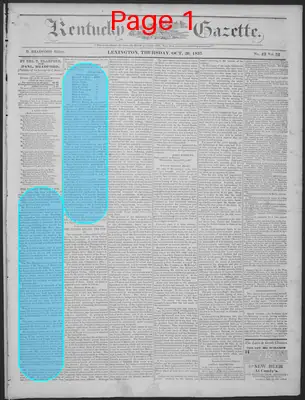
Story
October 26, 1837
Kentucky Gazette
Lexington, Fayette County, Kentucky
What is this article about?
In the Lowell murder case, Dr. Graves is committed to Concord Jail for trial after Mary Anne Wilson died from an abortion at his house. The court, led by Mr. Justice Locke, denies bail, citing strong evidence of his involvement and concealment of the death.
Clipping
OCR Quality
95%
Excellent
Full Text
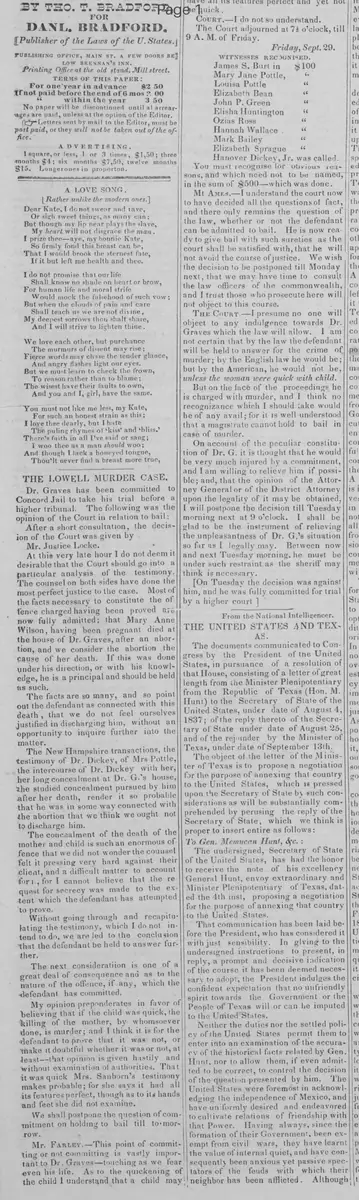
THE LOWELL MURDER CASE.
Dr. Graves has been committed to Concord Jail to take his trial before a higher tribunal. The following was the opinion of the Court in relation to bail:
After a short consultation, the decision of the Court was given by Mr. Justice Locke.
At this very late hour I do not deem it desirable that the Court should go into a particular analysis of the testimony. The counsel on both sides have done the most perfect justice to the case. Most of the facts necessary to constitute the offence charged having been proved are now fully admitted: that Mary Anne Wilson, having been pregnant died at the house of Dr. Graves, after an abortion, and we consider the abortion the cause of her death. If this was done under his direction, or with his knowledge, he is a principal and should be held as such.
The facts are so many, and so point out the defendant as connected with this death, that we do not feel ourselves justified in discharging him, without an opportunity to inquire further into the matter. The New Hampshire transactions, the testimony of Dr. Dickey, of Mrs Pottle, the intercourse of Dr. Dickey with her, her long concealment at Dr. G.'s house, the studied concealment pursued by him after her death, render it so probable that he was in some way connected with the abortion that we think we ought not to discharge him.
The concealment of the death of the mother and child is such an enormous offence that we did not wonder the counsel felt it pressing very hard against their client, and a difficult matter to account for, for I cannot believe that the request for secrecy was made to the extent which the defendant has attempted to prove.
Without going through and recapitulating the testimony, which I do not intend to do, we are led to the conclusion that the defendant be held to answer further.
The next consideration is one of a great deal of consequence and as to the nature of the offence, if any, which the defendant has committed.
My opinion preponderates in favor of believing that if the child was quick, the killing of the mother, by whomsoever done, is murder; and I think it is for the defendant to prove that it was not, or make it doubtful whether it was or not, at least—that opinion is given hastily and without examination of authorities. That it was quick Mrs. Sanborn's testimony makes probable; for she says it had all its features perfect, though as to its hands and feet she did not examine.
We shall postpone the question of commitment on holding to bail till tomorrow.
Mr. Farley.—This point of committing or not committing is vastly important to Dr. Graves—touching as we fear even his life. As to the quickening of the child I understand that a child may
Court, I do not so understand.
The Court adjourned at 7 o'clock, till 9 A. M. of Friday.
Friday, Sept. 29.
WITNESSES RECOGNIZED.
James S. Burt in $100
Mary Jane Pottle, $500
Louisa Pottle $500
Elizabeth Bean $500
John P. Green $500
Elisha Huntington $500
Ozias Ross $500
Hannah Wallace $500
Mark Bailey $500
Elizabeth Sprague $500
Hanover Dickey, Jr. was called. You must recognise for obvious reasons, and which need not to be named, in the sum of $500—which was done.
Mr. Ames.—I understand the court now to have decided all the questions of fact, and there only remains the question of the law, whether or not the defendant can be admitted to bail. He is now ready to give bail with such sureties as the court shall be satisfied with, that he will not avoid the course of justice. We wish the decision to be postponed till Monday next, that we may have time to consult the law officers of the commonwealth, and I trust those who prosecute here will not object to this course.
The Court.—I presume no one will object to any indulgence towards Dr. Graves which the law will allow. I am not certain that by the law the defendant will be held to answer for the crime of murder; by the English law he would be; but by the American, he would not be, unless the woman were quick with child.
But on the face of the proceedings he is charged with murder, and I think no recognizance which I should take would be of any avail; for it is well understood that a magistrate cannot hold to bail in case of murder.
On account of the peculiar constitution of Dr. G. it is thought that he would be very much injured by a commitment, and I am willing to relieve him if possible; and, that the opinion of the Attorney General or of the District Attorney upon the legality of it may be obtained, I will postpone the decision till Tuesday morning next at 9 o'clock. I shall be glad to be the instrument of relieving the unpleasantness of Dr. G.'s situation so far as I legally may. Between now and next Tuesday morning, he must be under such restraint as the sheriff may think is necessary.
[On Tuesday the decision was against him, and he was fully committed for trial by a higher court]
Dr. Graves has been committed to Concord Jail to take his trial before a higher tribunal. The following was the opinion of the Court in relation to bail:
After a short consultation, the decision of the Court was given by Mr. Justice Locke.
At this very late hour I do not deem it desirable that the Court should go into a particular analysis of the testimony. The counsel on both sides have done the most perfect justice to the case. Most of the facts necessary to constitute the offence charged having been proved are now fully admitted: that Mary Anne Wilson, having been pregnant died at the house of Dr. Graves, after an abortion, and we consider the abortion the cause of her death. If this was done under his direction, or with his knowledge, he is a principal and should be held as such.
The facts are so many, and so point out the defendant as connected with this death, that we do not feel ourselves justified in discharging him, without an opportunity to inquire further into the matter. The New Hampshire transactions, the testimony of Dr. Dickey, of Mrs Pottle, the intercourse of Dr. Dickey with her, her long concealment at Dr. G.'s house, the studied concealment pursued by him after her death, render it so probable that he was in some way connected with the abortion that we think we ought not to discharge him.
The concealment of the death of the mother and child is such an enormous offence that we did not wonder the counsel felt it pressing very hard against their client, and a difficult matter to account for, for I cannot believe that the request for secrecy was made to the extent which the defendant has attempted to prove.
Without going through and recapitulating the testimony, which I do not intend to do, we are led to the conclusion that the defendant be held to answer further.
The next consideration is one of a great deal of consequence and as to the nature of the offence, if any, which the defendant has committed.
My opinion preponderates in favor of believing that if the child was quick, the killing of the mother, by whomsoever done, is murder; and I think it is for the defendant to prove that it was not, or make it doubtful whether it was or not, at least—that opinion is given hastily and without examination of authorities. That it was quick Mrs. Sanborn's testimony makes probable; for she says it had all its features perfect, though as to its hands and feet she did not examine.
We shall postpone the question of commitment on holding to bail till tomorrow.
Mr. Farley.—This point of committing or not committing is vastly important to Dr. Graves—touching as we fear even his life. As to the quickening of the child I understand that a child may
Court, I do not so understand.
The Court adjourned at 7 o'clock, till 9 A. M. of Friday.
Friday, Sept. 29.
WITNESSES RECOGNIZED.
James S. Burt in $100
Mary Jane Pottle, $500
Louisa Pottle $500
Elizabeth Bean $500
John P. Green $500
Elisha Huntington $500
Ozias Ross $500
Hannah Wallace $500
Mark Bailey $500
Elizabeth Sprague $500
Hanover Dickey, Jr. was called. You must recognise for obvious reasons, and which need not to be named, in the sum of $500—which was done.
Mr. Ames.—I understand the court now to have decided all the questions of fact, and there only remains the question of the law, whether or not the defendant can be admitted to bail. He is now ready to give bail with such sureties as the court shall be satisfied with, that he will not avoid the course of justice. We wish the decision to be postponed till Monday next, that we may have time to consult the law officers of the commonwealth, and I trust those who prosecute here will not object to this course.
The Court.—I presume no one will object to any indulgence towards Dr. Graves which the law will allow. I am not certain that by the law the defendant will be held to answer for the crime of murder; by the English law he would be; but by the American, he would not be, unless the woman were quick with child.
But on the face of the proceedings he is charged with murder, and I think no recognizance which I should take would be of any avail; for it is well understood that a magistrate cannot hold to bail in case of murder.
On account of the peculiar constitution of Dr. G. it is thought that he would be very much injured by a commitment, and I am willing to relieve him if possible; and, that the opinion of the Attorney General or of the District Attorney upon the legality of it may be obtained, I will postpone the decision till Tuesday morning next at 9 o'clock. I shall be glad to be the instrument of relieving the unpleasantness of Dr. G.'s situation so far as I legally may. Between now and next Tuesday morning, he must be under such restraint as the sheriff may think is necessary.
[On Tuesday the decision was against him, and he was fully committed for trial by a higher court]
What sub-type of article is it?
Crime Story
Historical Event
What themes does it cover?
Crime Punishment
Justice
What keywords are associated?
Murder Trial
Abortion Death
Bail Denial
Dr. Graves
Lowell Case
Quick Child
Court Commitment
What entities or persons were involved?
Dr. Graves
Mary Anne Wilson
Mr. Justice Locke
Dr. Dickey
Mrs Pottle
Mrs. Sanborn
Mr. Farley
Mr. Ames
Where did it happen?
Concord Jail, New Hampshire
Story Details
Key Persons
Dr. Graves
Mary Anne Wilson
Mr. Justice Locke
Dr. Dickey
Mrs Pottle
Mrs. Sanborn
Mr. Farley
Mr. Ames
Location
Concord Jail, New Hampshire
Event Date
Friday, Sept. 29
Story Details
Dr. Graves is held without bail for the murder of pregnant Mary Anne Wilson, who died after an abortion at his house; court finds strong evidence of his involvement and concealment, committing him for trial.