Thank you for visiting SNEWPapers!
Sign up free
The National Intelligencer And Washington Advertiser
Washington, District Of Columbia
What is this article about?
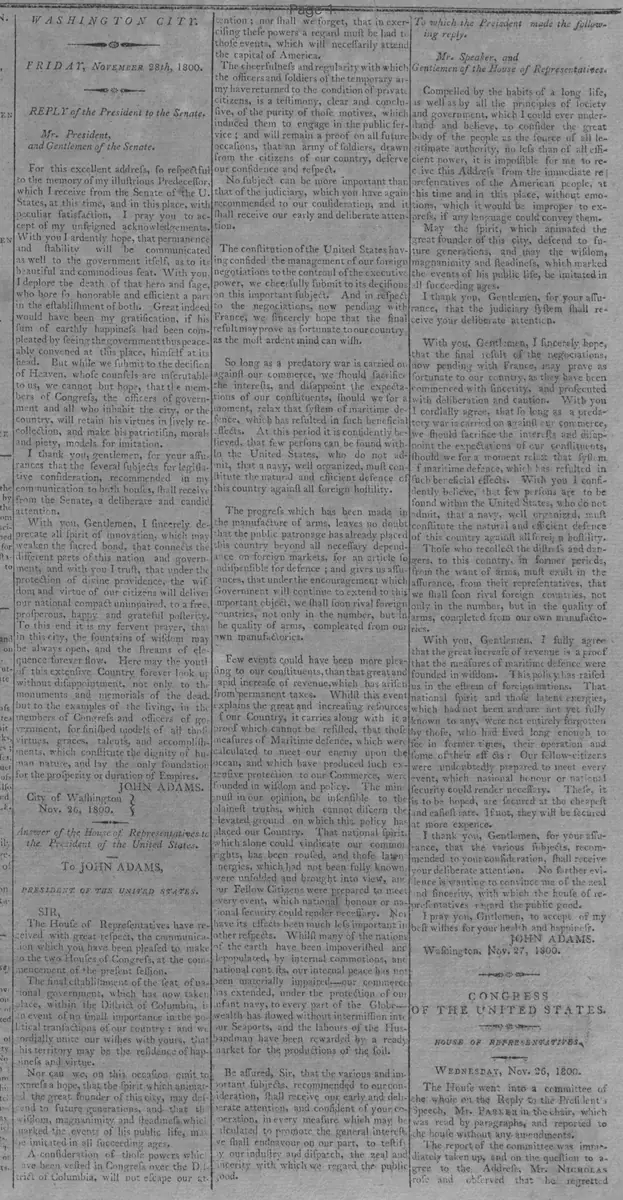
FRIDAY, NOVEMBER 28th, 1800. REPLY of the President to the Senate. Mr. President, and Gentlemen of the Senate. For this excellent address, so respectful to the memory of my illustrious Predecessor. which I receive from the Senate of the U. States, at this time, and in this place, with peculiar satisfaction, I pray you to ac- cept of my unfeigned acknowledgements. With you I ardently hope, that permanence and stability will be communicated as well to the government itself, as to its beautiful and commodious seat. With you. I deplore the death of that hero and sage, who bore so honorable and efficient a part in the establishment of both. Great indeed would have been my gratification, if his sum of earthly happiness had been com- pleted by seeing the government thus peace- ably convened at this place, himself at its head. But while we submit to the decision of Heaven, whose counsels are inscrutable to us, we cannot but hope, that the mem- bers of Congress, the officers of govern- ment and all who inhabit the city, or the country. will retain his virtues in lively re- collection, and make his patriotism, morals and piety, models for imitation. I thank you, gentlemen, for your as- surances that the several subjects for legisla- tive consideration, recommended in my communication to both houses, shall receive from the Senate, a deliberate and candid attention. With you, Gentlemen, I sincerely de- precate all spirit of innovation, which may weaken the sacred bond, that connects the different parts of this nation and govern- ment, and with you I trust, that under the protection of divine providence, the wisdom and virtue of our citizens will deliver our national compact unimpaired, to a free. prosperous, happy and grateful posterity. To this end it is my fervent prayer, that in this city, the fountains of wisdom may be always open, and the streams of elo- quence forever flow. Here may the youth of this extensive Country forever look up without disappointment. not only to the monuments and memorials of the dead. but to the examples of the living, in the members of Congress and officers of go- vernment, for finished models of all those virtues, graces, talents, and accomplish- ments, which constitute the dignity of hu- man nature, and lay the only foundation for the prosperity or duration of Empires. JOHN ADAMS. City of Washington Nov. 26, 1800. Answer of the House of Representatives to the President of the United States. To JOHN ADAMS, PRESIDENT OF THE UNITED STATES. SIR, The House of Representatives have re- ceived with great respect, the communica- tion which you have been pleased to make to the two Houses of Congress, at the com- mencement of the present session. The final establishment of the seat of na- tional government, which has now taken place, within the District of Columbia, is an event of no small importance in the po- litical transactions of our country : and we cordially unite our wishes with yours, that this territory may be the residence of hap- piness and virtue. Nor can we, on this occasion omit to express a hope, that the spirit which animat- ed the great founder of this city, may de- scend to future generations, and that the wisdom, magnanimity and steadiness which marked the events of his public life, may be imitated in all succeeding ages. A consideration of those powers which have been vested in Congress over the Dis- trict of Columbia, will not escape our at- tention ; nor shall we forget, that in exer- cising these powers a regard must be had to those events, which will necessarily attend the capital of America. The cheerfulness and regularity with which the officers and soldiers of the temporary ar- my have returned to the condition of private citizens, is a testimony, clear and conclu- sive, of the purity of those motives, which induced them to engage in the public ser- vice ; and will remain a proof on all future occasions, that an army of soldiers, drawn from the citizens of our country, deserve our confidence and respect. No subject can be more important than that of the judiciary, which you have again recommended to our consideration, and it shall receive our early and deliberate atten- tion. The constitution of the United States hav- ing confided the management of our foreign negotiations to the controul of the executive power, we cheerfully submit to its decisions on this important subject. And in respect to the negotiations, now pending with France, we sincerely hope that the final result may prove as fortunate to our country as the most ardent mind can wish. So long as a predatory war is carried on. against our commerce, we should sacrifice the interests, and disappoint the expecta- tions of our constituents, should we for a moment, relax that system of maritime de- fence, which has resulted in such beneficial effects. At this period it is confidently be- lieved. that few persons can be found with. in the United States, who do not ad- mit, that a navy, well organized, must con- stitute the natural and efficient defence of this country against all foreign hostility. The progress which has been made in the manufacture of arms, leaves no doubt that the public patronage has already placed this country beyond all necessary depend- ence on foreign markets, for an article so indispensible for defence ; and gives us as- surances, that under the encouragement which Government will continue to extend to this important object, we shall soon rival foreign countries, not only in the number, but in the quality of arms, completed from our own manufactories. Few events could have been more plea- sing to our constituents, than that great and rapid increase of revenue, which has arisen from permanent taxes. Whilst this event explains the great and increasing resources of our Country, it carries along with it a proof which cannot be resisted, that those measures of Maritime defence, which were calculated to meet our enemy upon the ocean, and which have produced such ex- tensive protection to our Commerce, were founded in wisdom and policy. The man- must in our opinion, be insensible to the clearest truths, which cannot discern the elevated ground on which this policy has placed our Country. That national spirit. which alone could vindicate our common rights, has been roused, and those latent energies, which had not been fully known were unfolded and brought into view, and our Fellow Citizens were prepared to meet every event, which national honour or na- tional security could render necessary. No have its effects been much less important in other respects. Whilst many of the nations of the earth have been impoverished and depopulated, by internal commotions, and ational contests, our internal peace has not been materially impaired-our commerce has extended, under the protection of our infant navy, to every part of the Globe— wealth has flowed without intermission into our Seaports, and the labours of the Hus- bandman have been rewarded by a ready market for the productions of the soil. Be assured, Sir, that the various and im- portant subjects, recommended to our con- sideration, shall receive our early and del- iberate attention, and confident of your co- operation, in every measure which may be calculated to promote the general interest. We shall endeavour on our part, to testify by our industry and dispatch, the zeal and sincerity with which we regard the public good. To which the President made the follow- ing reply. Mr. Speaker, and Gentlemen of the House of Representatives. Compelled by the habits of a long life, is well as by all the principles of Society and government, which I could ever under- stand and believe, to consider the great body of the people as the source of all le- gitimate authority, no less than of all effi- ient power, it is impossible for me to re- ceive this Address from the immediate re- presentatives of the American people, at this time and in this place, without emo- tions, which it would be improper to ex- press, if any language could convey them. May the spirit, which animated the great founder of this city, descend to fu- ture generations, and may the wisdom, magnanimity and steadiness, which marked the events of his public life, be imitated in all succeeding ages. I thank you, Gentlemen, for your as- surance, that the judiciary system shall re- ceive your deliberate attention. With you, Gentlemen, I sincerely hope, that the final result of the negotiations, now pending with France, may prove as fortunate to our country, as they have been commenced with sincerity, and prosecuted with deliberation and caution. With you I cordially agree, that so long as a preda- tory war is carried on against our commerce, we should sacrifice the interests and disap- point the expectations of our constituents- should we for a moment relax that system of maritime defence, which has resulted in such beneficial effects. With you I confi- dently believe, that few persons are to be found within the United States, who do not admit, that a navy, well organized, must constitute the natural and efficient defence of this country against all foreign hostility. Those who recollect the distress and dan- gers, to this country, in former periods, from the want of arms, must exult in the assurance, from their representatives, that we shall soon rival foreign countries, not only in the number, but in the quality of arms, completed from our own manufac- tories. With you, Gentlemen, I fully agree that the great increase of revenue is a proof that the measures of maritime defence were founded in wisdom. This policy has raised us in the esteem of foreign nations. That national spirit and those latent energies, which had not been and are not yet fully known to any, were not entirely forgotten by those, who had lived long enough to see in former times, their operation and some of their effects : Our fellow-citizens were undoubtedly prepared to meet every event, which national honour or national security could render necessary. These, it is to be hoped, are secured at the cheapest and easiest rate. If not, they will be secured at more expense. I thank you, Gentlemen, for your as- surance, that the various subjects, recom- mended to your consideration, shall receive your deliberate attention. No further evi- dence is wanting to convince me of the zeal and sincerity, with which the house of re- presentatives regard the public good. I pray you, Gentlemen, to accept of my best wishes for your health and happiness. JOHN ADAMS. Washington, Nov. 27, 1800. CONGRESS OF THE UNITED STATES. HOUSE OF REPRESENTATIVES- Wednesday, NOV. 26, 1800. The House went into a committee of the whole on the Reply to the President's Speech, Mr. Parker in the chair, which was read by paragraphs, and reported to the house without any amendments. The report of the committee was imme- diately taken up, and on the question to a- gree to the Address. Mr. Nicholas rose and observed that he regretted the introduction of political matter, calculated to produce discord and division. He was averse to the house spending time in propounding political theories, as no good but much mischief, might flow from such a procedure. Had no other topics or sentiments been alluded to than those contained in the President's Speech, there would have been much less division in the house than was to be expected from the insertion of extraneous ideas. He had no intention, however, to enter into a detail of the objections he entertained to the Address. For the reasons he had assigned, and others which he felt, he thought the style of the Address not only unnecessary, but worse than useless. He concluded by desiring the yeas and nays to be taken. The question being taken, was carried in the affirmative, yeas 36, nays 32, as follows: YEAS.—Messrs. Bartlett, Cooper, Craik, J. Davenport, F. Davenport, Dent, Dickson, Edmund, Evans, A. Foster, Freeman, E. Goodrich, Griswold, Henderson, Huger, Finlay, H. Lee, S. Lee, Linn, Morris, Otis, Page, Parker, Platt, Powell, Reed, Read, Sheppard, J. C. Smith, Spaight, Thatcher, Thomas, Wadsworth, Waln, L. Williams, Wood. 36. NAYS.—Messrs. Bishop, R. Brown, Christie, Clay, Claiborne, Condict, Dawson, Elmendorf, Gray, Gregg, Hanna, Heister, Holmes, Jackson, Kitterell, Leib, Macon, Muhlenberg, New, Nicholas, Randolph, Smilie, J. Smith, Stanford, Stone, Sumter, Tazewell, Thompson, A. Trigg, J. Trigg, Van Cortlandt, Vanreness. 32. Mr. Griswold moved that the Speaker, attended by the house, should deliver the Address to the President, and that a committee be appointed to wait on the President to know when and where it would be convenient to him to receive it.—Agreed to, and a committee of three was appointed, who soon afterwards reported that the President would receive the Address tomorrow at 12 o'clock at his own house. A message was received from the senate, informing the house that they had agreed to the resolution for appointing chaplains, with an amendment, directing that the chaplains should be of different denominations, in which amendment the house concurred. Ayes 36, noes 34. Mr. Dent, from the committee of elections, reported Nathan Read to be duly elected in the place of Samuel Sewall, John C. Smith in the place of Jonathan Brace, Littleton W. Tazewell in the place of John Marshall, and William M'Mellon in the place of H. W. Harrison. The house agreed to the reference to a committee of five members, of the motion respecting amendments to the post office law, laid on the table yesterday. Resolved that the house make choice of a chaplain tomorrow. On motion of Dr. Leib resolved that the petition of the Marshal of Pennsylvania, with the report made thereon last session, be referred to a committee of the whole, and that it be the order of the day for tomorrow. The motion, made yesterday by General Lee, for appointing a committee to report such measures as they may deem advisable for carrying into effect the resolutions agreed to at the last session, commemorative of the military and political services of George Washington, was agreed to, and a committee of seven appointed. THURSDAY NOV. 27, 1800. A bill extending the usual privilege of franking, attached to the members of the house, to the delegate from the territory N. W. of the Ohio, and for making provision for his compensation, was read twice, and referred to a committee of the whole house to-morrow. The House then proceeded in carriages in a body to the House of the President, to deliver their Address. A considerable number of members remained behind. In a short time the members returned, when the Speaker took the chair, and the reply of the President to the Address of the House was read. The House proceeded to the election of a chaplain. Mr. Dent and Mr. Otis were appointed tellers. A message was received from the Senate informing the House, that they had elected Bishop Claggett their chaplain. The election was then gone into by the House, and Rev. Mr. Lyle, previously nominated by Mr. Parker, was chosen. FRIDAY, Nov. 28. The House went into a committee of the whole on the President's speech, Mr. Morris in the chair. Propositions for the reference of the several parts thereof to select committees were made and reported; to which the house agreed and the committees were appointed.
Merged-components note: Continuation of congressional proceedings across pages, sequential reading order and text flow indicate single logical component.
Clippings
1 of 2
OCR Quality
Full Text
REPLY of the President to the Senate.
Mr. President,
and Gentlemen of the Senate.
For this excellent address, so respectful
to the memory of my illustrious Predecessor.
which I receive from the Senate of the U.
States, at this time, and in this place, with
peculiar satisfaction, I pray you to ac-
cept of my unfeigned acknowledgements.
With you I ardently hope, that permanence
and stability will be communicated
as well to the government itself, as to its
beautiful and commodious seat. With you.
I deplore the death of that hero and sage,
who bore so honorable and efficient a part
in the establishment of both. Great indeed
would have been my gratification, if his
sum of earthly happiness had been com-
pleted by seeing the government thus peace-
ably convened at this place, himself at its
head. But while we submit to the decision
of Heaven, whose counsels are inscrutable
to us, we cannot but hope, that the mem-
bers of Congress, the officers of govern-
ment and all who inhabit the city, or the
country. will retain his virtues in lively re-
collection, and make his patriotism, morals
and piety, models for imitation.
I thank you, gentlemen, for your as-
surances that the several subjects for legisla-
tive consideration, recommended in my
communication to both houses, shall receive
from the Senate, a deliberate and candid
attention.
With you, Gentlemen, I sincerely de-
precate all spirit of innovation, which may
weaken the sacred bond, that connects the
different parts of this nation and govern-
ment, and with you I trust, that under the
protection of divine providence, the wisdom
and virtue of our citizens will deliver
our national compact unimpaired, to a free.
prosperous, happy and grateful posterity.
To this end it is my fervent prayer, that
in this city, the fountains of wisdom may
be always open, and the streams of elo-
quence forever flow. Here may the youth
of this extensive Country forever look up
without disappointment. not only to the
monuments and memorials of the dead.
but to the examples of the living, in the
members of Congress and officers of go-
vernment, for finished models of all those
virtues, graces, talents, and accomplish-
ments, which constitute the dignity of hu-
man nature, and lay the only foundation
for the prosperity or duration of Empires.
JOHN ADAMS.
City of Washington
Nov. 26, 1800.
Answer of the House of Representatives to
the President of the United States.
To JOHN ADAMS,
PRESIDENT OF THE UNITED STATES.
SIR,
The House of Representatives have re-
ceived with great respect, the communica-
tion which you have been pleased to make
to the two Houses of Congress, at the com-
mencement of the present session.
The final establishment of the seat of na-
tional government, which has now taken
place, within the District of Columbia, is
an event of no small importance in the po-
litical transactions of our country : and we
cordially unite our wishes with yours, that
this territory may be the residence of hap-
piness and virtue.
Nor can we, on this occasion omit to
express a hope, that the spirit which animat-
ed the great founder of this city, may de-
scend to future generations, and that the
wisdom, magnanimity and steadiness which
marked the events of his public life, may
be imitated in all succeeding ages.
A consideration of those powers which
have been vested in Congress over the Dis-
trict of Columbia, will not escape our at-
tention ; nor shall we forget, that in exer-
cising these powers a regard must be had to
those events, which will necessarily attend
the capital of America.
The cheerfulness and regularity with which
the officers and soldiers of the temporary ar-
my have returned to the condition of private
citizens, is a testimony, clear and conclu-
sive, of the purity of those motives, which
induced them to engage in the public ser-
vice ; and will remain a proof on all future
occasions, that an army of soldiers, drawn
from the citizens of our country, deserve
our confidence and respect.
No subject can be more important than
that of the judiciary, which you have again
recommended to our consideration, and it
shall receive our early and deliberate atten-
tion.
The constitution of the United States hav-
ing confided the management of our foreign
negotiations to the controul of the executive
power, we cheerfully submit to its decisions
on this important subject. And in respect
to the negotiations, now pending with
France, we sincerely hope that the final
result may prove as fortunate to our country
as the most ardent mind can wish.
So long as a predatory war is carried on.
against our commerce, we should sacrifice
the interests, and disappoint the expecta-
tions of our constituents, should we for a
moment, relax that system of maritime de-
fence, which has resulted in such beneficial
effects. At this period it is confidently be-
lieved. that few persons can be found with.
in the United States, who do not ad-
mit, that a navy, well organized, must con-
stitute the natural and efficient defence of
this country against all foreign hostility.
The progress which has been made in
the manufacture of arms, leaves no doubt
that the public patronage has already placed
this country beyond all necessary depend-
ence on foreign markets, for an article so
indispensible for defence ; and gives us as-
surances, that under the encouragement which
Government will continue to extend to this
important object, we shall soon rival foreign
countries, not only in the number, but in
the quality of arms, completed from our
own manufactories.
Few events could have been more plea-
sing to our constituents, than that great and
rapid increase of revenue, which has arisen
from permanent taxes. Whilst this event
explains the great and increasing resources
of our Country, it carries along with it a
proof which cannot be resisted, that those
measures of Maritime defence, which were
calculated to meet our enemy upon the
ocean, and which have produced such ex-
tensive protection to our Commerce, were
founded in wisdom and policy. The man-
must in our opinion, be insensible to the
clearest truths, which cannot discern the
elevated ground on which this policy has
placed our Country. That national spirit.
which alone could vindicate our common
rights, has been roused, and those latent
energies, which had not been fully known
were unfolded and brought into view, and
our Fellow Citizens were prepared to meet
every event, which national honour or na-
tional security could render necessary. No
have its effects been much less important in
other respects. Whilst many of the nations
of the earth have been impoverished and
depopulated, by internal commotions, and
ational contests, our internal peace has not
been materially impaired-our commerce
has extended, under the protection of our
infant navy, to every part of the Globe—
wealth has flowed without intermission into
our Seaports, and the labours of the Hus-
bandman have been rewarded by a ready
market for the productions of the soil.
Be assured, Sir, that the various and im-
portant subjects, recommended to our con-
sideration, shall receive our early and del-
iberate attention, and confident of your co-
operation, in every measure which may be
calculated to promote the general interest.
We shall endeavour on our part, to testify
by our industry and dispatch, the zeal and
sincerity with which we regard the public
good.
To which the President made the follow-
ing reply.
Mr. Speaker, and
Gentlemen of the House of Representatives.
Compelled by the habits of a long life,
is well as by all the principles of Society
and government, which I could ever under-
stand and believe, to consider the great
body of the people as the source of all le-
gitimate authority, no less than of all effi-
ient power, it is impossible for me to re-
ceive this Address from the immediate re-
presentatives of the American people, at
this time and in this place, without emo-
tions, which it would be improper to ex-
press, if any language could convey them.
May the spirit, which animated the
great founder of this city, descend to fu-
ture generations, and may the wisdom,
magnanimity and steadiness, which marked
the events of his public life, be imitated in
all succeeding ages.
I thank you, Gentlemen, for your as-
surance, that the judiciary system shall re-
ceive your deliberate attention.
With you, Gentlemen, I sincerely hope,
that the final result of the negotiations,
now pending with France, may prove as
fortunate to our country, as they have been
commenced with sincerity, and prosecuted
with deliberation and caution. With you
I cordially agree, that so long as a preda-
tory war is carried on against our commerce,
we should sacrifice the interests and disap-
point the expectations of our constituents-
should we for a moment relax that system
of maritime defence, which has resulted in
such beneficial effects. With you I confi-
dently believe, that few persons are to be
found within the United States, who do not
admit, that a navy, well organized, must
constitute the natural and efficient defence
of this country against all foreign hostility.
Those who recollect the distress and dan-
gers, to this country, in former periods,
from the want of arms, must exult in the
assurance, from their representatives, that
we shall soon rival foreign countries, not
only in the number, but in the quality of
arms, completed from our own manufac-
tories.
With you, Gentlemen, I fully agree
that the great increase of revenue is a proof
that the measures of maritime defence were
founded in wisdom. This policy has raised
us in the esteem of foreign nations. That
national spirit and those latent energies,
which had not been and are not yet fully
known to any, were not entirely forgotten
by those, who had lived long enough to
see in former times, their operation and
some of their effects : Our fellow-citizens
were undoubtedly prepared to meet every
event, which national honour or national
security could render necessary. These, it
is to be hoped, are secured at the cheapest
and easiest rate. If not, they will be secured
at more expense.
I thank you, Gentlemen, for your as-
surance, that the various subjects, recom-
mended to your consideration, shall receive
your deliberate attention. No further evi-
dence is wanting to convince me of the zeal
and sincerity, with which the house of re-
presentatives regard the public good.
I pray you, Gentlemen, to accept of my
best wishes for your health and happiness.
JOHN ADAMS.
Washington, Nov. 27, 1800.
CONGRESS
OF THE UNITED STATES.
HOUSE OF REPRESENTATIVES-
Wednesday, NOV. 26, 1800.
The House went into a committee of
the whole on the Reply to the President's
Speech, Mr. Parker in the chair, which
was read by paragraphs, and reported to
the house without any amendments.
The report of the committee was imme-
diately taken up, and on the question to a-
gree to the Address. Mr. Nicholas
rose and observed that he regretted
the introduction of political matter, calculated to produce discord and division. He was averse to the house spending time in propounding political theories, as no good but much mischief, might flow from such a procedure. Had no other topics or sentiments been alluded to than those contained in the President's Speech, there would have been much less division in the house than was to be expected from the insertion of extraneous ideas. He had no intention, however, to enter into a detail of the objections he entertained to the Address. For the reasons he had assigned, and others which he felt, he thought the style of the Address not only unnecessary, but worse than useless. He concluded by desiring the yeas and nays to be taken.
The question being taken, was carried in the affirmative, yeas 36, nays 32, as follows:
YEAS.—Messrs. Bartlett, Cooper, Craik, J. Davenport, F. Davenport, Dent, Dickson, Edmund, Evans, A. Foster, Freeman, E. Goodrich, Griswold, Henderson, Huger, Finlay, H. Lee, S. Lee, Linn, Morris, Otis, Page, Parker, Platt, Powell, Reed, Read, Sheppard, J. C. Smith, Spaight, Thatcher, Thomas, Wadsworth, Waln, L. Williams, Wood. 36.
NAYS.—Messrs. Bishop, R. Brown, Christie, Clay, Claiborne, Condict, Dawson, Elmendorf, Gray, Gregg, Hanna, Heister, Holmes, Jackson, Kitterell, Leib, Macon, Muhlenberg, New, Nicholas, Randolph, Smilie, J. Smith, Stanford, Stone, Sumter, Tazewell, Thompson, A. Trigg, J. Trigg, Van Cortlandt, Vanreness. 32.
Mr. Griswold moved that the Speaker, attended by the house, should deliver the Address to the President, and that a committee be appointed to wait on the President to know when and where it would be convenient to him to receive it.—Agreed to, and a committee of three was appointed, who soon afterwards reported that the President would receive the Address tomorrow at 12 o'clock at his own house.
A message was received from the senate, informing the house that they had agreed to the resolution for appointing chaplains, with an amendment, directing that the chaplains should be of different denominations, in which amendment the house concurred. Ayes 36, noes 34.
Mr. Dent, from the committee of elections, reported Nathan Read to be duly elected in the place of Samuel Sewall, John C. Smith in the place of Jonathan Brace, Littleton W. Tazewell in the place of John Marshall, and William M'Mellon in the place of H. W. Harrison.
The house agreed to the reference to a committee of five members, of the motion respecting amendments to the post office law, laid on the table yesterday.
Resolved that the house make choice of a chaplain tomorrow.
On motion of Dr. Leib resolved that the petition of the Marshal of Pennsylvania, with the report made thereon last session, be referred to a committee of the whole, and that it be the order of the day for tomorrow.
The motion, made yesterday by General Lee, for appointing a committee to report such measures as they may deem advisable for carrying into effect the resolutions agreed to at the last session, commemorative of the military and political services of George Washington, was agreed to, and a committee of seven appointed.
THURSDAY NOV. 27, 1800.
A bill extending the usual privilege of franking, attached to the members of the house, to the delegate from the territory N. W. of the Ohio, and for making provision for his compensation, was read twice, and referred to a committee of the whole house to-morrow.
The House then proceeded in carriages in a body to the House of the President, to deliver their Address. A considerable number of members remained behind.
In a short time the members returned, when the Speaker took the chair, and the reply of the President to the Address of the House was read.
The House proceeded to the election of a chaplain. Mr. Dent and Mr. Otis were appointed tellers.
A message was received from the Senate informing the House, that they had elected Bishop Claggett their chaplain.
The election was then gone into by the House, and Rev. Mr. Lyle, previously nominated by Mr. Parker, was chosen.
FRIDAY, Nov. 28.
The House went into a committee of the whole on the President's speech, Mr. Morris in the chair.
Propositions for the reference of the several parts thereof to select committees were made and reported; to which the house agreed and the committees were appointed.
What sub-type of article is it?
What keywords are associated?
What entities or persons were involved?
Where did it happen?
Domestic News Details
Primary Location
City Of Washington
Event Date
November 26 28, 1800
Key Persons
Event Details
President John Adams replies to the Senate's address honoring George Washington and discussing government stability, legislative matters, and national unity. The House of Representatives responds to the President's speech, addressing the establishment of the national capital, military disbandment, judiciary, foreign negotiations, maritime defense, arms manufacture, and revenue increase. Adams replies to the House, echoing themes of national spirit and defense. House proceedings include debating and approving their reply to the President (yeas 36, nays 32), appointing committees, electing chaplains (Bishop Claggett for Senate, Rev. Mr. Lyle for House), reporting election results, and referring bills and petitions.