Thank you for visiting SNEWPapers!
Sign up free
Poem
June 21, 1839
The Liberator
Boston, Suffolk County, Massachusetts
What is this article about?
A poignant elegy where the speaker mourns his deceased beloved wife, seeing her memory in everyday objects and places, affirming her immortal soul in a fairer land. Attributed to Willis Gaylord Clark.
Clipping
OCR Quality
97%
Excellent
Full Text
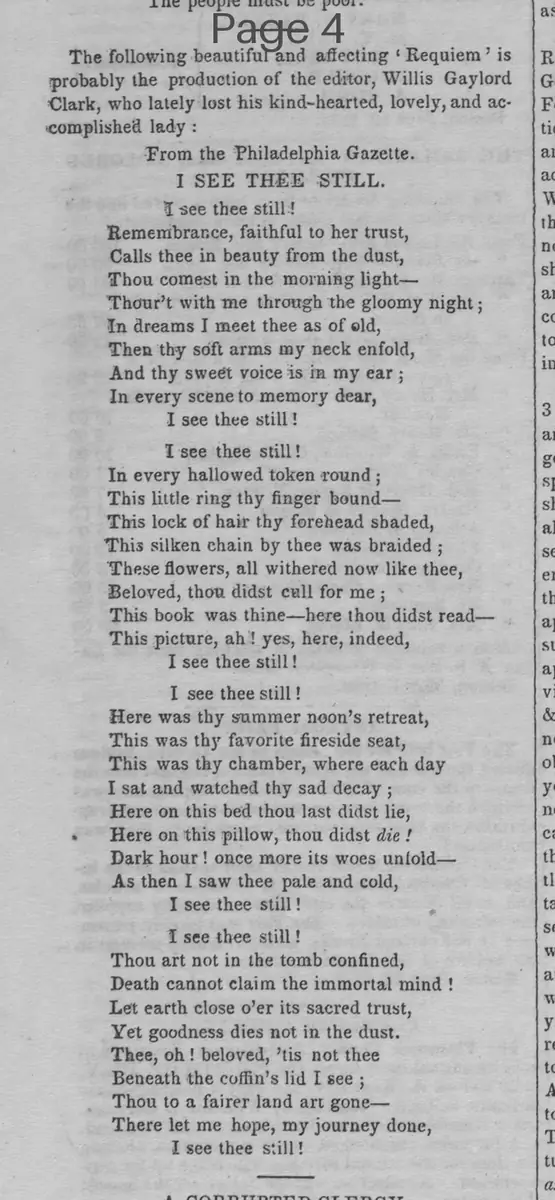
The following beautiful and affecting 'Requiem' is
probably the production of the editor, Willis Gaylord
Clark, who lately lost his kind-hearted, lovely, and accomplished lady:
From the Philadelphia Gazette.
I SEE THEE STILL.
I see thee still!
Remembrance, faithful to her trust,
Calls thee in beauty from the dust,
Thou comest in the morning light-
Thou'rt with me through the gloomy night;
In dreams I meet thee as of old,
Then thy soft arms my neck enfold,
And thy sweet voice is in my ear;
In every scene to memory dear,
I see thee still!
I see thee still!
In every hallowed token round;
This little ring thy finger bound—
This lock of hair thy forehead shaded,
This silken chain by thee was braided;
These flowers, all withered now like thee,
Beloved, thou didst cull for me;
This book was thine—here thou didst read—
This picture, ah! yes, here, indeed,
I see thee still!
I see thee still!
Here was thy summer noon's retreat,
This was thy favorite fireside seat,
This was thy chamber, where each day
I sat and watched thy sad decay;
Here on this bed thou last didst lie,
Here on this pillow, thou didst die!
Dark hour! once more its woes unfold—
As then I saw thee pale and cold,
I see thee still!
I see thee still!
Thou art not in the tomb confined,
Death cannot claim the immortal mind!
Let earth close o'er its sacred trust
Yet goodness dies not in the dust.
Thee, oh! beloved, 'tis not thee
Beneath the coffin's lid I see;
Thou to a fairer land art gone—
There let me hope, my journey done,
I see thee still!
probably the production of the editor, Willis Gaylord
Clark, who lately lost his kind-hearted, lovely, and accomplished lady:
From the Philadelphia Gazette.
I SEE THEE STILL.
I see thee still!
Remembrance, faithful to her trust,
Calls thee in beauty from the dust,
Thou comest in the morning light-
Thou'rt with me through the gloomy night;
In dreams I meet thee as of old,
Then thy soft arms my neck enfold,
And thy sweet voice is in my ear;
In every scene to memory dear,
I see thee still!
I see thee still!
In every hallowed token round;
This little ring thy finger bound—
This lock of hair thy forehead shaded,
This silken chain by thee was braided;
These flowers, all withered now like thee,
Beloved, thou didst cull for me;
This book was thine—here thou didst read—
This picture, ah! yes, here, indeed,
I see thee still!
I see thee still!
Here was thy summer noon's retreat,
This was thy favorite fireside seat,
This was thy chamber, where each day
I sat and watched thy sad decay;
Here on this bed thou last didst lie,
Here on this pillow, thou didst die!
Dark hour! once more its woes unfold—
As then I saw thee pale and cold,
I see thee still!
I see thee still!
Thou art not in the tomb confined,
Death cannot claim the immortal mind!
Let earth close o'er its sacred trust
Yet goodness dies not in the dust.
Thee, oh! beloved, 'tis not thee
Beneath the coffin's lid I see;
Thou to a fairer land art gone—
There let me hope, my journey done,
I see thee still!
What sub-type of article is it?
Elegy
What themes does it cover?
Death Mourning
Religious Faith
What keywords are associated?
Requiem
Grief
Immortality
Beloved Wife
Memory
Death
Afterlife
What entities or persons were involved?
Willis Gaylord Clark
Poem Details
Title
I See Thee Still.
Author
Willis Gaylord Clark
Subject
Requiem For His Deceased Wife
Key Lines
I See Thee Still!\Nremembrance, Faithful To Her Trust,\Ncalls Thee In Beauty From The Dust,
Thou Art Not In The Tomb Confined,\Ndeath Cannot Claim The Immortal Mind!
Thou To A Fairer Land Art Gone—\Nthere Let Me Hope, My Journey Done,\Ni See Thee Still!