Thank you for visiting SNEWPapers!
Sign up free
Story
April 1, 1854
Anti Slavery Bugle
New Lisbon, Salem, Columbiana County, Ohio
What is this article about?
Essay on the value of reciprocal courtesies in daily life, noting Americans' general politeness but lapses in small social graces, which can chill friendships; stresses mutual appreciation to sustain bonds, quoting Spenser and citing traveler Lady Wortley.
Clipping
OCR Quality
98%
Excellent
Full Text
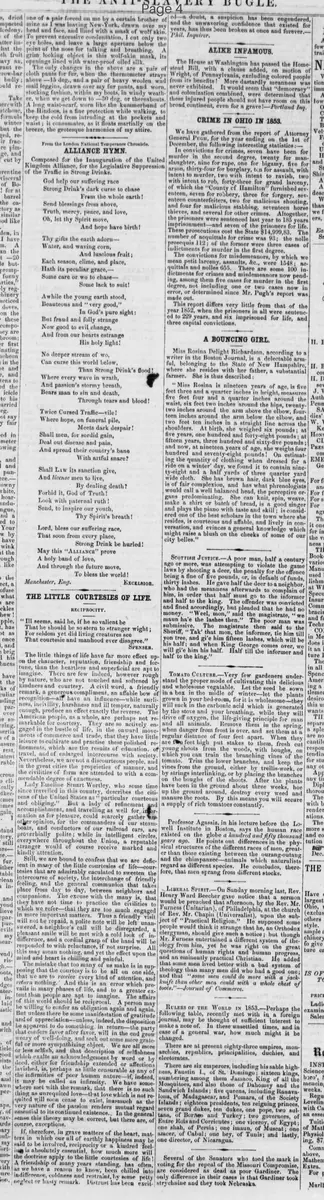
THE LITTLE COURTESIES OF LIFE.
RECIPROCITY.
"Ill seems, said he, if he so valiant be
That he should be so stern to stranger wight;
For seldom yet did living creatures see
That courtesie and manhood ever disagree."
SPENSER.
The little things of life have far more effect upon the character, reputation, friendship and fortune, than the heartless and superficial are apt to imagine. There are few indeed, however rough by nature, who are not touched and softened by kindness and courtesy. A civil word, a friendly remark, a generous compliment, an affable bow of recognition--all have an influence--while surliness, incivility, harshness and ill temper, naturally enough, produce an effect exactly the reverse. The American people, as a whole, are perhaps not remarkable for courtesy. They are so actively engaged in the bustle of life, in the onward movements of commerce and trade, that they have little leisure to cultivate and practise these polished refinements, which are the results of education, of travel, and of enlarged intercourse with society.
Nevertheless, we are not a discourteous people, and in the great cities the proprieties of manner, and the civilities of form are attended to with a commendable degree of exactness.
Lady Emeline Stuart Wortley, who some time since travelled in this country, describes the citizens of the United States as "particularly courteous and obliging." But a lady of refinement and accomplishment, and travelling as well for information as for pleasure, could scarcely gather any other opinion, for the commanders of our steamboats, and conductors of our railroad cars, are proverbially polite; while in intelligent circles, everywhere throughout the Union, a reputable stranger would of course receive marked and kindly attention.
Still, we are bound to confess that we are deficient in many of the little courtesies of life--courtesies that are admirably calculated to sweeten the intercourse of society, the interchange of friendly feeling, and the general communion that takes place from day to day, between neighbors and companions. The excuse with the many is, that they have not time to practice the civilities to which we refer--that they are too much engaged in more important matters. Thus a friendly visit will not be repaid, a polite note will be left unanswered, a neighbor's call will be disregarded, a pleasant smile will be met with a cold look of indifference, and a cordial grasp of the hand will be responded to with reluctance, if not surprise. All this may mean nothing, and yet the effect upon the mind and heart is chilling and painful.
The mistake that too many of us make is in supposing that the courtesy is to be all on one side, that we are to receive every kind of attention, and return nothing. And this is an error which prevails in many phases of life, and to a greater extent than people are apt to imagine. The affairs of this world should be reciprocal. A person may be willing to confer an obligation again and again. But unless there be some manifestation of gratitude and of appreciation--unless, indeed, the disposition to appear to do something in return--the party that confers favor after favor, will in the end grow weary of well-doing, and seek out some more grateful or more sympathizing object. We are all more or less selfish, and that description of selfishness which exalts an acknowledgement by word or by deed, either for friendship extended or affections invited, is, perhaps, a little censurable as any of the infirmities of poor human nature--if, indeed, it may be called an infirmity. We hear some where met with: the remark, that there is no such thing as unrequited love--that love which is not requited will soon cease to exist, inasmuch as the very nature of the passion renders mutual regard essential to its continued existence. In the general sense this theory may be correct, but there are, of course, exceptions.
If, therefore, in grave matters of the heart, matters in which our all of earthly happiness may be said to be involved, reciprocity or a kindred feeling is absolutely essential, how much more will the doctrine apply to the little courtesies of life! A friendship of many years standing, has often, as we have a reason to know, been chilled into indifference, coldness and restraint, by some petty neglect or hasty remark. Distrust has been excited--a doubt, a suspicion has been engendered, and the unwavering confidence that existed for years, has thus been broken at once and forever.--Phil. Inquirer.
RECIPROCITY.
"Ill seems, said he, if he so valiant be
That he should be so stern to stranger wight;
For seldom yet did living creatures see
That courtesie and manhood ever disagree."
SPENSER.
The little things of life have far more effect upon the character, reputation, friendship and fortune, than the heartless and superficial are apt to imagine. There are few indeed, however rough by nature, who are not touched and softened by kindness and courtesy. A civil word, a friendly remark, a generous compliment, an affable bow of recognition--all have an influence--while surliness, incivility, harshness and ill temper, naturally enough, produce an effect exactly the reverse. The American people, as a whole, are perhaps not remarkable for courtesy. They are so actively engaged in the bustle of life, in the onward movements of commerce and trade, that they have little leisure to cultivate and practise these polished refinements, which are the results of education, of travel, and of enlarged intercourse with society.
Nevertheless, we are not a discourteous people, and in the great cities the proprieties of manner, and the civilities of form are attended to with a commendable degree of exactness.
Lady Emeline Stuart Wortley, who some time since travelled in this country, describes the citizens of the United States as "particularly courteous and obliging." But a lady of refinement and accomplishment, and travelling as well for information as for pleasure, could scarcely gather any other opinion, for the commanders of our steamboats, and conductors of our railroad cars, are proverbially polite; while in intelligent circles, everywhere throughout the Union, a reputable stranger would of course receive marked and kindly attention.
Still, we are bound to confess that we are deficient in many of the little courtesies of life--courtesies that are admirably calculated to sweeten the intercourse of society, the interchange of friendly feeling, and the general communion that takes place from day to day, between neighbors and companions. The excuse with the many is, that they have not time to practice the civilities to which we refer--that they are too much engaged in more important matters. Thus a friendly visit will not be repaid, a polite note will be left unanswered, a neighbor's call will be disregarded, a pleasant smile will be met with a cold look of indifference, and a cordial grasp of the hand will be responded to with reluctance, if not surprise. All this may mean nothing, and yet the effect upon the mind and heart is chilling and painful.
The mistake that too many of us make is in supposing that the courtesy is to be all on one side, that we are to receive every kind of attention, and return nothing. And this is an error which prevails in many phases of life, and to a greater extent than people are apt to imagine. The affairs of this world should be reciprocal. A person may be willing to confer an obligation again and again. But unless there be some manifestation of gratitude and of appreciation--unless, indeed, the disposition to appear to do something in return--the party that confers favor after favor, will in the end grow weary of well-doing, and seek out some more grateful or more sympathizing object. We are all more or less selfish, and that description of selfishness which exalts an acknowledgement by word or by deed, either for friendship extended or affections invited, is, perhaps, a little censurable as any of the infirmities of poor human nature--if, indeed, it may be called an infirmity. We hear some where met with: the remark, that there is no such thing as unrequited love--that love which is not requited will soon cease to exist, inasmuch as the very nature of the passion renders mutual regard essential to its continued existence. In the general sense this theory may be correct, but there are, of course, exceptions.
If, therefore, in grave matters of the heart, matters in which our all of earthly happiness may be said to be involved, reciprocity or a kindred feeling is absolutely essential, how much more will the doctrine apply to the little courtesies of life! A friendship of many years standing, has often, as we have a reason to know, been chilled into indifference, coldness and restraint, by some petty neglect or hasty remark. Distrust has been excited--a doubt, a suspicion has been engendered, and the unwavering confidence that existed for years, has thus been broken at once and forever.--Phil. Inquirer.
What sub-type of article is it?
Essay
Moral Essay
What themes does it cover?
Social Manners
Moral Virtue
What keywords are associated?
Courtesy
Reciprocity
Social Manners
American Society
Politeness
What entities or persons were involved?
Lady Emeline Stuart Wortley
Where did it happen?
United States
Story Details
Key Persons
Lady Emeline Stuart Wortley
Location
United States
Story Details
An essay emphasizing the importance of reciprocity in small courtesies of life, critiquing American tendencies toward incivility due to busyness, and arguing that mutual politeness sustains friendships and social bonds, illustrated by examples of neglect leading to strained relations.