Thank you for visiting SNEWPapers!
Sign up free
Foreign News
June 26, 1815
Norfolk Gazette And Publick Ledger
Norfolk, Virginia
What is this article about?
The Austrian manifesto from Vienna on April 21 details King Joachim Murat's duplicitous actions towards the Allies, from secret negotiations to renewed support for Napoleon after his escape, culminating in Austria's declaration of war on Naples on April 10, 1815.
Clipping
OCR Quality
95%
Excellent
Full Text
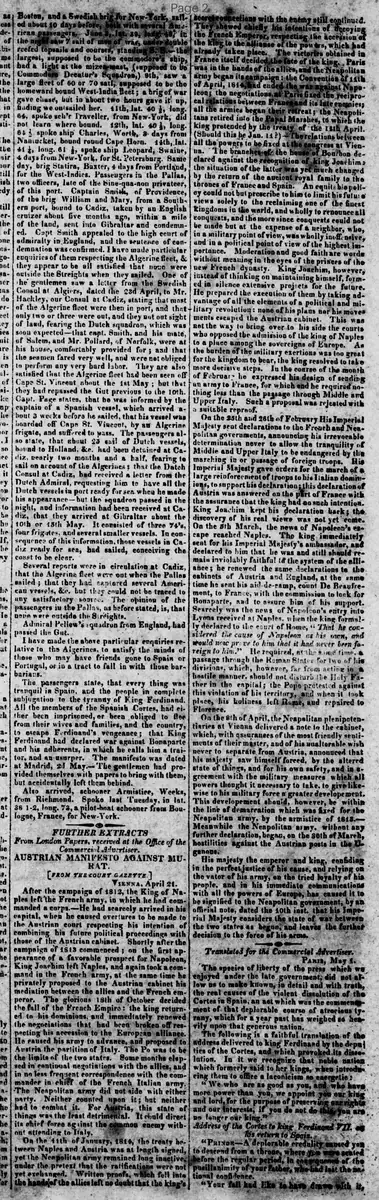
FURTHER EXTRACTS
From London Papers, received at the Office of the Commercial Advertiser.
AUSTRIAN MANIFESTO AGAINST MURAT.
[From the Court Gazette.]
Vienna, April 21.
After the campaign of 1812, the King of Naples left the French army, in which he had commanded a corps.--He had scarcely arrived in his capital, when he caused overtures to be made to the Austrian court respecting his intention of combining his future political proceedings with those of the Austrian cabinet. Shortly after the campaign of 1813 commenced ; on the first appearance of a favorable prospect for Napoleon, King Joachim left Naples, and again took a command in the French army, at the same time he privately proposed to the Austrian cabinet his mediation between the allies and the French emperor. The glorious 16th of October decided the fall of the French Empire : the king returned to his dominions, and immediately renewed the negociations that had been broken off respecting his accession to the European alliance. He caused his army to advance, and proposed to Austria the partition of Italy. The Po was to be the limits of the two states. Some months elapsed in continual negociations with the allies, and in no less frequent correspondence with the commander in chief of the French Italian army. The Neapolitan army did not side with either party. Neither counted upon it; but neither had to combat it. For Austria, this state of things was the least detrimental. It could direct its chief force against the common enemy without attending to Italy.
On the 11th of January, 1814, the treaty between Naples and Austria was at length signed, yet the Neapolitan army remained long inactive under the pretext that the ratifications were not yet exchanged. Written proofs, which fell into the hands of the allies left no doubt that the king's secret connections with the enemy still continued They shewed chiefly, his intentions of deceiving the French Emperor respecting the accession' of the king to the alliance of the powers, which had already taken place. The victories obtained in France itself decided the fate of the king Paris was in the hands of the allies, and the Neapolitan army began its campaign : the Convention of 11th of April, 1814 had ended the war against Napoleon; the negociations at Paris fixed the reciprocal relations between France and its late enemies; all the armies began their retreat; the Neapolitans retired into the Papal Marches, to which the king pretended by the treaty of -the 11th April. (Should this be Jan. 11 ?)-the relations between all the powers to be fixed at the congress at Vienna. The branch of the house of Bourbon declared against the recognition of king Joachim: the situation of the latter was yet much changed by the return of the ancient royal family to the thrones of France and Spain. An equitable policy could not but prescribe to him to limit his future views solely to the reclaiming one of the finest kingdoms in the world, and wholly to renounce all conquests, and the more since conquests could not be made but at the expense of a neighbor, who, in a military point of view, was wholly inoffensive, and in a political point of view of the highest importance. Moderation and good faith are words without meaning in the eyes of the princes of the new French dynasty. King Joachim, however, instead of thinking on maintaining himself, formed in silence extensive projects for the future. He prepared the execution of them by taking advantage of all the elements of a political and military revolution: none of his plans nor his movements escaped the Austrian cabinet. This was not the way to bring over to his side the courts who opposed the admission of the king of Naples to a place among the sovereigns of Europe. As the burden of the military exertions was too great for the kingdom to bear, the king resolved to take more decisive steps. In the course of the month of February: he expressed his design of sending an army to France, for which end he required nothing less than the passage through Middle and Upper Italy. Such a proposal was rejected with a suitable reproof.
On the 25th and 26th of February His Imperial Majesty sent declarations to the French and Neapolitan governments, announcing his irrevocable determination never to allow the tranquility of Middle and Upper Italy to be endangered by the marching in or passage of foreign troops. His Imperial Majesty gave orders for the march of a large reinforcement of troops to his Italian dominions, to support his declaration; this declaration of Austria was answered on the part of France with the assurance that the king had no such intention. King Joachim kept his declaration back; the discovery of his real views was not yet come.
On the 8th March, the news of Napoleon's escape reached Naples. The king immediately sent for his Imperial Majesty's ambassador, and declared to him that he was and still should remain inviolably faithful to the system of the alliance; he renewed the same declarations to the cabinets of Austria and England, at the same time he sent his aid-de-camp, count De Beaumont, to France, with the commission to look for Bonaparte, and to assure him of his support. Scarcely was the news of Napoleon's entry into Lyons received at Naples. when the king formally declared to the court of Rome, "That he considered the cause of Napoleon as his own, and would now prove to him that it had never been foreign to him." He required, at the same time. passage through the Roman States for two of his divisions, which, however, far from acting in hostile manner, should not disturb the Holy Father in the capital; the Pope protested against this violation of his territory. and when it took place, his holiness left Rome, and repaired to Florence.
On the 8th April, the Neapolitan plenipotentiaries at Vienna delivered a note to the cabinet, which, with assurances of the most friendly sentiments of their master, and of his unalterable wish never to separate from Austria, announced that his majesty saw himself forced, by the altered state of things, and for his own safety and in agreement with the military: measures which all powers thought it necessary to take, to give likewise to his military force a greater development. This development should, however, be within the line of demarcation which was fixed for the Neapolitan army, by the armistice of 1813.-- Meanwhile the Neapolitan army, without any further declaration, began, on the 30th of March, hostilities against the Austrian posts in the Ugamons.
His majesty the emperor and king, confiding in the perfect justice of his cause, and relying on the valor of his army, on the tried loyalty of his people, and in his immediate communications with all the powers of Europe has caused it to be signified to the Neapolitan government, by an official note, dated the 10th inst. that his Imperial Majesty considers the state of war between the two states as begun, and leaves the further decision to the force of his arms.
From London Papers, received at the Office of the Commercial Advertiser.
AUSTRIAN MANIFESTO AGAINST MURAT.
[From the Court Gazette.]
Vienna, April 21.
After the campaign of 1812, the King of Naples left the French army, in which he had commanded a corps.--He had scarcely arrived in his capital, when he caused overtures to be made to the Austrian court respecting his intention of combining his future political proceedings with those of the Austrian cabinet. Shortly after the campaign of 1813 commenced ; on the first appearance of a favorable prospect for Napoleon, King Joachim left Naples, and again took a command in the French army, at the same time he privately proposed to the Austrian cabinet his mediation between the allies and the French emperor. The glorious 16th of October decided the fall of the French Empire : the king returned to his dominions, and immediately renewed the negociations that had been broken off respecting his accession to the European alliance. He caused his army to advance, and proposed to Austria the partition of Italy. The Po was to be the limits of the two states. Some months elapsed in continual negociations with the allies, and in no less frequent correspondence with the commander in chief of the French Italian army. The Neapolitan army did not side with either party. Neither counted upon it; but neither had to combat it. For Austria, this state of things was the least detrimental. It could direct its chief force against the common enemy without attending to Italy.
On the 11th of January, 1814, the treaty between Naples and Austria was at length signed, yet the Neapolitan army remained long inactive under the pretext that the ratifications were not yet exchanged. Written proofs, which fell into the hands of the allies left no doubt that the king's secret connections with the enemy still continued They shewed chiefly, his intentions of deceiving the French Emperor respecting the accession' of the king to the alliance of the powers, which had already taken place. The victories obtained in France itself decided the fate of the king Paris was in the hands of the allies, and the Neapolitan army began its campaign : the Convention of 11th of April, 1814 had ended the war against Napoleon; the negociations at Paris fixed the reciprocal relations between France and its late enemies; all the armies began their retreat; the Neapolitans retired into the Papal Marches, to which the king pretended by the treaty of -the 11th April. (Should this be Jan. 11 ?)-the relations between all the powers to be fixed at the congress at Vienna. The branch of the house of Bourbon declared against the recognition of king Joachim: the situation of the latter was yet much changed by the return of the ancient royal family to the thrones of France and Spain. An equitable policy could not but prescribe to him to limit his future views solely to the reclaiming one of the finest kingdoms in the world, and wholly to renounce all conquests, and the more since conquests could not be made but at the expense of a neighbor, who, in a military point of view, was wholly inoffensive, and in a political point of view of the highest importance. Moderation and good faith are words without meaning in the eyes of the princes of the new French dynasty. King Joachim, however, instead of thinking on maintaining himself, formed in silence extensive projects for the future. He prepared the execution of them by taking advantage of all the elements of a political and military revolution: none of his plans nor his movements escaped the Austrian cabinet. This was not the way to bring over to his side the courts who opposed the admission of the king of Naples to a place among the sovereigns of Europe. As the burden of the military exertions was too great for the kingdom to bear, the king resolved to take more decisive steps. In the course of the month of February: he expressed his design of sending an army to France, for which end he required nothing less than the passage through Middle and Upper Italy. Such a proposal was rejected with a suitable reproof.
On the 25th and 26th of February His Imperial Majesty sent declarations to the French and Neapolitan governments, announcing his irrevocable determination never to allow the tranquility of Middle and Upper Italy to be endangered by the marching in or passage of foreign troops. His Imperial Majesty gave orders for the march of a large reinforcement of troops to his Italian dominions, to support his declaration; this declaration of Austria was answered on the part of France with the assurance that the king had no such intention. King Joachim kept his declaration back; the discovery of his real views was not yet come.
On the 8th March, the news of Napoleon's escape reached Naples. The king immediately sent for his Imperial Majesty's ambassador, and declared to him that he was and still should remain inviolably faithful to the system of the alliance; he renewed the same declarations to the cabinets of Austria and England, at the same time he sent his aid-de-camp, count De Beaumont, to France, with the commission to look for Bonaparte, and to assure him of his support. Scarcely was the news of Napoleon's entry into Lyons received at Naples. when the king formally declared to the court of Rome, "That he considered the cause of Napoleon as his own, and would now prove to him that it had never been foreign to him." He required, at the same time. passage through the Roman States for two of his divisions, which, however, far from acting in hostile manner, should not disturb the Holy Father in the capital; the Pope protested against this violation of his territory. and when it took place, his holiness left Rome, and repaired to Florence.
On the 8th April, the Neapolitan plenipotentiaries at Vienna delivered a note to the cabinet, which, with assurances of the most friendly sentiments of their master, and of his unalterable wish never to separate from Austria, announced that his majesty saw himself forced, by the altered state of things, and for his own safety and in agreement with the military: measures which all powers thought it necessary to take, to give likewise to his military force a greater development. This development should, however, be within the line of demarcation which was fixed for the Neapolitan army, by the armistice of 1813.-- Meanwhile the Neapolitan army, without any further declaration, began, on the 30th of March, hostilities against the Austrian posts in the Ugamons.
His majesty the emperor and king, confiding in the perfect justice of his cause, and relying on the valor of his army, on the tried loyalty of his people, and in his immediate communications with all the powers of Europe has caused it to be signified to the Neapolitan government, by an official note, dated the 10th inst. that his Imperial Majesty considers the state of war between the two states as begun, and leaves the further decision to the force of his arms.
What sub-type of article is it?
Diplomatic
War Report
What keywords are associated?
Austrian Manifesto
Murat Naples
Declaration Of War
Napoleon Return
Italian Campaign
What entities or persons were involved?
King Joachim
Napoleon
His Imperial Majesty
Where did it happen?
Vienna
Foreign News Details
Primary Location
Vienna
Event Date
April 21
Key Persons
King Joachim
Napoleon
His Imperial Majesty
Outcome
austria declares war on naples effective april 10
Event Details
The manifesto outlines King Joachim Murat's history of shifting allegiances, secret support for Napoleon after his escape from Elba, violations of treaties, and initiation of hostilities, leading to Austria's official declaration of war.