Thank you for visiting SNEWPapers!
Sign up free
Editorial
March 2, 1927
Douglas Daily Dispatch
Douglas, Cochise County, Arizona
What is this article about?
The editorial praises the U.S. Senate's 'dry' vote for cloture on a prohibition enforcement bill creating a Treasury bureau, rejecting a referendum amendment. It argues the 18th Amendment is unchangeable without constitutional process and criticizes political stances on it, contrasting with the 14th Amendment.
Clipping
OCR Quality
98%
Excellent
Full Text
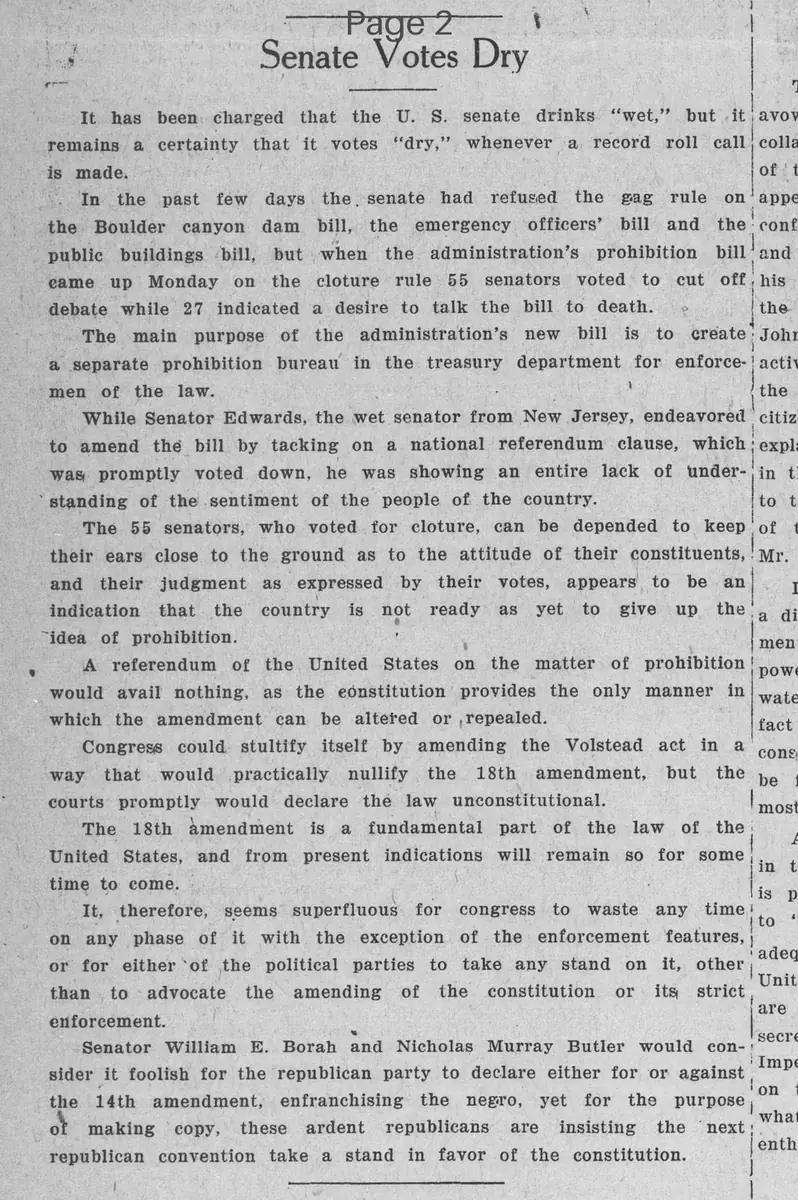
Senate Votes Dry
It has been charged that the U. S. senate drinks "wet," but it remains a certainty that it votes "dry," whenever a record roll call is made.
In the past few days the senate had refused the gag rule on the Boulder canyon dam bill, the emergency officers' bill and the public buildings bill, but when the administration's prohibition bill came up Monday on the cloture rule 55 senators voted to cut off debate while 27 indicated a desire to talk the bill to death.
The main purpose of the administration's new bill is to create a separate prohibition bureau in the treasury department for enforcement of the law.
While Senator Edwards, the wet senator from New Jersey, endeavored to amend the bill by tacking on a national referendum clause, which was promptly voted down, he was showing an entire lack of understanding of the sentiment of the people of the country.
The 55 senators, who voted for cloture, can be depended to keep their ears close to the ground as to the attitude of their constituents, and their judgment as expressed by their votes, appears to be an indication that the country is not ready as yet to give up the idea of prohibition.
A referendum of the United States on the matter of prohibition would avail nothing, as the constitution provides the only manner in which the amendment can be altered or repealed.
Congress could stultify itself by amending the Volstead act in a way that would practically nullify the 18th amendment, but the courts promptly would declare the law unconstitutional.
The 18th amendment is a fundamental part of the law of the United States, and from present indications will remain so for some time to come.
It, therefore, seems superfluous for congress to waste any time on any phase of it with the exception of the enforcement features, or for either of the political parties to take any stand on it, other than to advocate the amending of the constitution or its strict enforcement.
Senator William E. Borah and Nicholas Murray Butler would consider it foolish for the republican party to declare either for or against the 14th amendment, enfranchising the negro, yet for the purpose of making copy, these ardent republicans are insisting the next republican convention take a stand in favor of the constitution.
It has been charged that the U. S. senate drinks "wet," but it remains a certainty that it votes "dry," whenever a record roll call is made.
In the past few days the senate had refused the gag rule on the Boulder canyon dam bill, the emergency officers' bill and the public buildings bill, but when the administration's prohibition bill came up Monday on the cloture rule 55 senators voted to cut off debate while 27 indicated a desire to talk the bill to death.
The main purpose of the administration's new bill is to create a separate prohibition bureau in the treasury department for enforcement of the law.
While Senator Edwards, the wet senator from New Jersey, endeavored to amend the bill by tacking on a national referendum clause, which was promptly voted down, he was showing an entire lack of understanding of the sentiment of the people of the country.
The 55 senators, who voted for cloture, can be depended to keep their ears close to the ground as to the attitude of their constituents, and their judgment as expressed by their votes, appears to be an indication that the country is not ready as yet to give up the idea of prohibition.
A referendum of the United States on the matter of prohibition would avail nothing, as the constitution provides the only manner in which the amendment can be altered or repealed.
Congress could stultify itself by amending the Volstead act in a way that would practically nullify the 18th amendment, but the courts promptly would declare the law unconstitutional.
The 18th amendment is a fundamental part of the law of the United States, and from present indications will remain so for some time to come.
It, therefore, seems superfluous for congress to waste any time on any phase of it with the exception of the enforcement features, or for either of the political parties to take any stand on it, other than to advocate the amending of the constitution or its strict enforcement.
Senator William E. Borah and Nicholas Murray Butler would consider it foolish for the republican party to declare either for or against the 14th amendment, enfranchising the negro, yet for the purpose of making copy, these ardent republicans are insisting the next republican convention take a stand in favor of the constitution.
What sub-type of article is it?
Temperance
Constitutional
What keywords are associated?
Prohibition Enforcement
Senate Vote
18th Amendment
Cloture Rule
Temperance
Volstead Act
Constitutional Amendment
What entities or persons were involved?
U. S. Senate
Senator Edwards
Senator William E. Borah
Nicholas Murray Butler
Republican Party
Editorial Details
Primary Topic
Senate Support For Prohibition Enforcement Bill
Stance / Tone
Supportive Of Prohibition And Its Enforcement
Key Figures
U. S. Senate
Senator Edwards
Senator William E. Borah
Nicholas Murray Butler
Republican Party
Key Arguments
Senate Votes 'Dry' On Prohibition Issues Despite Charges Of Drinking 'Wet'
55 Senators Voted For Cloture To Cut Off Debate On The Administration's Prohibition Bill
The Bill Aims To Create A Separate Prohibition Bureau In The Treasury Department
Senator Edwards' Amendment For A National Referendum Was Voted Down
A Referendum Cannot Alter The 18th Amendment; Only Constitutional Amendment Can
Congress Cannot Nullify The 18th Amendment Via The Volstead Act As Courts Would Rule It Unconstitutional
The 18th Amendment Is Fundamental And Will Remain For Some Time
Congress Should Focus Only On Enforcement Features
Political Parties Should Not Take Stands Other Than Advocating Constitutional Amendment Or Strict Enforcement
Borah And Butler Foolishly Push Republicans To Take A Stand On Prohibition Unlike The 14th Amendment