Thank you for visiting SNEWPapers!
Sign up free
Story
August 5, 1847
Litchfield Enquirer
Litchfield, Litchfield County, Connecticut
What is this article about?
A reflective visit to Monticello describes Thomas Jefferson's mansion, his death chamber on July 4, 1826, the site's decay after his insolvency, and his neglected grave, calling for honors to the patriot and president.
Clipping
OCR Quality
95%
Excellent
Full Text
From the New York Observer.
Monticello.
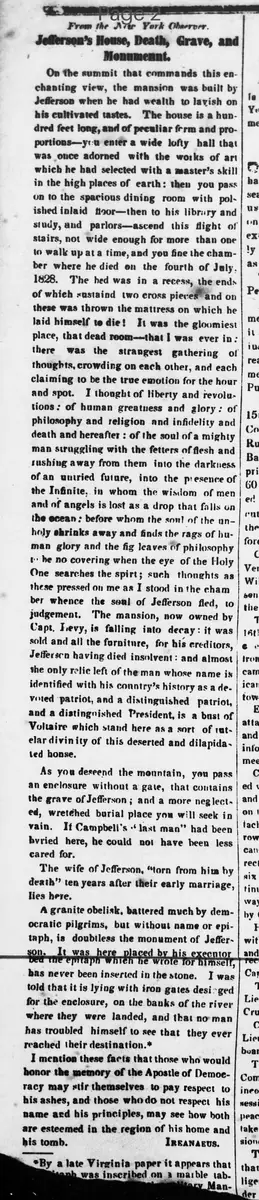
On the summit that commands this enchanting view, the mansion was built by Jefferson when he had wealth to lavish on his cultivated tastes. The house is a hundred feet long, and of peculiar form and proportions—you enter a wide lofty hall that was once adorned with the works of art which he had selected with a master's skill in the high places of earth: then you pass on to the spacious dining room with polished inlaid floor—then to his library and study, and parlors—ascend this flight of stairs, not wide enough for more than one to walk up at a time, and you find the chamber where he died on the fourth of July, 1826. The bed was in a recess, the ends of which sustained two cross pieces and on these was thrown the mattress on which he laid himself to die! It was the gloomiest place, that death room—that I was ever in: there was the strangest gathering of thoughts, crowding on each other, and each claiming to be the true emotion for the hour and spot. I thought of liberty and revolutions: of human greatness and glory: of philosophy and religion and infidelity and death and hereafter: of the soul of a mighty man struggling with the fetters of flesh and rushing away from them into the darkness of an untried future, into the presence of the Infinite, in whom the wisdom of men and of angels is lost as a drop that falls on the ocean: before whom the soul of the unholy shrinks away and finds the rags of human glory and the fig leaves of philosophy give no covering when the eye of the Holy One searches the spirit; such thoughts as these pressed on me as I stood in the chamber whence the soul of Jefferson fled, to judgement. The mansion, now owned by Capt. Levy, is falling into decay: it was sold and all the furniture, for his creditors, Jefferson having died insolvent: and almost the only relic left of the man whose name is identified with his country's history as a devoted patriot, and a distinguished President, is a bust of Voltaire which stands here as a sort of tutelar divinity of this deserted and dilapidated house.
As you descend the mountain, you pass an enclosure without a gate, that contains the grave of Jefferson; and a more neglected, wretched burial place you will seek in vain. If Campbell's 'last man' had been buried here, he could not have been less cared for.
The wife of Jefferson, 'torn from him by death' ten years after their early marriage, lies here.
A granite obelisk, battered much by democratic pilgrims, but without name or epitaph, is doubtless the monument of Jefferson. It was here placed by his executor and the epitaph which he wrote for himself, has never been inserted in the stone.
I was told that it is lying with iron gates designed for the enclosure, on the banks of the river where they were landed, and that no man has troubled himself to see that they ever reached their destination.*
I mention these facts that those who would honor the memory of the Apostle of Democracy may stir themselves to pay respect to his ashes, and those who do not respect his name and his principles, may see how both are esteemed in the region of his home and his tomb.
IRENAEUS.
By a late Virginia paper it appears that
enh was inscribed on a marble tab-
Monticello.
On the summit that commands this enchanting view, the mansion was built by Jefferson when he had wealth to lavish on his cultivated tastes. The house is a hundred feet long, and of peculiar form and proportions—you enter a wide lofty hall that was once adorned with the works of art which he had selected with a master's skill in the high places of earth: then you pass on to the spacious dining room with polished inlaid floor—then to his library and study, and parlors—ascend this flight of stairs, not wide enough for more than one to walk up at a time, and you find the chamber where he died on the fourth of July, 1826. The bed was in a recess, the ends of which sustained two cross pieces and on these was thrown the mattress on which he laid himself to die! It was the gloomiest place, that death room—that I was ever in: there was the strangest gathering of thoughts, crowding on each other, and each claiming to be the true emotion for the hour and spot. I thought of liberty and revolutions: of human greatness and glory: of philosophy and religion and infidelity and death and hereafter: of the soul of a mighty man struggling with the fetters of flesh and rushing away from them into the darkness of an untried future, into the presence of the Infinite, in whom the wisdom of men and of angels is lost as a drop that falls on the ocean: before whom the soul of the unholy shrinks away and finds the rags of human glory and the fig leaves of philosophy give no covering when the eye of the Holy One searches the spirit; such thoughts as these pressed on me as I stood in the chamber whence the soul of Jefferson fled, to judgement. The mansion, now owned by Capt. Levy, is falling into decay: it was sold and all the furniture, for his creditors, Jefferson having died insolvent: and almost the only relic left of the man whose name is identified with his country's history as a devoted patriot, and a distinguished President, is a bust of Voltaire which stands here as a sort of tutelar divinity of this deserted and dilapidated house.
As you descend the mountain, you pass an enclosure without a gate, that contains the grave of Jefferson; and a more neglected, wretched burial place you will seek in vain. If Campbell's 'last man' had been buried here, he could not have been less cared for.
The wife of Jefferson, 'torn from him by death' ten years after their early marriage, lies here.
A granite obelisk, battered much by democratic pilgrims, but without name or epitaph, is doubtless the monument of Jefferson. It was here placed by his executor and the epitaph which he wrote for himself, has never been inserted in the stone.
I was told that it is lying with iron gates designed for the enclosure, on the banks of the river where they were landed, and that no man has troubled himself to see that they ever reached their destination.*
I mention these facts that those who would honor the memory of the Apostle of Democracy may stir themselves to pay respect to his ashes, and those who do not respect his name and his principles, may see how both are esteemed in the region of his home and his tomb.
IRENAEUS.
By a late Virginia paper it appears that
enh was inscribed on a marble tab-
What sub-type of article is it?
Biography
Historical Event
What themes does it cover?
Misfortune
Providence Divine
Tragedy
What keywords are associated?
Monticello
Jefferson Death
Neglected Grave
Historical Decay
Patriot Memory
What entities or persons were involved?
Jefferson
Capt. Levy
Irenaeus
Where did it happen?
Monticello
Story Details
Key Persons
Jefferson
Capt. Levy
Irenaeus
Location
Monticello
Event Date
July 4, 1826
Story Details
Visitor describes Jefferson's Monticello mansion, death chamber, philosophical reflections on his passing, the site's decay and sale due to insolvency, neglected grave shared with his wife, and urges respect for his memory as patriot and president.