Thank you for visiting SNEWPapers!
Sign up free
Frostburg Mining Journal
Frostburg, Allegany County, Maryland
What is this article about?
The old stone church at Eckhart was demolished by dynamite due to unsafe walls, revealing mouldy contents from the 1847 corner-stone, including religious texts and newspapers, to be preserved in church archives. The land belonged to the Consolidation Coal Company despite church funding.
Clipping
OCR Quality
Full Text
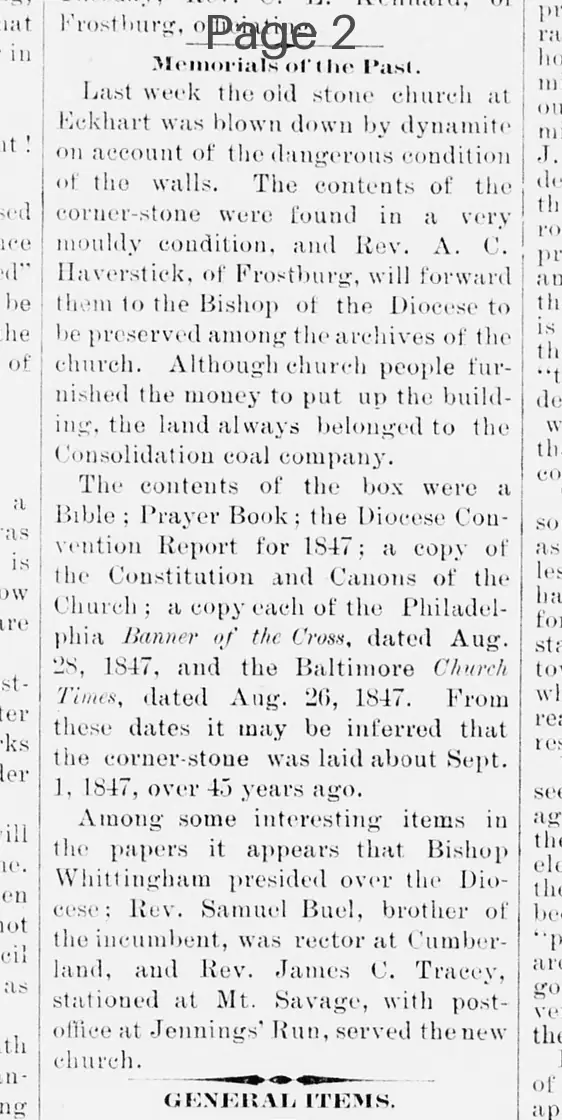
Last week the old stone church at Eckhart was blown down by dynamite on account of the dangerous condition of the walls. The contents of the corner-stone were found in a very mouldy condition, and Rev. A. C. Haverstick, of Frostburg, will forward them to the Bishop of the Diocese to be preserved among the archives of the church. Although church people furnished the money to put up the building, the land always belonged to the Consolidation coal company.
The contents of the box were a Bible; Prayer Book; the Diocese Convention Report for 1847; a copy of the Constitution and Canons of the Church; a copy each of the Philadelphia Banner of the Cross, dated Aug. 28, 1847, and the Baltimore Church Times, dated Aug. 26, 1847. From these dates it may be inferred that the corner-stone was laid about Sept. 1, 1847, over 45 years ago.
Among some interesting items in the papers it appears that Bishop Whittingham presided over the Diocese; Rev. Samuel Buel, brother of the incumbent, was rector at Cumberland, and Rev. James C. Tracey stationed at Mt. Savage, with post-office at Jennings' Run, served the new church.
What sub-type of article is it?
What themes does it cover?
What keywords are associated?
What entities or persons were involved?
Where did it happen?
Story Details
Key Persons
Location
Eckhart
Event Date
About Sept. 1, 1847
Story Details
Demolition of the old stone church at Eckhart uncovered contents from the corner-stone laid around September 1, 1847, including a Bible, Prayer Book, diocese reports, church constitution, and newspapers from 1847. Rev. A. C. Haverstick will send them to the Bishop for preservation. The land was owned by the Consolidation Coal Company.