Thank you for visiting SNEWPapers!
Sign up free
Literary
May 8, 1930
Watauga Democrat
Boone, Watauga County, North Carolina
What is this article about?
In this second installment of 'Miss Nobody from Nowhere,' an amnesiac woman arrives at the Garland Hotel in New York. With help from a kind stranger, Eric Hamilton, she learns her registered name is a French pun meaning 'Eve Nobody from Nowhere.' They dine together, and Hamilton arranges for a psychiatrist, Dr. Carrick, to examine her, offering support during her memory loss.
Merged-components note: Serialized fiction story with accompanying image; spatial relation indicates they form one component.
Clipping
OCR Quality
85%
Good
Full Text
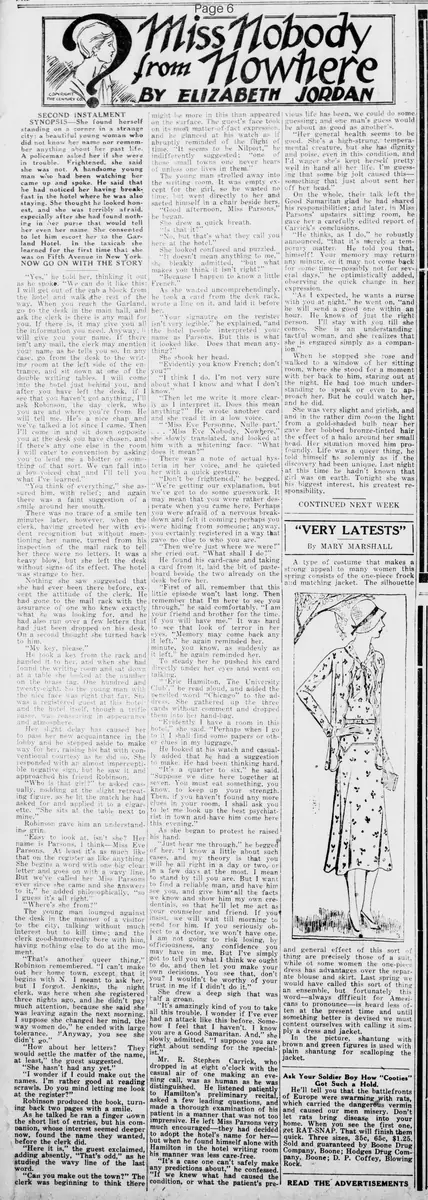
Miss Nobody from Nowhere
COPYRIGHT THE CENTURY CO. BY ELIZABETH JORDAN
SECOND INSTALMENT
SYNOPSIS—She found herself standing on a corner in a strange city; a beautiful young woman who did not know her name nor remember anything about her past life. A policeman asked her if she were in trouble. Frightened, she said she was not. A handsome young man who had been watching her came up and spoke. He said that he had noticed her having breakfast in the hotel where he was also staying. She thought he looked honest, and she was terribly afraid, especially after she had found nothing in her purse that would tell her even her name. She consented to let him escort her to the Garland Hotel. In the taxicab she learned for the first time that she was on Fifth Avenue in New York.
NOW GO ON WITH THE STORY
"Yes," he told her, thinking it out as he spoke. "We can do it like this: I will get out of the cab a block from the hotel and walk the rest of the way. When you reach the Garland, go to the desk in the main hall, and ask the clerk if there is any mail for you. If there is, it may give you all the information you need. Anyway, I will give you your name. If there isn't any mail, the clerk may mention your name as he tells you so. In any case, go from the desk to the writing room at the left side of the entrance, and sit down at one of the double writing tables. I will come into the hotel just behind you, and after you have left the desk, if I see that you haven't got anything, I'll ask Robinson, the day clerk, who you are and where you're from. He will tell me. He's a nice chap and we've talked a lot since I came. Then I'll come in and sit down opposite you at the desk you have chosen, and if there's any one else in the room I will cater to convention by asking you to lend me a blotter or something of that sort. We can fall into a low-voiced chat and I'll tell you what I've learned."
"You think of everything," she assured him with relief; and again there was a faint suggestion of a smile around her mouth.
There was no trace of a smile ten minutes later, however, when the clerk, having greeted her with evident recognition but without mentioning her name, turned from his inspection of the mail rack to tell her there were no letters. It was a heavy blow, but she left the desk without signs of its effect. The hotel was strange to her.
Nothing she saw suggested that she had ever been there before, except the attitude of the clerk. He had gone to the mail rack with the assurance of one who knew exactly what he was looking for, and he had also run over a few letters that had just been dropped on his desk.
On a second thought she turned back to him.
"My key, please."
He took a key from the rack and handed it to her, and when she had found the writing room and sat down at a table she looked at the number on the brass tag. One hundred and twenty-eight. So the young man with the nice face was right that far. She was a registered guest at this hotel and the hotel itself, though a trifle passe, was reassuring in appearance and atmosphere.
Her slight delay has caused her to pass her new acquaintance in the lobby and he stepped aside to make way for her, raising his hat with conventional courtesy as he did so. She responded with an almost imperceptible negative sign, but he saw it and approached his friend Robinson.
"Who is that girl?" he asked casually, nodding at the slight retreating figure, as he lit the match he had asked for and applied it to a cigarette. "She sits at the table next to mine."
Robinson gave him an understanding grin.
"Easy to look at, isn't she? Her name is Parsons, I think—Miss Eve Parsons. At least it's as much like that on the register as like anything. She begins a word with one big clear letter and goes on with a wavy line. But we've called her Miss Parsons ever since she came and she answers to it," he added philosophically, "so I guess it's all right."
"Where's she from?"
The young man lounged against the desk in the manner of a visitor to the city, talking without much interest but to kill time; and the clerk good-humoredly bore with him, having nothing else to do at the moment.
"That's another queer thing," Robinson remembered. "I can't make out her home town, except that it begins with N. I meant to ask her, but I forgot. Jenkins, the night clerk, was here when she registered three nights ago, and he didn't pay much attention, because she said she was leaving again the next morning. I suppose she changed her mind, the way women do," he ended with large tolerance.
"Anyway, you see she didn't go."
"How about her letters? They would settle the matter of the name, at least," the guest suggested.
"She hasn't had any yet."
"I wonder if I could make out the names. I'm rather good at reading scrawls. Do you mind letting me look at the register?"
Robinson produced the book, turning back two pages with a smile. As he talked he ran a finger down the short list of entries, but his companion, whose interest seemed deeper now, found the name they wanted, before the clerk did.
"Here it is," the guest exclaimed, adding absently, "That's odd," as he studied the wavy line of the last word.
"Can you make out the town?"
The clerk was beginning to think there might be more in this than appeared on the surface. The guest's face took on its most matter-of-fact expression, and he glanced at his watch as if abruptly reminded of the flight of time.
"It seems to be Nilport," he indifferently suggested; "one of those small towns one never hears of unless one lives in them."
The young man strolled away into the writing room. It was empty except for the girl, so he wasted no time, but went directly to her and seated himself in a chair beside hers.
"Good afternoon, Miss Parsons," he began.
She drew a quick breath.
"Is that it?"
"No, but that's what they call you here at the hotel."
She looked confused and puzzled.
"It doesn't mean anything to me," she bleakly admitted. "But what makes you think it isn't right?"
"Because I happen to know a little French."
As she waited uncomprehendingly, he took a card from the desk rack, wrote a line on it, and laid it before her.
"Your signature on the register isn't very legible," he explained, "and the hotel people interpreted your name as Parsons. But this is what it looked like. Does that mean anything?"
She shook her head.
"Evidently you know French; don't you?"
"I think I do. I'm not very sure about what I know and what I don't know."
"Then let me write it more clearly as I interpret it. Does this mean anything?" He wrote another card and she read it in a low voice.
" 'Miss Eve Personne, Nulle part.' . . . 'Miss Eve Nobody, Nowhere,' " she slowly translated, and looked at him with a whitening face. "What does it mean?"
There was a note of actual hysteria in her voice, and he quieted her with a quick gesture.
"Don't be frightened," he begged. "We're getting our explanation, but we've got to do some guesswork. It may mean that you were rather desperate when you came here. Perhaps you were afraid of a nervous breakdown and felt it coming; perhaps you were hiding from someone; anyway, you certainly registered in a way that gave no clue to who you are."
"Then we're just where we were!" she cried out. "What shall I do?"
He found his card-case and taking a card from it, laid the bit of pasteboard beside the two already on the desk before her.
"First of all, remember that this little episode won't last long. Then remember that I'm here to see you through," he said comfortably. "I am your friend and brother for the time, if you will have me." It was hard to see that look of terror in her eyes. "Memory may come back any minute, you know, as suddenly as it left."
To steady her he pushed his card directly under her eyes and went on talking.
"Eric Hamilton, The University Club," he read aloud, and added the penciled word "Chicago" to the address. She gathered up the three cards without comment and dropped them into her hand-bag.
"Evidently I have a room in this hotel," she said. "Perhaps when I go to it I shall find some papers or other clues in my luggage."
He looked at his watch and casually added that he had a suggestion to make. He had been thinking hard.
"It's a quarter to six," he said. "Suppose we dine here together at seven. You must eat something, you know, to keep up your strength. Then, if you haven't found any more clues in your room, I shall ask you to let me look up the best psychiatrist in town and have him come here this evening."
As she began to protest he raised his hand.
"Just hear me through," he begged of her. "I know a little about such cases, and my theory is that you will be all right in a day or two, or in a few days at the most. I mean to stand by till you are. But I want to find a reliable man, and have him see you, and give him all the facts we know and show him my own credentials, so that he'll let me act as your counselor and friend. If you insist, we will wait till morning to send for him. If you seriously object to a doctor, we won't have one. I am not going to risk losing, by officiousness, any confidence you may have in me. But I've simply got to tell you what I think we ought to do, and then let you make your own decisions. You see that, don't you? I wouldn't be worthy of your trust in me if I didn't do it."
She drew a deep sigh that was half a groan.
"It's amazingly kind of you to take all this trouble. I wonder if I've ever had an attack like this before. Somehow I feel that I haven't. I know you are a Good Samaritan. And," she slowly admitted, "I suppose you are right about sending for the specialist."
Mr. R. Stephen Carrick, who dropped in at eight o'clock with the casual air of one making an evening call, was as human as he was distinguished. He listened patiently to Hamilton's preliminary recital, asked a few leading questions, and made a thorough examination of his patient in a manner that was not too impressive. He left Miss Parsons very much encouraged—they had decided to adopt the hotel's name for her—but when he found himself alone with Hamilton in the hotel writing room his manner was less care-free.
"It's a case one can't safely make any predictions about," he confessed. "If we knew what had caused the condition, or what the patient's previous life has been, we could do some guessing; and one man's guess would be about as good as another's.
"Her general health seems to be good. She's a high-strung, temperamental creature, but she has dignity and poise, even in this condition, and I'd wager she's kept herself pretty well in hand all her life. I'm guessing that some big jolt caused this—something that just about sent her off her head."
On the whole, their talk left the Good Samaritan glad he had shared his responsibilities; and later, in Miss Parsons' upstairs sitting room, he gave her a carefully edited report of Carrick's conclusions.
"He thinks, as I do," he robustly announced, "that it's merely a temporary matter. He told you that, himself! Your memory may return any minute, or it may not come back for some time—possibly not for several days," he optimistically added, observing the quick change in her expression.
"As I expected, he wants a nurse with you at night," he went on, "and he will send a good one within an hour. He knows of just the right person. I'll stay with you till she comes. She is an understanding, tactful woman, and she realizes that she is engaged simply as a companion."
When he stopped she rose and walked to a window of her sitting room, where she stood for a moment with her back to him, staring out at the night. He had too much understanding to speak or even to approach her. But he could watch her, and he did.
She was very slight and girlish, and in the rather dim room the light from a gold-shaded bulb near her gave her bobbed bronze-tinted hair the effect of a halo around her small head. Her situation moved him profoundly. Life was a queer thing, he told himself as solemnly as if the discovery had been unique. Last night at this time he hadn't known that girl was on earth. Tonight she was his biggest interest, his greatest responsibility.
CONTINUED NEXT WEEK
COPYRIGHT THE CENTURY CO. BY ELIZABETH JORDAN
SECOND INSTALMENT
SYNOPSIS—She found herself standing on a corner in a strange city; a beautiful young woman who did not know her name nor remember anything about her past life. A policeman asked her if she were in trouble. Frightened, she said she was not. A handsome young man who had been watching her came up and spoke. He said that he had noticed her having breakfast in the hotel where he was also staying. She thought he looked honest, and she was terribly afraid, especially after she had found nothing in her purse that would tell her even her name. She consented to let him escort her to the Garland Hotel. In the taxicab she learned for the first time that she was on Fifth Avenue in New York.
NOW GO ON WITH THE STORY
"Yes," he told her, thinking it out as he spoke. "We can do it like this: I will get out of the cab a block from the hotel and walk the rest of the way. When you reach the Garland, go to the desk in the main hall, and ask the clerk if there is any mail for you. If there is, it may give you all the information you need. Anyway, I will give you your name. If there isn't any mail, the clerk may mention your name as he tells you so. In any case, go from the desk to the writing room at the left side of the entrance, and sit down at one of the double writing tables. I will come into the hotel just behind you, and after you have left the desk, if I see that you haven't got anything, I'll ask Robinson, the day clerk, who you are and where you're from. He will tell me. He's a nice chap and we've talked a lot since I came. Then I'll come in and sit down opposite you at the desk you have chosen, and if there's any one else in the room I will cater to convention by asking you to lend me a blotter or something of that sort. We can fall into a low-voiced chat and I'll tell you what I've learned."
"You think of everything," she assured him with relief; and again there was a faint suggestion of a smile around her mouth.
There was no trace of a smile ten minutes later, however, when the clerk, having greeted her with evident recognition but without mentioning her name, turned from his inspection of the mail rack to tell her there were no letters. It was a heavy blow, but she left the desk without signs of its effect. The hotel was strange to her.
Nothing she saw suggested that she had ever been there before, except the attitude of the clerk. He had gone to the mail rack with the assurance of one who knew exactly what he was looking for, and he had also run over a few letters that had just been dropped on his desk.
On a second thought she turned back to him.
"My key, please."
He took a key from the rack and handed it to her, and when she had found the writing room and sat down at a table she looked at the number on the brass tag. One hundred and twenty-eight. So the young man with the nice face was right that far. She was a registered guest at this hotel and the hotel itself, though a trifle passe, was reassuring in appearance and atmosphere.
Her slight delay has caused her to pass her new acquaintance in the lobby and he stepped aside to make way for her, raising his hat with conventional courtesy as he did so. She responded with an almost imperceptible negative sign, but he saw it and approached his friend Robinson.
"Who is that girl?" he asked casually, nodding at the slight retreating figure, as he lit the match he had asked for and applied it to a cigarette. "She sits at the table next to mine."
Robinson gave him an understanding grin.
"Easy to look at, isn't she? Her name is Parsons, I think—Miss Eve Parsons. At least it's as much like that on the register as like anything. She begins a word with one big clear letter and goes on with a wavy line. But we've called her Miss Parsons ever since she came and she answers to it," he added philosophically, "so I guess it's all right."
"Where's she from?"
The young man lounged against the desk in the manner of a visitor to the city, talking without much interest but to kill time; and the clerk good-humoredly bore with him, having nothing else to do at the moment.
"That's another queer thing," Robinson remembered. "I can't make out her home town, except that it begins with N. I meant to ask her, but I forgot. Jenkins, the night clerk, was here when she registered three nights ago, and he didn't pay much attention, because she said she was leaving again the next morning. I suppose she changed her mind, the way women do," he ended with large tolerance.
"Anyway, you see she didn't go."
"How about her letters? They would settle the matter of the name, at least," the guest suggested.
"She hasn't had any yet."
"I wonder if I could make out the names. I'm rather good at reading scrawls. Do you mind letting me look at the register?"
Robinson produced the book, turning back two pages with a smile. As he talked he ran a finger down the short list of entries, but his companion, whose interest seemed deeper now, found the name they wanted, before the clerk did.
"Here it is," the guest exclaimed, adding absently, "That's odd," as he studied the wavy line of the last word.
"Can you make out the town?"
The clerk was beginning to think there might be more in this than appeared on the surface. The guest's face took on its most matter-of-fact expression, and he glanced at his watch as if abruptly reminded of the flight of time.
"It seems to be Nilport," he indifferently suggested; "one of those small towns one never hears of unless one lives in them."
The young man strolled away into the writing room. It was empty except for the girl, so he wasted no time, but went directly to her and seated himself in a chair beside hers.
"Good afternoon, Miss Parsons," he began.
She drew a quick breath.
"Is that it?"
"No, but that's what they call you here at the hotel."
She looked confused and puzzled.
"It doesn't mean anything to me," she bleakly admitted. "But what makes you think it isn't right?"
"Because I happen to know a little French."
As she waited uncomprehendingly, he took a card from the desk rack, wrote a line on it, and laid it before her.
"Your signature on the register isn't very legible," he explained, "and the hotel people interpreted your name as Parsons. But this is what it looked like. Does that mean anything?"
She shook her head.
"Evidently you know French; don't you?"
"I think I do. I'm not very sure about what I know and what I don't know."
"Then let me write it more clearly as I interpret it. Does this mean anything?" He wrote another card and she read it in a low voice.
" 'Miss Eve Personne, Nulle part.' . . . 'Miss Eve Nobody, Nowhere,' " she slowly translated, and looked at him with a whitening face. "What does it mean?"
There was a note of actual hysteria in her voice, and he quieted her with a quick gesture.
"Don't be frightened," he begged. "We're getting our explanation, but we've got to do some guesswork. It may mean that you were rather desperate when you came here. Perhaps you were afraid of a nervous breakdown and felt it coming; perhaps you were hiding from someone; anyway, you certainly registered in a way that gave no clue to who you are."
"Then we're just where we were!" she cried out. "What shall I do?"
He found his card-case and taking a card from it, laid the bit of pasteboard beside the two already on the desk before her.
"First of all, remember that this little episode won't last long. Then remember that I'm here to see you through," he said comfortably. "I am your friend and brother for the time, if you will have me." It was hard to see that look of terror in her eyes. "Memory may come back any minute, you know, as suddenly as it left."
To steady her he pushed his card directly under her eyes and went on talking.
"Eric Hamilton, The University Club," he read aloud, and added the penciled word "Chicago" to the address. She gathered up the three cards without comment and dropped them into her hand-bag.
"Evidently I have a room in this hotel," she said. "Perhaps when I go to it I shall find some papers or other clues in my luggage."
He looked at his watch and casually added that he had a suggestion to make. He had been thinking hard.
"It's a quarter to six," he said. "Suppose we dine here together at seven. You must eat something, you know, to keep up your strength. Then, if you haven't found any more clues in your room, I shall ask you to let me look up the best psychiatrist in town and have him come here this evening."
As she began to protest he raised his hand.
"Just hear me through," he begged of her. "I know a little about such cases, and my theory is that you will be all right in a day or two, or in a few days at the most. I mean to stand by till you are. But I want to find a reliable man, and have him see you, and give him all the facts we know and show him my own credentials, so that he'll let me act as your counselor and friend. If you insist, we will wait till morning to send for him. If you seriously object to a doctor, we won't have one. I am not going to risk losing, by officiousness, any confidence you may have in me. But I've simply got to tell you what I think we ought to do, and then let you make your own decisions. You see that, don't you? I wouldn't be worthy of your trust in me if I didn't do it."
She drew a deep sigh that was half a groan.
"It's amazingly kind of you to take all this trouble. I wonder if I've ever had an attack like this before. Somehow I feel that I haven't. I know you are a Good Samaritan. And," she slowly admitted, "I suppose you are right about sending for the specialist."
Mr. R. Stephen Carrick, who dropped in at eight o'clock with the casual air of one making an evening call, was as human as he was distinguished. He listened patiently to Hamilton's preliminary recital, asked a few leading questions, and made a thorough examination of his patient in a manner that was not too impressive. He left Miss Parsons very much encouraged—they had decided to adopt the hotel's name for her—but when he found himself alone with Hamilton in the hotel writing room his manner was less care-free.
"It's a case one can't safely make any predictions about," he confessed. "If we knew what had caused the condition, or what the patient's previous life has been, we could do some guessing; and one man's guess would be about as good as another's.
"Her general health seems to be good. She's a high-strung, temperamental creature, but she has dignity and poise, even in this condition, and I'd wager she's kept herself pretty well in hand all her life. I'm guessing that some big jolt caused this—something that just about sent her off her head."
On the whole, their talk left the Good Samaritan glad he had shared his responsibilities; and later, in Miss Parsons' upstairs sitting room, he gave her a carefully edited report of Carrick's conclusions.
"He thinks, as I do," he robustly announced, "that it's merely a temporary matter. He told you that, himself! Your memory may return any minute, or it may not come back for some time—possibly not for several days," he optimistically added, observing the quick change in her expression.
"As I expected, he wants a nurse with you at night," he went on, "and he will send a good one within an hour. He knows of just the right person. I'll stay with you till she comes. She is an understanding, tactful woman, and she realizes that she is engaged simply as a companion."
When he stopped she rose and walked to a window of her sitting room, where she stood for a moment with her back to him, staring out at the night. He had too much understanding to speak or even to approach her. But he could watch her, and he did.
She was very slight and girlish, and in the rather dim room the light from a gold-shaded bulb near her gave her bobbed bronze-tinted hair the effect of a halo around her small head. Her situation moved him profoundly. Life was a queer thing, he told himself as solemnly as if the discovery had been unique. Last night at this time he hadn't known that girl was on earth. Tonight she was his biggest interest, his greatest responsibility.
CONTINUED NEXT WEEK
What sub-type of article is it?
Prose Fiction
What themes does it cover?
Friendship
Moral Virtue
Amnesia
Identity
What keywords are associated?
Amnesia
Mystery
New York
Hotel Register
Good Samaritan
Psychiatrist
French Pun
Identity Loss
What entities or persons were involved?
By Elizabeth Jordan
Literary Details
Title
Miss Nobody From Nowhere
Author
By Elizabeth Jordan
Key Lines
" 'Miss Eve Personne, Nulle Part.' . . . 'Miss Eve Nobody, Nowhere,' " She Slowly Translated, And Looked At Him With A Whitening Face.
"I Am Your Friend And Brother For The Time, If You Will Have Me."
"It's A Case One Can't Safely Make Any Predictions About," He Confessed.