Thank you for visiting SNEWPapers!
Sign up free
Literary
April 19, 1867
The Daily Phoenix
Columbia, Richland County, South Carolina
What is this article about?
In a grand medieval tournament hosted by Emperor Maximilian, knights compete for Archduchess Clothilde's hand. Otto of Ehenheim, the Landgrave of Alsace, faces a mysterious double, the Knight of the Violet (Count Karl of the Fen in disguise). After jousts, the tie is decided by riding at the ring, where Karl wins, marries Clothilde, and they live happily.
Clipping
OCR Quality
98%
Excellent
Full Text
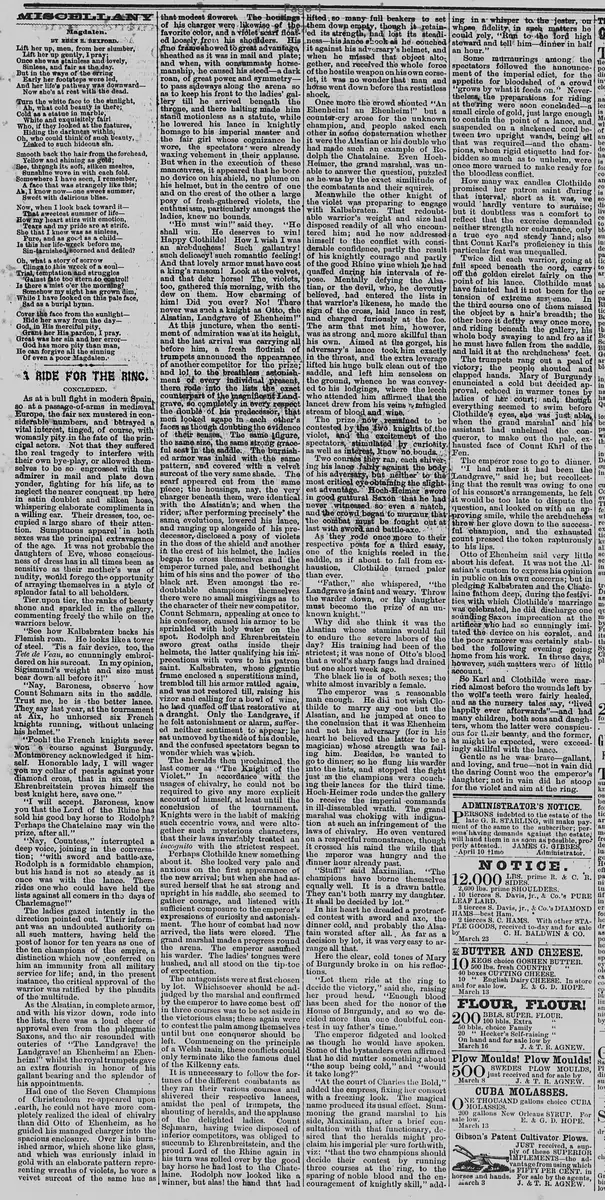
A RIDE FOR THE RING.
CONCLUDED.
As at a bull fight in modern Spain, so at a passage-of-arms in mediaeval Europe, the fair sex mustered in considerable numbers, and betrayed a vital interest, tinged, of course, with womanly pity, in the fate of the principal actors. Not that they suffered the real tragedy to interfere with their own bye-play, or allowed themselves to be so engrossed with the admirer in mail and plate down yonder, fighting for his life, as to neglect the nearer conquest up here in satin doublet and silken hose, whispering elaborate compliments in a willing ear. Their dresses, too, occupied a large share of their attention. Sumptuous apparel in both sexes was the principal extravagance of the age. It was not probable the daughters of Eve, whose consciousness of dress has in all times been as sensitive as their mother's was of nudity, would forego the opportunity of arraying themselves in a style of splendor fatal to all beholders.
Tier upon tier, the ranks of beauty shone and sparkled in the gallery, commenting freely the while on the warriors below.
"See how Kalbsbraten backs his Flemish roan. He looks like a tower of steel. 'Tis a fair device, too, the Tete de Veau, so cunningly embroidered on his surcoat. In my opinion, Sigismund's weight and size must bear down all before it!"
"Nay, Baroness, observe how Count Schmarn sits in the saddle. Trust me, he is the better lance. They say last year, at the tournament at Aix, he unhorsed six French knights running, without unlacing his helmet."
"Pooh! the French knights never won a course against Burgundy. Montmorency acknowledged it himself. Honorable lady, I will wager you my collar of pearls against your diamond cross, that in six courses Ehrenbreitstein proves himself the best knight here, save one."
"I will accept. Baroness, know you that the Lord of the Rhine has sold his good bay horse to Rodolph? Perhaps the Chatelaine may win the prize, after all."
"Nay, Countess," interrupted a deep voice, joining in the conversation; "with sword and battle-axe, Rodolph is a formidable champion, but his hand is not so steady as it once was with the lance. There rides one who could have held the lists against all comers in the days of Charlemagne!"
The ladies gazed intently in the direction pointed out. Their informant was an undoubted authority on all such matters, having held the post of honor for ten years as one of the ten champions of the empire, a distinction which now conferred on him an immunity from all military service for life; and, in the present instance, the critical approval of the warrior was ratified by the plaudits of the multitude.
As the Alsatian, in complete armor, and with his visor down, rode into the lists, there was a loud cheer of approval even from the phlegmatic Saxons, and the air resounded with outcries of "The Landgrave! the Landgrave! an Ehenheim! an Ehenheim!" whilst the royal trumpets gave an extra flourish in honor of his gallant bearing and the splendor of his appointments.
Had one of the Seven Champions of Christendom re-appeared upon earth, he could not have more completely realized the ideal of chivalry than did Otto of Ehenheim, as he guided his managed charger into the spacious enclosure. Over his burnished armor, which shone like glass, and which was curiously inlaid in gold with an elaborate pattern representing wreaths of violets, he wore a velvet surcoat of the same hue as that modest floweret. The housings of his charger were likewise of the favorite color, and a violet scarf floated loosely from his shoulders. His fine frame showed to great advantage sheathed as it was in mail and plate; and when, with consummate horsemanship, he caused his steed—a dark roan, of great power and symmetry—to pass sideways along the arena so as to keep his front to the ladies' gallery till he arrived beneath the throne, and there halting made him stand motionless as a statue, while he lowered his lance in knightly homage to his imperial master and the fair girl whose cognizance he wore, the spectators were already waxing vehement in their applause.
But when in the execution of these manoeuvres, it appeared that he bore no device on his shield, no plume on his helmet, but in the centre of one and on the crest of the other a large posy of fresh-gathered violets, the enthusiasm, particularly amongst the ladies, knew no bounds.
"He must win!" said they. "He shall win. He deserves to win! Happy Clothilde! How I wish I was an archduchess! Such gallantry! such delicacy! such romantic feeling! And that lovely armor must have cost a king's ransom! Look at the velvet, and that dear horse! The violets, too, gathered this morning, with the dew on them. How charming of him! Did you ever? No! There never was such a knight as Otto, the Alsatian, Landgrave of Ehenheim!"
At this juncture, when the sentiment of admiration was at its height, and the last arrival was carrying all before him, a fresh flourish of trumpets announced the appearance of another competitor for the prize; and lo! to the breathless astonishment of every individual present, there rode into the lists, the exact counterpart of the magnificent Landgrave, so completely in every respect the double of his predecessor, that men looked agape in each other's faces as though doubting the evidence of their senses. The same figure, the same size, the same strong graceful seat in the saddle. The burnished armor was inlaid with the same pattern, and covered with a velvet surcoat of the very same shade. The scarf appeared cut from the same piece; the housings, nay, the very charger beneath them, were identical with the Alsatian's; and when the rider, after performing precisely the same evolutions, lowered his lance, and ranging up alongside of his predecessor, disclosed a posy of violets in the boss of the shield and another in the crest of his helmet, the ladies began to cross themselves and the emperor turned pale, and bethought him of his sins and the power of the black art. Even amongst the redoubtable champions themselves there were no small misgivings as to the character of their new competitor. Count Schmarn, appealing at once to his confessor, caused his armor to be sprinkled with holy water on the spot. Rodolph and Ehrenbreitstein swore great oaths inside their helmets, the latter qualifying his imprecations with vows to his patron saint. Kalbsbraten, whose gigantic frame enclosed a superstitious mind, trembled till his armor rattled again, and was not restored till, raising his visor and calling for a bowl of wine, he had quaffed off that restorative at a draught. Only the Landgrave, if he felt astonishment or alarm, suffered neither sentiment to appear; he sat unmoved by the side of his double, and the confused spectators began to wonder which was which.
The heralds then proclaimed the last comer as "The Knight of the Violet." In accordance with the usages of chivalry, he could not be required to give any more explicit account of himself, at least until the conclusion of the tournament. Knights were in the habit of making such eccentric vows, and were altogether such mysterious characters, that their laws invariably treated an incognito with the strictest respect. Perhaps Clothilde knew something about it. She looked very pale and anxious on the first appearance of the new arrival; but when she had assured herself that he sat strong and upright in his saddle, she seemed to gather courage, and listened with sufficient composure to the emperor's expressions of curiosity and astonishment. The hour of combat had now arrived, the lists were closed. The grand marshal made a progress round the arena. The emperor assumed his warder. The ladies' tongues were hushed, and all stood on the tip-toe of expectation.
The antagonists were at first chosen by lot. Whichsoever should be adjudged by the marshal and confirmed by the emperor to have come best off in three courses was to be set aside in the victorious class; these again were to contest the palm among themselves until but one conqueror should be left. Commencing on the principle of a Welsh main, these conflicts could only terminate like the famous duel of the Kilkenny cats.
It is unnecessary to follow the fortunes of the different combatants as they ran their various courses and shivered their respective lances, amidst the peal of trumpets, the shouting of heralds, and the applause of the delighted ladies. Count Schmarn, having twice disposed of inferior competitors, was obliged to succumb to Ehrenbreitstein, and the proud Lord of the Rhine again in his turn was rolled over by the good bay horse he had lost to the Chatelaine. Rodolph now looked like a winner, but alas! the hand that had lifted so many full beakers to set them down empty, though it retained its strength, had lost its steadiness—his lance shook as he couched it against his adversary's helmet, and when he missed that object altogether, and received the whole force of the hostile weapon on his own corslet, it was no wonder that man and horse went down before the resistless shock.
Once more the crowd shouted "An Ehenheim! an Ehenheim!" but a counter-cry arose for the unknown champion, and people asked each other in some consternation whether it were the Alsatian or his double who had made such an example of Rodolph the Chatelaine. Even Hochheimer, the grand marshal, was unable to answer the question, puzzled as he was by the exact similitude of the combatants and their squires.
Meanwhile the other knight of the violet was preparing to engage with Kalbsbraten. That redoubtable warrior's weight and size had disposed readily of all who encountered him; and he now addressed himself to the conflict with considerable confidence, partly the result of his knightly courage and partly of the good Rhine wine which he had quaffed during his intervals of repose. Mentally defying the Alsatian, or the devil, who, he devoutly believed, had entered the lists in that warrior's likeness, he made the sign of the cross, laid lance in rest, and charged furiously at the foe. The arm that met him, however, was as strong and more skillful than his own. Aimed at the gorget, his adversary's lance took him exactly in the throat, and the extra leverage lifted his huge bulk clean out of the saddle, and left him senseless on the ground, whence he was conveyed to his lodgings, where the leech who attended him affirmed that the lancet drew from his veins a mingled stream of blood and wine.
The prize now remained to be contested by the two knights of the violet, and the excitement of the spectators, stimulated by curiosity as well as interest, knew no bounds. Two courses they ran, each shivering his lance fairly against the body of his adversary, but neither to the most critical eye obtaining the slightest advantage. Hochheimer swore in good guttural Saxon that he had never witnessed so even a match, and the crowd began to murmur that the combat must be fought out at last with sword and battle-axe.
As they rode once more to their respective posts for a third essay, one of the knights reeled in the saddle, as if about to fall from exhaustion. Clothilde turned paler than ever.
"Father," she whispered, "the Landgrave is faint and weary. Throw the warder down, or thy daughter must become the prize of an unknown knight."
Why did she think it was the Alsatian whose stamina would fail to endure the severe labors of the day? His training had been of the strictest; it was none of Otto's blood that a wolf's sharp fangs had drained but one short week ago.
The black lie is of both sexes; the white almost invariably a female.
The emperor was a reasonable man enough. He did not wish Clothilde to marry any one but the Alsatian, and he jumped at once to the conclusion that it was Ehenheim and not his adversary (for in his heart he believed the latter to be a magician) whose strength was failing him. Besides, he wanted to go to dinner; so he flung his warder into the lists, and stopped the fight just as the champions were couching their lances for the third time.
Hochheimer rode under the gallery to receive the imperial commands in ill-dissembled wrath. The grand marshal was choking with indignation at such an infringement of the laws of chivalry. He even ventured on a respectful remonstrance, though it crossed his mind the while that the emperor was hungry and the dinner hour already past.
"Stuff!" said Maximilian. "The champions have borne themselves equally well. It is a drawn battle. They can't both marry my daughter. It shall be decided by lot."
In his heart he dreaded a protracted contest with sword and axe, the dinner cold, and probably the Alsatian worsted after all. As far as a decision by lot, it was very easy to arrange all that.
Here the clear, cold tones of Mary of Burgundy broke in on his reflections.
"Let them ride at the ring to decide the victory," said she, raising her proud head. "Enough blood has been shed for the honor of the House of Burgundy, and so we decided more than one doubtful contest in my father's time."
The emperor fidgeted and looked as though he would have spoken. Some of the bystanders even affirmed that he did mutter something about "the soup being cold," and "would it take long?"
"At the court of Charles the Bold," added the empress, fixing her consort with a freezing look. The magical name produced its usual effect. Summoning the grand marshal to his side, Maximilian, after a brief consultation with that functionary, desired that the heralds might proclaim his imperial pleasure forthwith, viz: "that the two champions should decide their contest by running three courses at the ring, to the sparing of noble blood and the encouragement of knightly skill," adding in a whisper to the jester, on whose fidelity in such matters he could rely, "Run to the lord high steward and tell him—dinner in half an hour."
Some murmurings among the spectators followed the announcement of the imperial edict, for the appetite for bloodshed of a crowd "grows by what it feeds on." Nevertheless, the preparations for riding at the ring were soon concluded—a small circle of gold, just large enough to contain the point of a lance, and suspended on a slackened cord between two upright wands, being all that was required—and the champions, whom rigid etiquette had forbidden so much as to unhelm, were once more warned to make ready for the bloodless conflict.
How many wax candles Clothilde promised her patron saint during that interval, short as it was, we would hardly venture to surmise; but it doubtless was a comfort to reflect that the exercise demanded neither strength nor endurance, only a true eye and steady hand; also that Count Karl's proficiency in this particular feat was unequalled.
Twice did each warrior, going at full speed beneath the cord, carry off the golden circlet fairly on the point of his lance. Clothilde must have fainted had it not been for the tension of extreme suspense. In the third course one of them missed the object by a hair's breadth; the other bore it deftly away once more, and riding beneath the gallery, his whole body swaying to and fro as if he must have fallen from the saddle, laid it at the archduchess' feet.
The trumpets rang out a peal of victory; the people shouted and clapped hands. Mary of Burgundy enunciated a cold but decided approval, echoed in warmer tones by ladies of her court; and though everything seemed to swim before Clothilde's eyes, she was just able, when the grand marshal and his assistant had unhelmed the conqueror, to make out the pale, exhausted face of Count Karl of the Fen.
The emperor rose to go to dinner.
"I had rather it had been the Landgrave," said he; but recollecting that the result was owing to one of his consort's arrangements, he felt it would be too late to dispute the question, and looked on with an approving smile, while the archduchess threw her glove down to the successful champion, and the exhausted count pressed the token rapturously to his lips.
Otto of Ehenheim said very little about his defeat. It was not the Alsatian's custom to express his opinion in public on his own concerns; but in pledging Kalbsbraten and the Chatelaine fathom deep, during the festivities with which Clothilde's marriage was celebrated, he did discharge one sounding Saxon imprecation at the artificer who had so cunningly imitated the device on his corslet, and the poor armorer was certainly stabbed the following evening going home from his work. In those days, however, such matters were of little account.
So Karl and Clothilde were married almost before the wounds left by the wolf's teeth were fairly healed, and as the nursery tales say, "lived happily ever afterwards"—and had many children, both sons and daughters, whom the latter were conspicuous for their beauty, and the former, as might be expected, were exceedingly skillful with the lance.
Gentle as he was brave—gallant and loving, and true—not in vain did the daring Count woo the emperor's daughter; not in vain did he stoop for the violet and aim at the ring.
CONCLUDED.
As at a bull fight in modern Spain, so at a passage-of-arms in mediaeval Europe, the fair sex mustered in considerable numbers, and betrayed a vital interest, tinged, of course, with womanly pity, in the fate of the principal actors. Not that they suffered the real tragedy to interfere with their own bye-play, or allowed themselves to be so engrossed with the admirer in mail and plate down yonder, fighting for his life, as to neglect the nearer conquest up here in satin doublet and silken hose, whispering elaborate compliments in a willing ear. Their dresses, too, occupied a large share of their attention. Sumptuous apparel in both sexes was the principal extravagance of the age. It was not probable the daughters of Eve, whose consciousness of dress has in all times been as sensitive as their mother's was of nudity, would forego the opportunity of arraying themselves in a style of splendor fatal to all beholders.
Tier upon tier, the ranks of beauty shone and sparkled in the gallery, commenting freely the while on the warriors below.
"See how Kalbsbraten backs his Flemish roan. He looks like a tower of steel. 'Tis a fair device, too, the Tete de Veau, so cunningly embroidered on his surcoat. In my opinion, Sigismund's weight and size must bear down all before it!"
"Nay, Baroness, observe how Count Schmarn sits in the saddle. Trust me, he is the better lance. They say last year, at the tournament at Aix, he unhorsed six French knights running, without unlacing his helmet."
"Pooh! the French knights never won a course against Burgundy. Montmorency acknowledged it himself. Honorable lady, I will wager you my collar of pearls against your diamond cross, that in six courses Ehrenbreitstein proves himself the best knight here, save one."
"I will accept. Baroness, know you that the Lord of the Rhine has sold his good bay horse to Rodolph? Perhaps the Chatelaine may win the prize, after all."
"Nay, Countess," interrupted a deep voice, joining in the conversation; "with sword and battle-axe, Rodolph is a formidable champion, but his hand is not so steady as it once was with the lance. There rides one who could have held the lists against all comers in the days of Charlemagne!"
The ladies gazed intently in the direction pointed out. Their informant was an undoubted authority on all such matters, having held the post of honor for ten years as one of the ten champions of the empire, a distinction which now conferred on him an immunity from all military service for life; and, in the present instance, the critical approval of the warrior was ratified by the plaudits of the multitude.
As the Alsatian, in complete armor, and with his visor down, rode into the lists, there was a loud cheer of approval even from the phlegmatic Saxons, and the air resounded with outcries of "The Landgrave! the Landgrave! an Ehenheim! an Ehenheim!" whilst the royal trumpets gave an extra flourish in honor of his gallant bearing and the splendor of his appointments.
Had one of the Seven Champions of Christendom re-appeared upon earth, he could not have more completely realized the ideal of chivalry than did Otto of Ehenheim, as he guided his managed charger into the spacious enclosure. Over his burnished armor, which shone like glass, and which was curiously inlaid in gold with an elaborate pattern representing wreaths of violets, he wore a velvet surcoat of the same hue as that modest floweret. The housings of his charger were likewise of the favorite color, and a violet scarf floated loosely from his shoulders. His fine frame showed to great advantage sheathed as it was in mail and plate; and when, with consummate horsemanship, he caused his steed—a dark roan, of great power and symmetry—to pass sideways along the arena so as to keep his front to the ladies' gallery till he arrived beneath the throne, and there halting made him stand motionless as a statue, while he lowered his lance in knightly homage to his imperial master and the fair girl whose cognizance he wore, the spectators were already waxing vehement in their applause.
But when in the execution of these manoeuvres, it appeared that he bore no device on his shield, no plume on his helmet, but in the centre of one and on the crest of the other a large posy of fresh-gathered violets, the enthusiasm, particularly amongst the ladies, knew no bounds.
"He must win!" said they. "He shall win. He deserves to win! Happy Clothilde! How I wish I was an archduchess! Such gallantry! such delicacy! such romantic feeling! And that lovely armor must have cost a king's ransom! Look at the velvet, and that dear horse! The violets, too, gathered this morning, with the dew on them. How charming of him! Did you ever? No! There never was such a knight as Otto, the Alsatian, Landgrave of Ehenheim!"
At this juncture, when the sentiment of admiration was at its height, and the last arrival was carrying all before him, a fresh flourish of trumpets announced the appearance of another competitor for the prize; and lo! to the breathless astonishment of every individual present, there rode into the lists, the exact counterpart of the magnificent Landgrave, so completely in every respect the double of his predecessor, that men looked agape in each other's faces as though doubting the evidence of their senses. The same figure, the same size, the same strong graceful seat in the saddle. The burnished armor was inlaid with the same pattern, and covered with a velvet surcoat of the very same shade. The scarf appeared cut from the same piece; the housings, nay, the very charger beneath them, were identical with the Alsatian's; and when the rider, after performing precisely the same evolutions, lowered his lance, and ranging up alongside of his predecessor, disclosed a posy of violets in the boss of the shield and another in the crest of his helmet, the ladies began to cross themselves and the emperor turned pale, and bethought him of his sins and the power of the black art. Even amongst the redoubtable champions themselves there were no small misgivings as to the character of their new competitor. Count Schmarn, appealing at once to his confessor, caused his armor to be sprinkled with holy water on the spot. Rodolph and Ehrenbreitstein swore great oaths inside their helmets, the latter qualifying his imprecations with vows to his patron saint. Kalbsbraten, whose gigantic frame enclosed a superstitious mind, trembled till his armor rattled again, and was not restored till, raising his visor and calling for a bowl of wine, he had quaffed off that restorative at a draught. Only the Landgrave, if he felt astonishment or alarm, suffered neither sentiment to appear; he sat unmoved by the side of his double, and the confused spectators began to wonder which was which.
The heralds then proclaimed the last comer as "The Knight of the Violet." In accordance with the usages of chivalry, he could not be required to give any more explicit account of himself, at least until the conclusion of the tournament. Knights were in the habit of making such eccentric vows, and were altogether such mysterious characters, that their laws invariably treated an incognito with the strictest respect. Perhaps Clothilde knew something about it. She looked very pale and anxious on the first appearance of the new arrival; but when she had assured herself that he sat strong and upright in his saddle, she seemed to gather courage, and listened with sufficient composure to the emperor's expressions of curiosity and astonishment. The hour of combat had now arrived, the lists were closed. The grand marshal made a progress round the arena. The emperor assumed his warder. The ladies' tongues were hushed, and all stood on the tip-toe of expectation.
The antagonists were at first chosen by lot. Whichsoever should be adjudged by the marshal and confirmed by the emperor to have come best off in three courses was to be set aside in the victorious class; these again were to contest the palm among themselves until but one conqueror should be left. Commencing on the principle of a Welsh main, these conflicts could only terminate like the famous duel of the Kilkenny cats.
It is unnecessary to follow the fortunes of the different combatants as they ran their various courses and shivered their respective lances, amidst the peal of trumpets, the shouting of heralds, and the applause of the delighted ladies. Count Schmarn, having twice disposed of inferior competitors, was obliged to succumb to Ehrenbreitstein, and the proud Lord of the Rhine again in his turn was rolled over by the good bay horse he had lost to the Chatelaine. Rodolph now looked like a winner, but alas! the hand that had lifted so many full beakers to set them down empty, though it retained its strength, had lost its steadiness—his lance shook as he couched it against his adversary's helmet, and when he missed that object altogether, and received the whole force of the hostile weapon on his own corslet, it was no wonder that man and horse went down before the resistless shock.
Once more the crowd shouted "An Ehenheim! an Ehenheim!" but a counter-cry arose for the unknown champion, and people asked each other in some consternation whether it were the Alsatian or his double who had made such an example of Rodolph the Chatelaine. Even Hochheimer, the grand marshal, was unable to answer the question, puzzled as he was by the exact similitude of the combatants and their squires.
Meanwhile the other knight of the violet was preparing to engage with Kalbsbraten. That redoubtable warrior's weight and size had disposed readily of all who encountered him; and he now addressed himself to the conflict with considerable confidence, partly the result of his knightly courage and partly of the good Rhine wine which he had quaffed during his intervals of repose. Mentally defying the Alsatian, or the devil, who, he devoutly believed, had entered the lists in that warrior's likeness, he made the sign of the cross, laid lance in rest, and charged furiously at the foe. The arm that met him, however, was as strong and more skillful than his own. Aimed at the gorget, his adversary's lance took him exactly in the throat, and the extra leverage lifted his huge bulk clean out of the saddle, and left him senseless on the ground, whence he was conveyed to his lodgings, where the leech who attended him affirmed that the lancet drew from his veins a mingled stream of blood and wine.
The prize now remained to be contested by the two knights of the violet, and the excitement of the spectators, stimulated by curiosity as well as interest, knew no bounds. Two courses they ran, each shivering his lance fairly against the body of his adversary, but neither to the most critical eye obtaining the slightest advantage. Hochheimer swore in good guttural Saxon that he had never witnessed so even a match, and the crowd began to murmur that the combat must be fought out at last with sword and battle-axe.
As they rode once more to their respective posts for a third essay, one of the knights reeled in the saddle, as if about to fall from exhaustion. Clothilde turned paler than ever.
"Father," she whispered, "the Landgrave is faint and weary. Throw the warder down, or thy daughter must become the prize of an unknown knight."
Why did she think it was the Alsatian whose stamina would fail to endure the severe labors of the day? His training had been of the strictest; it was none of Otto's blood that a wolf's sharp fangs had drained but one short week ago.
The black lie is of both sexes; the white almost invariably a female.
The emperor was a reasonable man enough. He did not wish Clothilde to marry any one but the Alsatian, and he jumped at once to the conclusion that it was Ehenheim and not his adversary (for in his heart he believed the latter to be a magician) whose strength was failing him. Besides, he wanted to go to dinner; so he flung his warder into the lists, and stopped the fight just as the champions were couching their lances for the third time.
Hochheimer rode under the gallery to receive the imperial commands in ill-dissembled wrath. The grand marshal was choking with indignation at such an infringement of the laws of chivalry. He even ventured on a respectful remonstrance, though it crossed his mind the while that the emperor was hungry and the dinner hour already past.
"Stuff!" said Maximilian. "The champions have borne themselves equally well. It is a drawn battle. They can't both marry my daughter. It shall be decided by lot."
In his heart he dreaded a protracted contest with sword and axe, the dinner cold, and probably the Alsatian worsted after all. As far as a decision by lot, it was very easy to arrange all that.
Here the clear, cold tones of Mary of Burgundy broke in on his reflections.
"Let them ride at the ring to decide the victory," said she, raising her proud head. "Enough blood has been shed for the honor of the House of Burgundy, and so we decided more than one doubtful contest in my father's time."
The emperor fidgeted and looked as though he would have spoken. Some of the bystanders even affirmed that he did mutter something about "the soup being cold," and "would it take long?"
"At the court of Charles the Bold," added the empress, fixing her consort with a freezing look. The magical name produced its usual effect. Summoning the grand marshal to his side, Maximilian, after a brief consultation with that functionary, desired that the heralds might proclaim his imperial pleasure forthwith, viz: "that the two champions should decide their contest by running three courses at the ring, to the sparing of noble blood and the encouragement of knightly skill," adding in a whisper to the jester, on whose fidelity in such matters he could rely, "Run to the lord high steward and tell him—dinner in half an hour."
Some murmurings among the spectators followed the announcement of the imperial edict, for the appetite for bloodshed of a crowd "grows by what it feeds on." Nevertheless, the preparations for riding at the ring were soon concluded—a small circle of gold, just large enough to contain the point of a lance, and suspended on a slackened cord between two upright wands, being all that was required—and the champions, whom rigid etiquette had forbidden so much as to unhelm, were once more warned to make ready for the bloodless conflict.
How many wax candles Clothilde promised her patron saint during that interval, short as it was, we would hardly venture to surmise; but it doubtless was a comfort to reflect that the exercise demanded neither strength nor endurance, only a true eye and steady hand; also that Count Karl's proficiency in this particular feat was unequalled.
Twice did each warrior, going at full speed beneath the cord, carry off the golden circlet fairly on the point of his lance. Clothilde must have fainted had it not been for the tension of extreme suspense. In the third course one of them missed the object by a hair's breadth; the other bore it deftly away once more, and riding beneath the gallery, his whole body swaying to and fro as if he must have fallen from the saddle, laid it at the archduchess' feet.
The trumpets rang out a peal of victory; the people shouted and clapped hands. Mary of Burgundy enunciated a cold but decided approval, echoed in warmer tones by ladies of her court; and though everything seemed to swim before Clothilde's eyes, she was just able, when the grand marshal and his assistant had unhelmed the conqueror, to make out the pale, exhausted face of Count Karl of the Fen.
The emperor rose to go to dinner.
"I had rather it had been the Landgrave," said he; but recollecting that the result was owing to one of his consort's arrangements, he felt it would be too late to dispute the question, and looked on with an approving smile, while the archduchess threw her glove down to the successful champion, and the exhausted count pressed the token rapturously to his lips.
Otto of Ehenheim said very little about his defeat. It was not the Alsatian's custom to express his opinion in public on his own concerns; but in pledging Kalbsbraten and the Chatelaine fathom deep, during the festivities with which Clothilde's marriage was celebrated, he did discharge one sounding Saxon imprecation at the artificer who had so cunningly imitated the device on his corslet, and the poor armorer was certainly stabbed the following evening going home from his work. In those days, however, such matters were of little account.
So Karl and Clothilde were married almost before the wounds left by the wolf's teeth were fairly healed, and as the nursery tales say, "lived happily ever afterwards"—and had many children, both sons and daughters, whom the latter were conspicuous for their beauty, and the former, as might be expected, were exceedingly skillful with the lance.
Gentle as he was brave—gallant and loving, and true—not in vain did the daring Count woo the emperor's daughter; not in vain did he stoop for the violet and aim at the ring.
What sub-type of article is it?
Prose Fiction
What themes does it cover?
Love Romance
Moral Virtue
War Peace
What keywords are associated?
Medieval Tournament
Chivalry
Romance
Knight Of The Violet
Riding At The Ring
Archduchess Clothilde
Count Karl
Otto Of Ehenheim
Literary Details
Title
A Ride For The Ring.
Subject
Tournament For Archduchess Clothilde's Hand
Key Lines
"He Must Win!" Said They. "He Shall Win. He Deserves To Win! Happy Clothilde! How I Wish I Was An Archduchess! Such Gallantry! Such Delicacy! Such Romantic Feeling!"
"Let Them Ride At The Ring To Decide The Victory," Said She, Raising Her Proud Head. "Enough Blood Has Been Shed For The Honor Of The House Of Burgundy, And So We Decided More Than One Doubtful Contest In My Father's Time."
Gentle As He Was Brave—Gallant And Loving, And True—Not In Vain Did The Daring Count Woo The Emperor's Daughter; Not In Vain Did He Stoop For The Violet And Aim At The Ring.