Thank you for visiting SNEWPapers!
Sign up free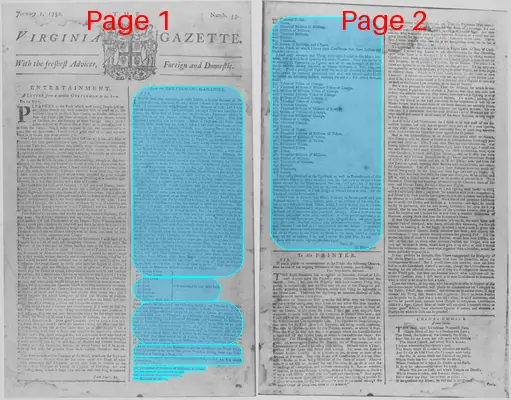
The Virginia Gazette
Richmond, Williamsburg, Richmond County, Virginia
What is this article about?
Account of Jedediah Buxton, an illiterate laborer from Elmton, Derbyshire, renowned for his extraordinary mental arithmetic abilities, including rapid calculations of areas, volumes, and vast numbers, as detailed in a 1725 examination.
Merged-components note: This is a continuation across pages of a report excerpted from the Gentleman's Magazine about the remarkable calculator Jedediah Buxton; relabeled the second part from letter_to_editor to foreign_news as it fits international reporting rather than a direct reader letter to this newspaper.
Clippings
1 of 2
OCR Quality
Full Text
SIR,
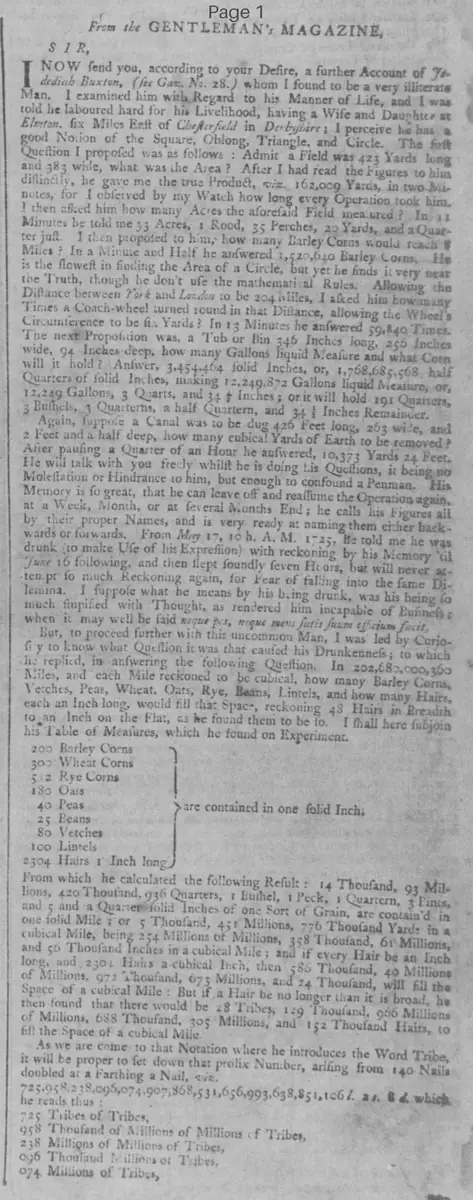
I now send you, according to your Desire, a further Account of Jedediah Buxton, (see Gaz. No. 28.) whom I found to be a very illiterate Man. I examined him with Regard to his Manner of Life, and was told he laboured hard for his Livelihood, having a Wife and Daughter. He lives at Elmton, six Miles East of Chesterfield in Derbyshire; I perceive he has a good Notion of the Square, Oblong, Triangle, and Circle. The first Question I proposed was as follows: Admit a Field was 423 Yards long and 283 wide, what was the Area? After I had read the Figures to him distinctly, he gave me the true Product, viz. 162,066 Yards, in two Minutes, for I observed by my Watch how long every Operation took him. I then asked him how many Acres the aforesaid Field measured? In 11 Minutes he told me 33 Acres, 1 Rood, 35 Perches, 20 Yards, and a Quarter just. I then proposed to him, how many Barley Corns would reach 3 Miles? In a Minute and Half he answered 1,520,640 Barley Corns. He is the lowest in finding the Area of a Circle, but yet he finds it very near the Truth, though he don't use the mathematical Rules. Allowing the Distance between York and London to be 204 Miles, I asked him how many Times a Coach-wheel turned round in that Distance, allowing Circumference to be six Yards: In 13 Minutes he answered 59,840 Times. The next Proposition was, a Tub or Bin 346 wide, 94 Inches deep, how many Gallons liquid Measure and what Corn will it hold? Answer, 3,454,464 solid Inches, or, 1,768,685.568 Quarters of solid Inches, making 12,249.872 Gallons liquid Measure, 12,249 Gallons, 3 Quarts, and 3/4 Inches; or it will hold 191 3 Bushels, 3 Quarters, a half Quarter, and 3/4 Inches Remainder. Again, suppose a Canal was to be dug 426 Feet long, 263 Inches wide, 255 Inches 2 Feet and a half deep, how many cubical Yards of Earth to be removed? After pausing a Quarter of an Hour he answered, 10,373 Yards 24 Feet. He will talk with you freely whilst he is doing these Questions, it being no Molestation or Hindrance to him, but enough to confound a Penman. Memory is so great, that he can leave off and resume the Operation again, at a Week, Month, or at several Months End; he calls his Figures all by their proper Names, and is very ready at naming them either backwards or forwards. From May 17, 10 h. A. M. 1725, He told me he was his drunk (to make Use of his Expression) with reckoning by his Memory 'til June 16 following, and then slept soundly even Hours, but will never attempt so much Reckoning again, for Fear of falling into the same Dilemma. I suppose what he means by his being drunk, was his being so much stupified with Thought, as rendered him incapable of Business; when it may well be said neque pes, neque mens atis um efcium facit, Bur, to proceed further with this uncommon Man, I was led by Curiosity to know what Question it was that caused his Drunkenness; to which he replied, in answering the following Question. In 202,680,360 Miles, and each Mile reckoned to be cubical, how many Vetches, Peas, Wheat, Oats, Rye, Beans, Lintels, and how many Barley Corns, Hairs, in Breadth to an Inch on the Flat, as he found them to be to. I shall here subjoin his Table of Measures, which he found on Experiment.
200 Barley Corns
300 Wheat Corns
512 Rye Corns
180 Oats
40 Peas are contained in one solid Inch.
25 Beans
80 Vetches
100 Lintels
2304 Hairs 1 Inch long
From which he calculated the following Result: 14 Thousand, 93 Millions, 420 Thousand, 936 Quarters, 1 Bushel, 1 Peck, 1 Quartern, 3 and 5 and a Quarter Solid Inches of one Sort of Grain, are contain'd in one solid Mile; or 5 Thousand, 451 Millions, (cubical Mile, being 254 Millions of Millions, 358 776 Thousand, Thousand 61 Yards Millions, in a and 56 Thousand Inches in a cubical Mile; and if every Hair be an Inch long, and 230 Hairs a cubical Inch, then of Millions, 972 Thousand, 673 Millions, and 24 Space of a cubical Mile: But if a Hair be no longer than it is broad,1 586 Thousand, Thousand, will 40 Millions 611 the he then found that there would be 28 Tribes, 19 Thousand, 966 Millions of Millions, 688 Thousand, 305 Millions, and 152 Thousand Hairs, to fill the Space of a cubical Mile
As we are come to that Notation where he introduces the Word Tribe, it will be proper to set down that prolix Number, arising from 140 doubled at a Farthing a Nail, viz. Nails 725.958.238,005.074.007868 25,957.238,095,074.907,868,531,656,993,638,851,1c61. a5. 82 whic he reads thus- 1. 11 958 Thousand of Millions of Millions f Tribes 238 Mil hons of Millions of Tribes, 0g6 Thoulaud Millions of Tib 074 Millions of Tribes,
907 Thousand Tribes,
968 Tribes,
531 Thousand Millions of Millions,
655 Millions of Millions,
993 Thousand Millions,
638 Millions,
851 Thousands,
106 Pounds, 2 Shillings, and 8 Pence.
For the Truth of which I leave those Gentlemen that have Leisure and Curiosity to try it.
I shall only mention one Thing more with Regard to this Man's Memory, and it shall be in squaring the above Number. Now you see he is to multiply 39 Figures by 39 Figures, and all by the Strength of his Memory, without having Recourse to human Assistance, or Pen, Ink, and Paper. What a prodigious Task must this be to be operated by the Head only, which he certainly performed, and after two Months and a Half, he brings the following Answer, omitting the odd 2 s. 8 d. which he reads thus:
527 Tribes of Tribes of Cramp,
015 Thousand Millions of Millions Tribes of Cramp,
4, 4
363 Millions of Millions Tribes of Cramp,
459 Thousand Millions Tribes of Cramp,
557 Millions of Tribes of Cramp,
385 Thousand Tribes of Cramp,
673 Tribes of Cramp,
733 Thousand Millions of Millions of Cramp,
542 Million of Millions of Cramp,
638 Thousand Millions of Cramp,
591 Millions of Cramp,
721 Thousand Cramp,
213 Cramp,
298 Tribes of Tribes,
966 Thousand Millions of Millions of Tribes,
079 Millions of Millions of Tribes,
307 Thousand Millions of Tribes,
524 Millions of Tribes,
904 Thousand Tribes,
j8i Tribes,
389 Thousand Millions of Millions,
499 Million of Millions,
251 Thousands of Millions,
637 Millions,
423 Thousands,
236 Pounds.
I was vastly surprised at the Quickness as well as Extensiveness of this poor Man's Memory, and I do assure you, Sir, that he does all that I have above recited by the Head without Pen, Ink, or Paper; or I am now thoroughly convinced that he is no Conjurer, or makes Use of any Art or Insinuations to deceive, as I first imagined when I heard of him: Oh the Depth of human Penetration!
I don't find, in History, any Man's Memory to be compared with this Jedediah Buxton's. - Seneca, indeed, gives us an Account of his own Memory, as a Miracle in those Times, which I choose to send you in his own Words: Hanc memoriam aliquando in me fuisse, ut non tantum ad usum sufficeret, sed in miraculum usque procederet, non nego. Nam et zooo nominum recitata, quo ordine erant dicta, reddebam: et ab iis qui ad audiendum praeceptorem nostrum convenerunt, ingules ver us ingules datos, cum plures quam 2Co essent, ab ultimo incipiens usque ad primum recitabam. This is the only Instance I can find as a Competitor to this our Author. I appeal to any Person however well conversant in Figures, whether to multiply by 20 or 30 Figures by the Head, or divide by the same, which is equal to him, be not an arduous Task, and whether this poor Man be not Rara avis in terris, nigroque simillima cygno.
Yours, &c.
T. HOLLIDAY.
What sub-type of article is it?
What keywords are associated?
What entities or persons were involved?
Where did it happen?
Foreign News Details
Primary Location
Elmton, Derbyshire
Event Date
1725
Key Persons
Event Details
Detailed account of Jedediah Buxton's extraordinary mental calculation abilities, including solving complex arithmetic problems on areas, volumes, distances, and vast numbers without aids, demonstrated in examinations around 1725, with examples of his computations and a table of measures for grains and hairs per cubic inch.