Thank you for visiting SNEWPapers!
Sign up free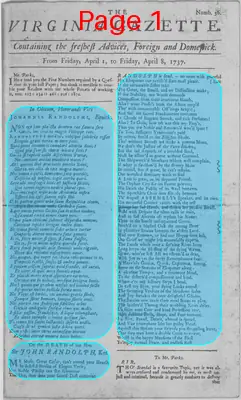
The Virginia Gazette
Richmond, Williamsburg, Richmond County, Virginia
What is this article about?
Latin elegy with English translation mourning the death of Sir John Randolph, knight, speaker, and public servant. Laments his eloquence, virtues, and profound loss to academy, city, and society, invoking classical imagery of grief.
Merged-components note: These two components are the Latin original and English translation of the same elegy poem on the death of Sir John Randolph, continuing sequentially in reading order on page 1.
Clipping
OCR Quality
Full Text
JOHANNIS RANDOLPHI,
Equitis.
Non ego jam planctu decorem tua funera sero.
V. Cujar, nec cineres magis Philippe tuos.
RANDOLPHI obitus moritur, robisque calubria cessat
Eloquii grato verba movere sono.
Quid juvat innumeris cumulari altaria donis?
Quid pia fumosis thura micare focis?
Omnia si rapiunt nullo discrimine Parcae
Nec revocant avidas nobiliora manus?
Sic quoties dixi precibus parcere Divis.
Gloria vos alia de rebus inania manent.
Non tamen in injustis damnamus fata querelis.
Tristitia alit motus, cogit acerba queri.
Saepe ubi naufragii levis est jactura slighta
Qui tamen ingentes navita plorat opes.
Innimis lugit miserrima Academia nostra
Efferri hinc ista funere visa sibi.
Urbs primum gemit orba suum Respublica civem
Ruitur Sanctorem mista Cathedra suum.
Inque omnes partes Cojus sua bracchia tendens,
Ista vocat taciti nomen inane viri.
Urque piam thalami subeunt dispendia mentem
Continuo tepidas irrigat imbre genas.
Sic vidua sterilem moris sedet arbore turtur
Comparis aeterno murmure fata gemens.
In te, forte minor si spes, fama fuisset.
De te, forte minor nostra querela foret.
Rura semel pinguis quae fluminis unda rigavit,
Dona diu retinent aufugientis aquae.
Nos quoque, qui nuper tot cara relinquimus in te,
Temporis exacti, sensus & umbra juvant.
Ingenium celsum quod scanderet ad auras,
Et nitor ei qui more fluentis aquae.
Et placidi mores atque asperitate carentes,
Cor tenerum in viduas, mensque benigna bonis.
Heu! quocunque gradum maestus vel lumina flexo
Insequitur vultus pallida forma meos.
Nec vigor et herbae, nec amoenis gratia silvis,
Jamque silent homines, jamque silent aves.
Nos pietate tua studiisque fidelibus orbos,
Conscit ambiguis spei timore malis.
Inlicit passim, fraudesque, doliq; triumphant;
Et docet exemplo crimina quisque suo.
Tu tamen his socios luentantes deseris undis,
Causa sit ut gemina jussa dolore queri.
Dum castos inter catus animasque piorum
Fulgidus aeternae munera pacis habes.
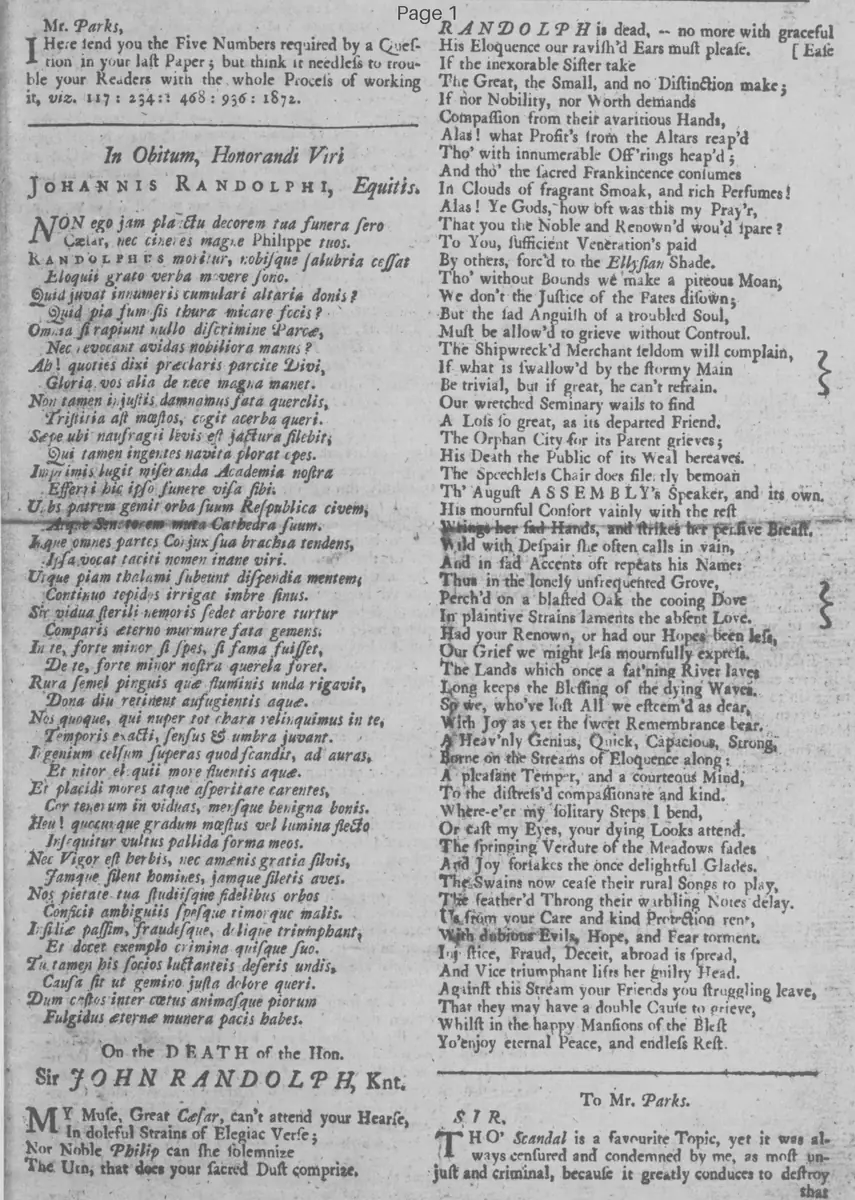
On the DEATH of the Hon.
Sir JOHN RANDOLPH, Knt.
My Muse, great Sir, can't attend your Hearse,
With doleful Strains of Elegiac Verse;
Nor Noble Philip can she solemnize
The Urn, that does your sacred Dust comprize,
RANDOLPH Is dead, no more with graceful Ease
His Eloquence our ravish'd Ears must please.
If the inexorable Sister take
The Great, the Small, and no Distinction make;
If nor Nobility, nor Worth demands
Compassion from their avaritious Hands,
Alas! what Profit's from the Altars reap'd
Tho' with innumerable Off'rings heap'd;
And tho' the sacred Frankincense consumes
In Clouds of fragrant Smoak, and rich Perfumes!
Alas! Ye Gods, how oft was this my Pray'r,
That you the Noble and Renown'd wou'd spare?
To You, Sufficient Veneration's paid
By others, forc'd to the Elysian Shade.
Tho' without Bounds we make a piteous Moan;
We don't the Justice of the Fates disown;
But the sad Anguish of a troubled Soul,
Must be allow'd to grieve without Controul.
The Shipwreck'd Merchant seldome will complain,
If what is swallow'd by the stormy Main
Be trivial, but if great, he can't refrain.
Our wretched Seminary wails to find
A Loss so great, as its departed Friend.
The Orphan City for its Parent grieves;
His Death the Public of its Weal bereaves.
The Speaker's Chair does filently bemoan
Th' August ASSEMBLY's Speaker, and its own.
His mournful Confort vainly with the rest
Wrings her sad Hands, and strikes her pensive Breast.
Wild with Despair she often calls in vain,
And in sad Accents oft repeats his Name:
Thus in the lonely unfrequented Grove,
Perch'd on a blasted Oak the cooing Dove
In plaintive Strains laments the absent Love.
Had your Renown, or had our Hopes been less,
Our Grief we might less mournfully express.
The Lands which once a fat'ning River laves
Long keeps the Blessing of the dying Waves.
So we, who've lost All we esteem'd as dear,
With Joy as well the sweet Remembrance bear.
A Heav'nly Genius, Quick, Capacious, Strong
Borne on the Streams of Eloquence along:
A pleasant Temper, and a courteous Mind,
To the distres'd compassionate and kind.
Where-e'er my solitary Steps I bend,
Or cast my Eyes, your dying Looks attend.
The springing Verdure of the Meadows fades
And Joy forsakes the once delightful Glades.
The Swains now cease their rural Songs to play,
The feather'd Throng their warbling Notes delay.
We, from your Care and kind Protection rent,
With dubious Evils, Hope, and Fear torment.
Injustice, Fraud, Deceit, abroad is spread,
And Vice triumphant lifts her guilty Head.
Against this Stream your Friends you struggling leave,
That they may have a double Cause to grieve,
Whil'st in the happy Mansions of the Blest
You enjoy eternal Peace, and endless Rest.
What sub-type of article is it?
What themes does it cover?
What keywords are associated?
Poem Details
Title
In Obitum, Honorandi Viri Johannis Randolphi, Equitis
Subject
On The Death Of The Hon. Sir John Randolph, Knt.
Form / Style
Latin Elegy With English Verse Translation In Rhymed Couplets
Key Lines