Thank you for visiting SNEWPapers!
Sign up free
New Hampshire Statesman And State Journal
Concord, Merrimack County, New Hampshire
What is this article about?
Whig State Convention in Concord, NH, on Oct. 21, 1841, nominated Enos Stevens for Governor, adopted resolutions on reforming executive power and condemning prior administrations, and organized for the upcoming election.
Merged-components note: Merged continuation of Whig State Convention proceedings across pages into a single story.
Clippings
1 of 2
OCR Quality
Full Text
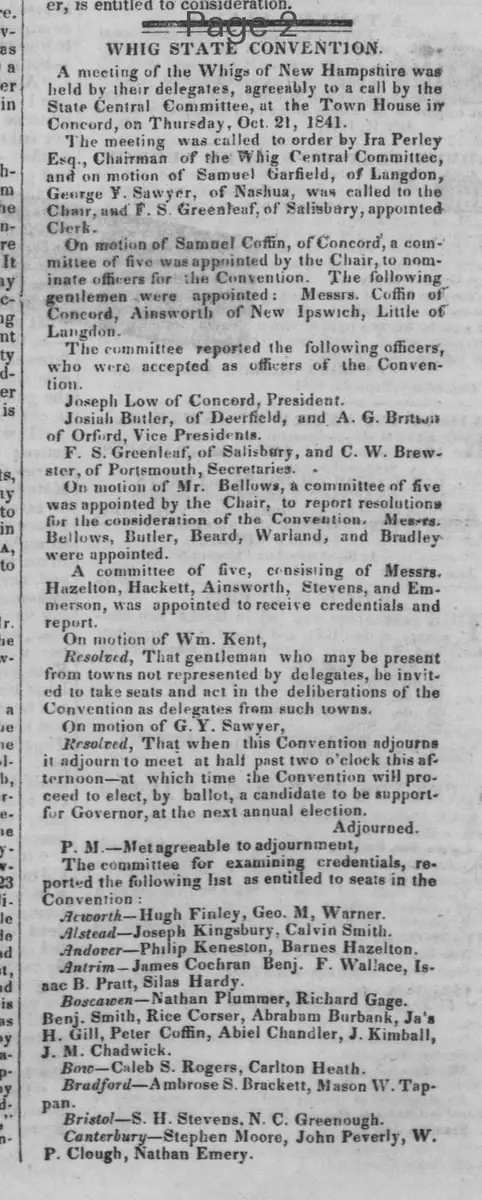
A meeting of the Whigs of New Hampshire was held by their delegates, agreeably to a call by the State Central Committee, at the Town House in Concord, on Thursday, Oct. 21, 1841.
The meeting was called to order by Ira Perley Esq., Chairman of the Whig Central Committee, and on motion of Samuel Garfield, of Langdon, George Y. Sawyer, of Nashua, was called to the Chair, and F. S. Greenleaf, of Salisbury, appointed Clerk.
On motion of Samuel Coffin, of Concord, a committee of five was appointed by the Chair, to nominate officers for the Convention. The following gentlemen were appointed: Messrs. Coffin of Concord, Ainsworth of New Ipswich, Little of Langdon.
The committee reported the following officers, who were accepted as officers of the Convention.
Joseph Low of Concord, President.
Josiah Butler, of Deerfield, and A. G. Britton of Orford, Vice Presidents.
F. S. Greenleaf, of Salisbury, and C. W. Brewster, of Portsmouth, Secretaries.
On motion of Mr. Bellows, a committee of five was appointed by the Chair, to report resolutions for the consideration of the Convention. Messrs. Bellows, Butler, Beard, Warland, and Bradley were appointed.
A committee of five, consisting of Messrs. Hazleton, Hackett, Ainsworth, Stevens, and Emerson, was appointed to receive credentials and report.
On motion of Wm. Kent,
Resolved, That gentlemen who may be present from towns not represented by delegates, be invited to take seats and act in the deliberations of the Convention as delegates from such towns.
On motion of G. Y. Sawyer,
Resolved, That when this Convention adjourns it adjourn to meet at half past two o'clock this afternoon—at which time the Convention will proceed to elect, by ballot, a candidate to be supported for Governor, at the next annual election.
Adjourned.
P. M.—Met agreeable to adjournment,
The committee for examining credentials, reported the following list as entitled to seats in the Convention:
Boscawen—Nathan Plummer, Richard Gage. Benj. Smith, Rice Corser, Abraham Burbank, Ja's H. Gill, Peter Coffin, Abiel Chandler, J. Kimball, J. M. Chadwick.
Boto—Caleb S. Rogers, Carlton Heath.
Bradford—Ambrose S. Brackett, Mason W. Tappan.
Bristol—S. H. Stevens. N. C. Greenough.
Canterbury—Stephen Moore, John Peverly, W. P. Clough, Nathan Emery.
Whig State Convention Delegates:
Centre Harbor—John Thompson
Charlestown—Benj. Chellis, Ashbel Hamlin.
Chester—John White, Walter Morse, Isaac Lane, J. W. Noyes, David Currier.
Claremont—J. H. Warland, Nathaniel Cotton, L. A. Grannis, Asa Sawtell, Danford Rice, James Sherry.
Concord—Sam'l Coffin, G. W. Brown, Joseph Low, Wm. Kent, Rich'd Bradley, Asa McFarland, Ira Perley, John L. Eastman.
Deerfield—Josiah Butler, H. F. Cilley, Geo. W. Simpson, E. D. Lacy.
Deering—S. S. Clement
Epping—C. L. Godfrey
Francestown—William Bixby, Nahum Farnham.
Franklin—Henry Burleigh, Samuel George.
Gilford—H. L. Hazelton, A. M. Chase, Benj. Gilman.
Gilmanton—Benj. Emerson, John Evans, Allen Hackett, Thomas Price.
Gilsum—Lemuel Bingham.
Hanover—Enos Merrill.
Hillsboro'—Jesse Clement.
Hill—Geo. E. Sherwin, Lewis Lord.
Hopkinton—James Stanwood, Asa Herrick, Aaron Palmer, Nathan Sargent.
Langdon—Sam'l Garfield, Edmund Holden.
Landaff—Moses Webster.
Lebanon—G. W. Lathrop, Richard Kimball, Elisha P. Liscomb, John E. Wood.
Littleton—H. A. Bellows, Alden Moffit, Philip C. Wilkins, L. A. Russell.
Loudon—M. W. Boynton, Joseph Baker
Lyman—Jesse Bailey, Freeman Henman
Manchester—Hiram Brown, Henry C. Gillis, G. F. Judkins, Barton Munsey, A. F. Stevens, N. G. Thom, Dan'l J. Clark,
Meredith—Wm M. Ladd, Green Smith.
Nashua—G. Y. Sawyer, Thomas W. Gillis, M. F. Dodge, Jr., George W. Perham, Cyrus Baldwin, Jesse H. Woodard, Franklin Munroe, Albin Beard.
New Ipswich—Jer'h. Smith, W. Ainsworth.
New Market—S. P. Green, Geo. O. Hilton, Skinner.
Nottingham—Jona Gove, John O. Cilley
Orange—Zenas Whittier, Nathaniel Whittier.
Orford—A. G. Britton, Nathan Kingman.
Ossipee—James Stevens, S. J. Quarles, W. L. Young, Sam'l. Hanson.
Pittsfield—Charles Sanderson, J. A. E. Merrill.
Portsmouth—C. W. Brewster, Wm. D. Little, L. A. Hackett, Jacob Wendell, G. T. Ball, R. C. Cutter, W. A. Goodrich, C. H. Rowe, M. Bufford, J. S. Walker, 2d.
Rochester—Luther Hale, James Wilson, Sam'l. Rogers, T. F. Milton.
Rumney—Robert Morse.
Salisbury—S. C. Bartlett, F. S. Greenleaf.
Sanbornton—A. L. Morrison.
Strafford—Dan'l Winkley, Isaac Foss, N. E. Hanscom, Joseph Hayes.
Tamworth—David Dow.
Walpole—John P. Maynard
Wilton—Abiel Abbott, Geo. L. Dascomb.
Windsor—Calvin Curtice.
The Convention proceeded to ballot for a candidate to be supported by the whigs at the next annual election. The Hon. ENOS STEVENS, of Charlestown, having a majority of the votes, it was unanimously resolved to support him as the whig candidate for Governor of the State, and that all fair and honorable means be used to advance his election.
The committee on Resolutions reported the following, which were separately read and adopted.
Resolved, That in the election to the Presidency of the United States of the pure, the patriotic and the deeply lamented Harrison, by an overwhelming majority of the American Electors, we beheld the evidence of their strong condemnation of the principles and measures of the late administration, and of their hearty approval of the principles of the party now in power.
Resolved, That the principles of the Whig party, and which were everywhere urged with untiring zeal and fidelity, during the late Presidential canvass, were mainly included in the duty to arrest that alarming tendency which had been constantly exhibited during the two last administrations of the Federal Government, to concentrate all political power in the hands of the Chief Magistrate.
Resolved, That to accomplish that object the Whigs proposed—a limitation of the Presidential office to a single term—a separation of the purse and the sword—a diminution of Executive patronage, growing out of his control over the Treasury and Post office Departments—reform in the exercise of the veto power—a retrenchment in the public expenditures, and a rigid system of accountability in the public officers—a restraint upon Executive interference in elections, and generally a reform of those abuses which had well nigh destroyed the independence of Congress.
Resolved, That under any conceivable circumstances, the amount of good already attained by the late political revolution is incalculable; and notwithstanding the unfortunate disagreement among the different branches of the government in relation to one measure, we are strong in the faith, that the great Whig work of reform is yet destined to be accomplished.
Resolved, That in the vitally important measures which have already been perfected, in the firmness, patriotism and integrity of those who compose the present commanding majority of both Houses of Congress—in the cheerful co-operation of the President in those measures; in the pledges he has freely given, and in the uncompromising and fearless opposition which he has heretofore manifested to Executive encroachments, we have abiding security that the constitutional action of the different branches of the Federal Government shall yet be fully restored.
Resolved, That the duty of the Whig party at this important period, is plain and imperative—that, disregarding all considerations, merely personal in their character, with an eye fixed steadily upon the great interests of the country, and with a charitable reliance upon each others patriotism and good faith; we should move steadily towards the accomplishment of the great work which we have undertaken.
Resolved, That in the differences of opinion which have existed between the various branches of the government and among members of the same political party, and the frankness with which they have been avowed and discussed, we recognize a spirit which cannot be turned into subservience to political leaders; and while we deprecate that zeal which defeats its own object, we cannot be insensible to the strong contrast which it presents, to that silent and anti-republican acquiescence in the views of the executive, which formed the most conspicuous and alarming feature in the character of our opponents.
Resolved, That the Whigs of New Hampshire, though in a minority, are not therefore, powerless, nor free from responsibility—that they are called upon by every consideration of duty and patriotism to contribute their utmost efforts to such reform in the Federal Government as will take from the President, whoever he may be, or by whatsoever party elected, that power to do evil, the exercise of which has led to the late glorious revolution.
The resolutions were supported by energetic and animated speeches from Messrs. Emerson, of Gilmanton, Wallace of Antrim, Butler of Deerfield, and Bixby of Francestown.
On motion of Mr. Butler, it was
Voted, That the Central Committee be instructed to appoint committees in the several Senatorial Districts, as they may think proper, to act as Committees of Vigilance to promote the election of the Whig candidates at the next election.
Voted, That the Central Committee be further instructed to proceed immediately to make an organization of the entire Whig party of the State preparatory to the next election.
Voted, That the thanks of this Convention be presented to the officers of this Convention for the acceptable manner in which they have presided over its deliberations.
Voted, That the proceedings be signed by the President and Secretaries and published in the Whig papers of the State.
Voted, That this Convention now adjourn sine die.
JOSEPH LOW, President.
F. S. GREENLEAF,
C. W. BREWSTER
Secretaries.
What sub-type of article is it?
What themes does it cover?
What keywords are associated?
What entities or persons were involved?
Where did it happen?
Story Details
Key Persons
Location
Town House In Concord, New Hampshire
Event Date
Thursday, Oct. 21, 1841
Story Details
Whig delegates met in Concord to organize the convention, appoint officers, verify credentials, nominate Enos Stevens as gubernatorial candidate by ballot and unanimous resolution, adopt resolutions on Whig principles and political reform, and instruct the Central Committee on party organization.