Thank you for visiting SNEWPapers!
Sign up free
The Wilmington Morning Star
Wilmington, New Hanover County, North Carolina
What is this article about?
A 1940 report details the U.S. government's Home Owners Loan Corporation efforts since 1933 to manage over 1 million distressed home mortgages from the Great Depression, including billions invested, ongoing foreclosures, and strategies to aid borrowers, as per chairman John H. Fahey.
Clipping
OCR Quality
Full Text
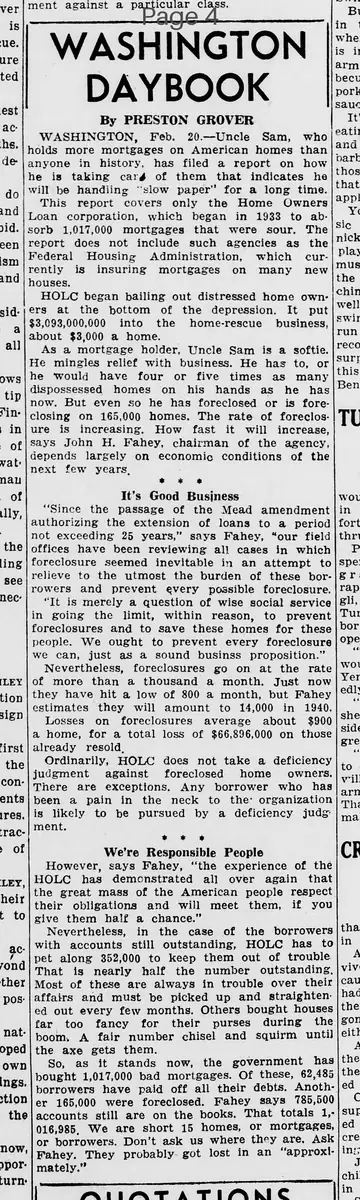
By PRESTON GROVER
WASHINGTON, Feb. 20.--Uncle Sam, who holds more mortgages on American homes than anyone in history, has filed a report on how he is taking care of them that indicates he will be handling "slow paper" for a long time.
This report covers only the Home Owners Loan corporation, which began in 1933 to absorb 1,017,000 mortgages that were sour. The report does not include such agencies as the Federal Housing Administration, which currently is insuring mortgages on many new houses.
HOLC began bailing out distressed home owners at the bottom of the depression. It put $3,093,000,000 into the home-rescue business, about $3,000 a home.
As a mortgage holder, Uncle Sam is a softie. He mingles relief with business. He has to, or he would have four or five times as many dispossessed homes on his hands as he has now. But even so he has foreclosed or is foreclosing on 165,000 homes. The rate of foreclosure is increasing. How fast it will increase, says John H. Fahey, chairman of the agency, depends largely on economic conditions of the next few years.
It's Good Business
"Since the passage of the Mead amendment authorizing the extension of loans to a period not exceeding 25 years," says Fahey, "our field offices have been reviewing all cases in which foreclosure seemed inevitable in an attempt to relieve to the utmost the burden of these borrowers and prevent every possible foreclosure.
It is merely a question of wise social service in going the limit, within reason, to prevent foreclosures and to save these homes for these people. We ought to prevent every foreclosure we can, just as a sound business proposition."
Nevertheless, foreclosures go on at the rate of more than a thousand a month. Just now they have hit a low of 800 a month, but Fahey estimates they will amount to 14,000 in 1940.
Losses on foreclosures average about $900 a home, for a total loss of $66,896,000 on those already resold.
Ordinarily, HOLC does not take a deficiency judgment against foreclosed home owners.
There are exceptions. Any borrower who has been a pain in the neck to the organization is likely to be pursued by a deficiency judgment.
We're Responsible People
However, says Fahey, "the experience of the HOLC has demonstrated all over again that the great mass of the American people respect their obligations and will meet them, if you give them half a chance."
Nevertheless, in the case of the borrowers with accounts still outstanding, HOLC has to pet along 352,000 to keep them out of trouble. That is nearly half the number outstanding.
Most of these are always in trouble over their affairs and must be picked up and straightened out every few months. Others bought houses far too fancy for their purses during the boom. A fair number chisel and squirm until the axe gets them.
So, as it stands now, the government has bought 1,017,000 bad mortgages. Of these, 62,485 borrowers have paid off all their debts. Another 165,000 were foreclosed. Fahey says 785,500 accounts still are on the books. That totals 1,016,985. We are short 15 homes, or mortgages, or borrowers. Don't ask us where they are. Ask Fahey. They probably got lost in an approximation.
What sub-type of article is it?
What themes does it cover?
What keywords are associated?
What entities or persons were involved?
Where did it happen?
Story Details
Key Persons
Location
Washington
Event Date
Beginning In 1933
Story Details
The Home Owners Loan Corporation, started in 1933, absorbed over a million distressed mortgages during the depression, investing billions to help homeowners. Despite efforts to prevent foreclosures through extended loans, thousands are foreclosed annually, with chairman Fahey emphasizing social service and business sense in saving homes.