Thank you for visiting SNEWPapers!
Sign up free
Story
June 4, 1921
The Cordova Daily Times
Cordova, Alaska
What is this article about?
Washington correspondent reports on potential clash between President Harding and Congress over 'less government in business' policy, pitting conservative senators (Penrose, Smoot, Lodge) against progressives (Johnson, Borah, LaFollette, Lenroot) on bills regulating meat packers, grain exchanges, and coal industry.
Clipping
OCR Quality
98%
Excellent
Full Text
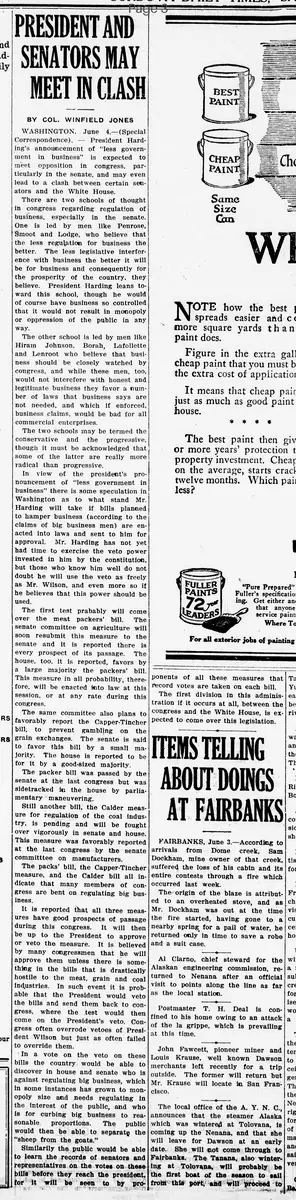
PRESIDENT AND SENATORS MAY MEET IN CLASH
By Col. Winfield Jones
WASHINGTON, June 4.--(Special Correspondence).--President Harding's announcement of "less government in business" is expected to meet opposition in congress, particularly in the senate, and may even lead to a clash between certain senators and the White House.
There are two schools of thought in congress regarding regulation of business, especially in the senate. One is led by men like Penrose, Smoot and Lodge, who believe that the less regulation for business the better. The less legislative interference with business the better it will be for business and consequently for the prosperity of the country, they believe. President Harding leans toward this school, though he would of course have business so controlled that it would not result in monopoly or oppression of the public in any way.
The other school is led by men like Hiram Johnson, Borah, LaFollette and Lenroot who believe that business should be closely watched by congress, and while these men, too, would not interfere with honest and legitimate business they favor a number of laws that business says are not needed, and which if enforced, business claims, would be bad for all commercial enterprises.
The two schools may be termed the conservative and the progressive, though it must be acknowledged that some of the latter are really more radical than progressive.
In view of the president's pronouncement of "less government in business" there is some speculation in Washington as to what stand Mr. Harding will take if bills planned to hamper business (according to the claims of big business men) are enacted into laws and sent to him for approval. Mr. Harding has not yet had time to exercise the veto power invested in him by the constitution but those who know him well do not doubt he will use the veto as freely as Mr. Wilson, and even more so if he believes that this power should be used.
The first test probably will come over the meat packers' bill. The senate committee on agriculture will soon resubmit this measure to the senate and it is reported there is every prospect of its passage. The house, too, it is reported, favors by a large majority the packers' bill. This measure in all probability, therefore, will be enacted into law at this session, or at any rate during this congress.
The same committee also plans to favorably report the Capper-Tincher bill, to prevent gambling on the grain exchanges. The senate is said to favor this bill by a small majority. The house is reported to be for it by a good-sized majority.
The packer bill was passed by the senate at the last congress but was sidetracked in the house by parliamentary maneuvering.
Still another bill, the Calder measure for regulation of the coal industry, is pending and will be fought over vigorously in senate and house. This measure was favorably reported at the last congress by the senate committee on manufacturers.
The packers' bill, the Capper-Tincher measure, and the Calder bill all indicate that many members of congress are bent on regulating big business.
It is reported that all three measures have good prospects of passage during this congress. It will then be up to the President to approve or veto the measure. It is believed by many congressmen that he will approve them unless there is some thing in the bills that is drastically hostile to the meat, grain and coal industries. In such event it is probable that the President would veto the bills and send them back to congress, where the test would then come on the President's veto. Congress often overrode vetoes of President Wilson but just as often failed to override them.
In a vote on the veto on these bills the country would be able to discover in house and senate who is against regulating big business, which in some instances has grown to monopoly size and needs regulating in the interest of the public, and who is for curbing big business to reasonable proportions. The public would then be able to separate the "sheep from the goats."
Similarly the public would be able to learn the records of senators and representatives on the votes on these bills before they reach the president, for it will be seen to by proponents of all these measures that record votes are taken on each bill.
The first division in this administration if it occurs at all, between the congress and the White House, is expected to come over this legislation.
By Col. Winfield Jones
WASHINGTON, June 4.--(Special Correspondence).--President Harding's announcement of "less government in business" is expected to meet opposition in congress, particularly in the senate, and may even lead to a clash between certain senators and the White House.
There are two schools of thought in congress regarding regulation of business, especially in the senate. One is led by men like Penrose, Smoot and Lodge, who believe that the less regulation for business the better. The less legislative interference with business the better it will be for business and consequently for the prosperity of the country, they believe. President Harding leans toward this school, though he would of course have business so controlled that it would not result in monopoly or oppression of the public in any way.
The other school is led by men like Hiram Johnson, Borah, LaFollette and Lenroot who believe that business should be closely watched by congress, and while these men, too, would not interfere with honest and legitimate business they favor a number of laws that business says are not needed, and which if enforced, business claims, would be bad for all commercial enterprises.
The two schools may be termed the conservative and the progressive, though it must be acknowledged that some of the latter are really more radical than progressive.
In view of the president's pronouncement of "less government in business" there is some speculation in Washington as to what stand Mr. Harding will take if bills planned to hamper business (according to the claims of big business men) are enacted into laws and sent to him for approval. Mr. Harding has not yet had time to exercise the veto power invested in him by the constitution but those who know him well do not doubt he will use the veto as freely as Mr. Wilson, and even more so if he believes that this power should be used.
The first test probably will come over the meat packers' bill. The senate committee on agriculture will soon resubmit this measure to the senate and it is reported there is every prospect of its passage. The house, too, it is reported, favors by a large majority the packers' bill. This measure in all probability, therefore, will be enacted into law at this session, or at any rate during this congress.
The same committee also plans to favorably report the Capper-Tincher bill, to prevent gambling on the grain exchanges. The senate is said to favor this bill by a small majority. The house is reported to be for it by a good-sized majority.
The packer bill was passed by the senate at the last congress but was sidetracked in the house by parliamentary maneuvering.
Still another bill, the Calder measure for regulation of the coal industry, is pending and will be fought over vigorously in senate and house. This measure was favorably reported at the last congress by the senate committee on manufacturers.
The packers' bill, the Capper-Tincher measure, and the Calder bill all indicate that many members of congress are bent on regulating big business.
It is reported that all three measures have good prospects of passage during this congress. It will then be up to the President to approve or veto the measure. It is believed by many congressmen that he will approve them unless there is some thing in the bills that is drastically hostile to the meat, grain and coal industries. In such event it is probable that the President would veto the bills and send them back to congress, where the test would then come on the President's veto. Congress often overrode vetoes of President Wilson but just as often failed to override them.
In a vote on the veto on these bills the country would be able to discover in house and senate who is against regulating big business, which in some instances has grown to monopoly size and needs regulating in the interest of the public, and who is for curbing big business to reasonable proportions. The public would then be able to separate the "sheep from the goats."
Similarly the public would be able to learn the records of senators and representatives on the votes on these bills before they reach the president, for it will be seen to by proponents of all these measures that record votes are taken on each bill.
The first division in this administration if it occurs at all, between the congress and the White House, is expected to come over this legislation.
What sub-type of article is it?
Historical Event
What themes does it cover?
Justice
Social Manners
What keywords are associated?
Business Regulation
Congressional Bills
Presidential Veto
Senate Division
Meat Packers Bill
Capper Tincher Bill
Calder Bill
What entities or persons were involved?
President Harding
Penrose
Smoot
Lodge
Hiram Johnson
Borah
Lafollette
Lenroot
Wilson
Where did it happen?
Washington
Story Details
Key Persons
President Harding
Penrose
Smoot
Lodge
Hiram Johnson
Borah
Lafollette
Lenroot
Wilson
Location
Washington
Event Date
June 4
Story Details
Potential clash between President Harding and Congress over business regulation, with conservatives favoring less interference and progressives pushing bills on meat packers, grain gambling, and coal industry; speculation on vetoes and public insight into lawmakers' stances.