Thank you for visiting SNEWPapers!
Sign up free
The National Intelligencer And Washington Advertiser
Washington, District Of Columbia
What is this article about?
Debate in the U.S. House of Representatives on March 23, 1802, regarding a bill to continue salary augmentations for government officers established in 1799. Speakers including Dawson, Smilie, and others argued for and against based on economic conditions, fairness, and republican principles. The bill passed 50-22.
Merged-components note: Continuation of the debate on the bill to revive and continue the act augmenting salaries of officers; relabeled to 'story' as it is a full narrative article on the congressional proceedings.
Clippings
1 of 2
OCR Quality
Full Text
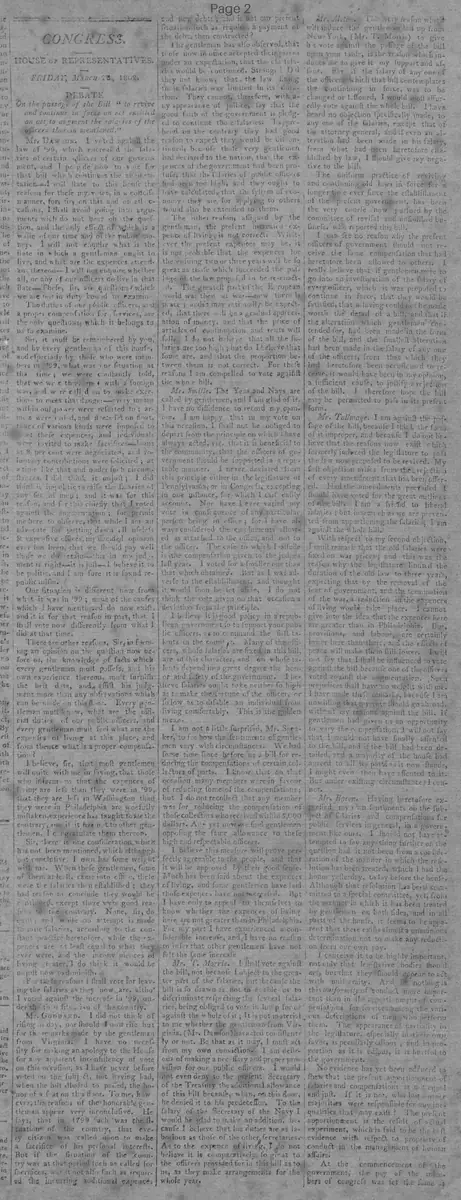
HOUSE OF REPRESENTATIVES.
FRIDAY, MARCH 23, 1802.
DEBATE
On the passage of the Bill "to revive and continue in force an act entitled an act to augment the salaries of the officers therein mentioned."
Mr. Dawson. I voted against the law of '99, which increased the salaries of certain officers of our government, and I propose now to vote for that bill which continues the augmentation. I will state to this House the reasons for these my votes, in a concise manner, for, sir on this and on all occasions, I shall avoid going into arguments which do not bear on the question, and the only effect of which is a waste of our time and of the public money. I will not enquire what is the state in which a gentleman ought to live, and what are the expenses attending thereon—I will not enquire whether all, or any of our officers do live in that state—These, sir, are questions which we are not in duty bound to examine. The duties of our public officers, and a proper compensation for services, are the only questions, which it belongs to us to examine:
Sir, it must be remembered by you, and by every gentleman of this House, and especially by those who were members in '99, what was our situation at that time; we were constantly told, that we were threatened with a foreign war and were called on to make exertions to meet that danger—every means within our power were resorted to; armies were raised, and a fleet put to sea, taxes of various kinds were imposed to meet these expenses, and individuals were invited to make sacrifices—loans at 8 per cent were negotiated, and voluntary contributions were solicited; at a time like that and under such circumstances, I did think it unjust; I did think it impolitic to raise the salaries of any set of men; and it was on this reason, and for this chiefly that I voted against the augmentation; for permit me here to observe, that while I am an advocate for putting down all useless and expensive offices, my decided opinion ever has been, that we should pay well those we do retain—this in my judgment is right—sir it is just—I believe it to be politic, and I am sure it is sound republicanism.
Our Situation is different now from what it was in '99; none of the causes which I have mentioned do now exist, and it is for that reason in part, that I shall vote now differently; from what I did at that time.
There are other reasons, Sir, in forming an opinion on the question now before us, the knowledge of facts which every gentleman must possess, and his own experience thereon, must furnish the best data, and aid his judgment more than any observations which can be made on this floor. Every gentleman must know what are the official duties of our public officers, and every gentleman must feel what are the expenses of living at this place, and from thence what is a proper compensation?
I believe, sir, that most gentlemen will unite with me in saying, that those who affirm that the expenses of living are less than they were in '99, that they are less in Washington than they were in Philadelphia are woefully mistaken, experience has taught me the contrary, and if it has not to other gentlemen, I congratulate them thereon.
Sir, there is one consideration which has not been mentioned, which although not conclusive, I own has some weight with me. When these gentlemen, some of them: at least, came into office, these were the salaries then established; they had reason to conclude they would be continued, except there were good reasons to the contrary. None, sir, do exist; and while no attempt is made to raise salaries, according to the constant practice heretofore, while the expenses are at least equal to what they ever were, and the inconveniences of living greater, I do think it would be unjust now to diminish.
For these reasons I shall vote for leaving the salaries as they now are, altho' I voted against the increase in '99, under the then situation of the country.
Mr. Goodard. I did not think of rising to-day, nor should I now rise but for the remarks made by the gentleman from Virginia. I have no necessity of making an apology to the House for any apparent inconsistency of vote on this occasion, as I have never before voted on the subject, not having had, when the bill alluded to passed, the honor of a seat on this floor. To me, however, the reasons of the honorable gentleman appear very inconclusive. He says, that in 1799 such was the situation of the country, that every citizen was called upon to make a sacrifice of his personal interests. But if the situation of the country was at that period such as called for sacrifices, was it not also such as required the incurring additional expenses and new debts: and is not our present situation such as requires a payment of the debts then contracted?
The gentleman has also observed, that those now in office accepted their places under an expectation, that the salaries would be continued. Strange! Did they not know, that the law fixing those salaries was limited in its duration. They cannot, therefore, with any appearance of justice, say that the good faith of the government is pledged to continue those salaries. I apprehend on the contrary they had good reason to expect they would be discontinued; because those very gentlemen had declared to the nation, that the expenses of the government had been profuse, that the salaries of public officers had been too high, and they ought to have calculated, that the system of economy they are now applying to others would also be extended to them.
The other reason, argued by the gentleman, the present increased expense of living, is not correct. Whatever the present expenses may be, it is not probable that the expenses for the ensuing two or three years will be so great as those which succeeded the passage of the law proposed to be re-enacted. The greatest part of the European world was then at war—now there is peace; and it may rationally be expected, that there will be a gradual appreciation of money, and that the price of articles of consumption and rents will fall. I do not believe that all the salaries are too high; but do I believe that some are, and that the proportion between them is not correct. For these reasons I am compelled to vote against the whole bill.
Mr. Smilie. The Yeas and Nays are called by gentlemen, and I am glad of it. I have no diffidence to record my opinion. I am happy that in my vote on this occasion, I shall not be obliged to depart from the principle on which I have always acted, viz. that it is beneficial to the community, that the officers of government should be supported in a reputable manner. I never deviated from this principle either in the legislature of Pennsylvania, or in Congress, excepting in one instance, or which I can easily account. Nor have I ever varied my vote in consequence of any particular person being in office; for I have always considered the emoluments allowed as attached to the office, and not to the officer. The case to which I allude is the compensation given to the judges last year. I voted for a smaller one than that which obtained. But as I was adverse to the establishment, and thought it would soon be set aside, I do not think the vote given on that occasion a deviation from the principle.
I believe it is good policy in a republican government so to support your public officers, as to command the first talents in the Country. Many of the officers, whose salaries are fixed in this bill, are of this character, and on whose talents depend in a great degree the honor and safety of the government. I believe salaries ought to be neither so high as to make the fortune of the officer, or so low as to disable an individual from living comfortably. This is the golden mean.
I am not a little surprised, Mr. Speaker, to see how the sentiments of gentlemen vary with circumstances. We had some time since before us a bill for reducing the compensations of certain collectors of ports. I know that on that occasion many members were in favor of reducing some of the compensations; but I do not recollect that any member was for reducing the compensation of those collectors who received within 5,000 dollars. And yet now we find gentlemen opposing the same allowance to these high and respectable officers.
I believe this measure will prove perfectly agreeable to the people, and that it will be approved by their good sense. Much has been said about the expenses of living, and some gentlemen have said those expenses have not increased. But I have only to appeal to themselves to know whether the expenses of living here are not greater than in Philadelphia. For my part I have experienced a considerable increase, and I have no reason to infer that other gentlemen have not felt the same increase.
Mr. T. Morris. I shall vote against the bill, not because I object to the greater part of the salaries, but because the bill is so drawn as not to enable us to discriminate respecting the several Salaries, being obliged to vote in lump for or against the whole of it; It is not material to me whether the gentleman from Virginia, (Mr. Dawson) has acted consistently or not. Be that as it may, I must act from my own conviction. I am desirous of making a necessary and proper provision for our public officers. I would not even deny to the present Secretary of the Treasury the additional allowance of this bill because, when, on this floor, he denied it to his predecessor. To the salary of the Secretary of the Navy I would be glad to make an addition, because I believe that his duties are as laborious as those of the other secretaries. As to the expense of living, I do not believe it is comparatively so great to the officers provided for in this bill as to us, as they make arrangements for the whole year.
Mr. Alton. The very reason which will induce the gentleman last up from New-York, (Mr. T. Morris) to give his vote against the passage of the bill upon your table, is the reason which induces me to give it my support and assent. For if the salary of any one of the officers which that bill contemplates the continuing in force, was to be changed or lessened, I would most assuredly vote against the whole bill. I have heard no objection specifically made, to any one of the salaries, except that of the attorney general, and if even an alteration had been made in his salary, from what had been heretofore established by law, I should give my negative to the bill.
The uniform practice of reviving and continuing old laws in force for a longer time ever since the establishment of the present government, has been the very course now pursued by the committee of revisal and unfinished business, who reported this bill.
I can see no reason why the present officers of government should not receive the same compensation that had heretofore been allowed to others. I really believe that if gentlemen were to go into an investigation of the salary of every officer, which it was proposed to continue in force, that they would be satisfied, that a saving could not be made worth the detail of a bill, and that if the alteration which gentlemen contended for, had been made in the form of the bill, and the smallest alteration had been made in the salary of any one of the officers, from that which they had heretofore been accustomed to receive, it would have been in my opinion, a sufficient cause, to justify a rejection of the bill. I therefore hope the bill may be permitted to pass in its present form.
Mr. Talmage. I am against the passage of the bill, because I think the form of it improper, and because I do not believe that the reasons now exist which formerly induced the legislature to pass the law now proposed to be revived. My first objection arises from the rejection of every amendment that has been offered. Had the amendments prevailed I should have voted for the great outlines of the bill. I am a friend to liberal salaries; but inasmuch as we are prevented from apportioning the salaries, I am against the whole bill.
With respect to my second objection, I must remark that the old salaries were fixed on war prices; and this was the reason why the legislature limited the duration of the old law to three years, expecting that by the removal of the seat of government, and the termination of the war, a reduction in the expenses of living would take place. I cannot give into the idea that the expenses here are greater than in Philadelphia. But, provisions, and labour, are certainly lower here than there, and the effects of peace will make them still lower. I will not say that I shall be influenced to vote against the bill because one of the officers voted against the augmentation. Such prejudices shall have no weight with me. I have made these remarks, because I am unwilling that my vote should go abroad, without my reasons against the bill. If gentlemen had given us an opportunity to vary the compensation, I will not say that I would not have finally assented to the bill, and if the bill had been detailed, and a majority of the house had agreed to all its parts as it now stands, I might even then have assented to it. But under existing circumstances I cannot.
Mr. Bacon. Having heretofore expressed my own sentiments on the subject of salaries and compensations for public services in general, in a government like ours, I should not have attempted to say any thing further on the question had it not been from a consideration of the manner in which the resolution has been treated, which I had the honor yesterday, to lay before the house. Although that resolution has been committed to a special committee, yet, from the manner in which it has been treated by gentlemen on both sides, and in all parts of the house, it seems to be apparent that there exists almost a unanimous determination not to make any reduction from our own pay.
I conceive it to be highly important, not only that legislative bodies should act, but that they should appear to act with uniformity. And in nothing is this uniformity of conduct more important than in the apportionment of compensations for services among the various descriptions of men who perform them. The appearance of partiality in the legislature, especially in their own favor, is peculiarly odious; and in proportion as it is odious, it is hurtful to the government.
No evidence has yet been adduced to show that the present apportionment of salaries and compensations is not equal and just. If it is not, who but former majorities were responsible for any inequalities that may exist? The present apportionment is the result of actual experiment, which is said to be the best evidence with respect to propriety of conduct in the management of human affairs.
At the commencement of the government; the pay of the members of congress was at the same rate as... It now stands. And salaries of the city officers which are named in the present bill, are shown to be considerably lower than what they now are. The establishment of salaries and compensations which was first made, District was, nor could be, any other thing an estimate of experiment. It was found by experience, after several years practice, that the apportionment was unequal,-- that the pay of the senators and representatives was out of proportion to that of the officers named in the bill. Our predecessors, therefore, who were then in the majority, increased the salaries of the latter, while they permitted their own pay to remain as it was initially established. This, it must be presumed, was found to be in fact the case, and we conclude that the congress at that time established a system of favoritism, the most distant idea of which by no means be indulged.
It has been, and still is, a prevailing opinion with us, that in a government like ours, the salaries and compensations established by law are generally too high, and I sincerely wish that they might be uniformly reduced. At the same time, I cannot feel myself justified in giving my vote to reduce the compensations of others, while there appears to be no disposition to lower our own. This, in my opinion, would indicate an undue regard to our own private interest, and give occasion to our adversaries to speak reproachfully of us.
Mr. Nicholson. I will state but a single fact. I have heard only one salary objected to by gentlemen as too high, viz. that of the attorney general. They have informed the house that the annual allowance of 600 dollars has been made that officer in consideration of services rendered under the British treaty. It is true that sum was allowed in 1797. At that time the salary was 2,000 dollars. In 1799, when the law, now proposed to be revived, was passed, the salary was fixed at 3,000 dollars. The then attorney general, and the present attorney general; both drew from that time 3,000 dollars. But the operations under the 6th article of the British treaty must now cease; and of course the additional 600 dollars must also cease; the salary will hereafter stand as fixed by the act of 1799, and there can still no reason, in consequence of a diminution of services, arising from the termination of the operations of the 6th article of the treaty, for a diminution of the fixed salary.
Mr. Elmer said he had thought the amendment offered proper, but as it had been carried, he would pursue a different line of conduct from that pursued by the gentleman from Connecticut. Though he might not be of opinion that there was an exact proportion preserved in the compensations made to the several officers, yet as he was satisfied with the general provisions of the bill, he would vote for it.
Mr. Claiborne declared himself in favor, and Mr. Hastings against the passage of the bill; when the question was taken by yeas and nays, and carried-- Yeas 50 nays 22.
What sub-type of article is it?
What themes does it cover?
What keywords are associated?
What entities or persons were involved?
Where did it happen?
Story Details
Key Persons
Location
House Of Representatives, Washington
Event Date
1802 03 23
Story Details
Members of the House debate reviving a 1799 act augmenting salaries for government officers, citing changes in national circumstances from war to peace, living expenses in Washington versus Philadelphia, fairness to officers, and republican principles of adequate compensation. Arguments vary on consistency, bill form, and economic expectations; the bill passes 50-22.