Thank you for visiting SNEWPapers!
Sign up free
The Daily Bulletin
Dayton, Montgomery County, Ohio
What is this article about?
The American Council on Race Relations proposes neighborhood controls based on occupancy standards to replace race- or religion-based restrictive covenants, aiming to prevent segregation spread amid housing shortages. Analysis by Robert C. Weaver published in pamphlet 'Hemmed In' advocates non-segregated housing and outlines covenant history and impacts.
Clipping
OCR Quality
Full Text
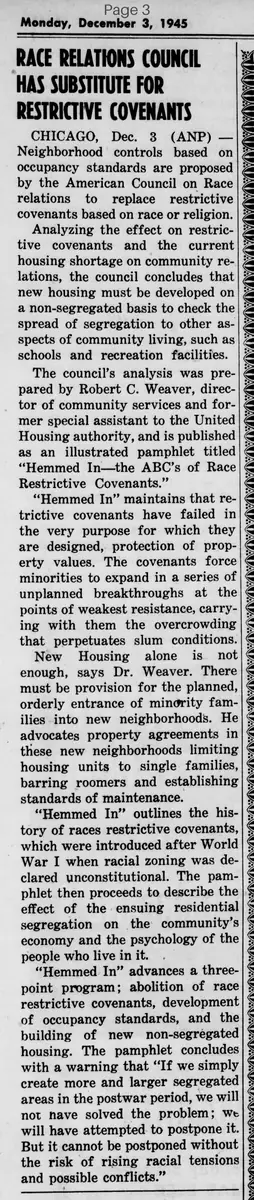
RACE RELATIONS COUNCIL
HAS SUBSTITUTE FOR
RESTRICTIVE COVENANTS
CHICAGO, Dec. 3 (ANP) - Neighborhood controls based on occupancy standards are proposed by the American Council on Race relations to replace restrictive covenants based on race or religion.
Analyzing the effect on restrictive covenants and the current housing shortage on community relations, the council concludes that new housing must be developed on a non-segregated basis to check the spread of segregation to other aspects of community living, such as schools and recreation facilities.
The council's analysis was prepared by Robert C. Weaver, director of community services and former special assistant to the United Housing authority, and is published as an illustrated pamphlet titled "Hemmed In the ABC's of Race Restrictive Covenants."
"Hemmed In" maintains that restrictive covenants have failed in the very purpose for which they are designed, protection of property values. The covenants force minorities to expand in a series of unplanned breakthroughs at the points of weakest resistance, carrying with them the overcrowding that perpetuates slum conditions.
New Housing alone is not enough, says Dr. Weaver. There must be provision for the planned. orderly entrance of minority families into new neighborhoods. He advocates property agreements in these new neighborhoods limiting housing units to single families. barring roomers and establishing standards of maintenance.
"Hemmed In" outlines the history of races restrictive covenants, which were introduced after World War I when racial zoning was declared unconstitutional. The pamphlet then proceeds to describe the effect of the ensuing residential segregation on the community's economy and the psychology of the people who live in it.
"Hemmed In" advances a three- point program; abolition of race restrictive covenants, development of occupancy standards, and the building of new non-segregated housing. The pamphlet concludes with a warning that "If we simply create more and larger segregated areas in the postwar period, we will not have solved the problem; we will have attempted to postpone it. But it cannot be postponed without the risk of rising racial tensions and possible conflicts."
What sub-type of article is it?
What themes does it cover?
What keywords are associated?
What entities or persons were involved?
Where did it happen?
Story Details
Key Persons
Location
Chicago
Event Date
Monday, December 3, 1945
Story Details
The American Council on Race Relations proposes occupancy standards to replace restrictive covenants, concluding new non-segregated housing is needed to prevent segregation spread. Pamphlet 'Hemmed In' by Robert C. Weaver analyzes covenant failures, history, and effects, advocating abolition, standards, and new housing to avoid rising tensions.